The word biohacking often brings to mind futuristic gadgets, expensive supplements, or complex morning routines that look more like lab experiments than real life.
But here’s the truth: the most powerful biohacks don’t come from technology — they come from simplicity.
In the past few years, I’ve experimented with many habits — tracking sleep, fasting windows, sunlight exposure, movement routines, and mindfulness practices. What surprised me most wasn’t how complex these habits were, but how effective the simplest ones turned out to be.
Biohacking doesn’t have to mean optimizing every variable in your body.
It can simply mean learning how to feel better with less effort — by stacking small, consistent wins that compound over time.
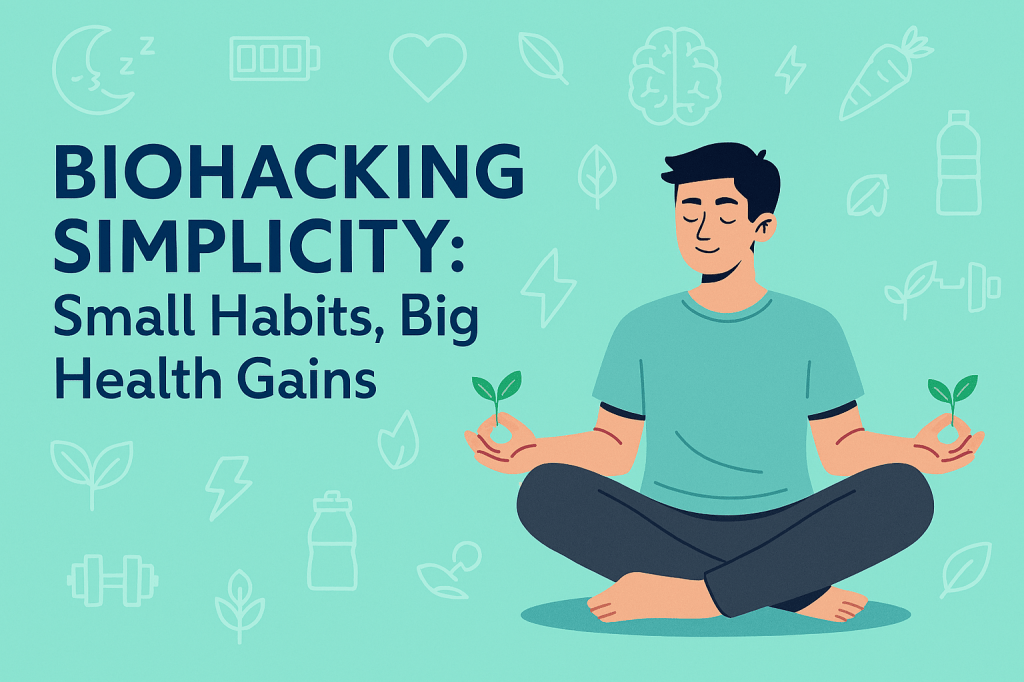
Here’s what I’ve learned about simplifying health through small daily habits that deliver big returns.
1. Redefine What “Biohacking” Means
At its core, biohacking is about understanding yourself as a system. It’s about observing inputs (what you eat, how you move, when you sleep) and noticing outputs (energy, mood, focus, longevity).
For me, simplifying this meant stripping away complexity.
No fancy trackers, no 20-step morning rituals. Just a few foundational practices that make everything else easier:
- Sleep deeply.
- Move daily.
- Eat with awareness.
- Spend time in light and nature.
- Protect attention like it’s your most valuable resource.
The best biohack isn’t the one with the most data — it’s the one you can repeat effortlessly.
2. The Compound Effect of Tiny Health Wins
We often underestimate what small habits can do over time.
Drinking a glass of water right after waking up doesn’t seem like much. Neither does a 10-minute walk after lunch. But done daily, these small choices stack up into big physiological shifts.
When I started walking after meals, my energy spikes disappeared.
When I began morning sunlight exposure (just 5 minutes outside), my sleep quality improved dramatically within weeks.
And when I swapped evening screens for quiet reading, I noticed I woke up calmer — even without an alarm.
None of these required a major lifestyle overhaul — just consistency.
That’s the secret to sustainable biohacking: repeat small, measurable actions that improve your baseline.
3. Morning Sunlight Is a Free Mood Upgrade
If there’s one “hack” I’d recommend to anyone, it’s this:
Get sunlight in your eyes within 30 minutes of waking.
You don’t need supplements or caffeine to regulate your circadian rhythm — nature already built that feature in. Morning light tells your brain it’s time to be alert, sets your internal clock for better sleep at night, and boosts serotonin (your natural mood stabilizer).
It’s one of those rare habits that improves both productivity and peace of mind.
And it’s free.
4. Move Like You Mean to Age Well
You don’t need a 2-hour gym routine to biohack your body. Movement should feel like maintenance, not punishment.
My “movement minimums” are simple:
- Walk 8,000–10,000 steps a day.
- Do short bodyweight strength sessions 3–4 times a week.
- Stretch before bed.
Think of it as software updates for your body — short, consistent downloads that keep your system running smoothly.
Even on busy days, 5 minutes of mobility or a short walk between calls can reset your focus and physiology.
Longevity isn’t built in the gym — it’s built in the in-between moments.
5. Eat to Stay Even, Not Excited
Modern eating is full of extremes — strict diets, fasting windows, supplements galore. But simplicity here pays off, too.
My simplest nutrition rule: eat in a way that keeps your energy steady.
That usually means:
- Real, unprocessed food.
- Plenty of protein and fiber.
- Minimal sugar and refined carbs.
- Consistent meal timing.
I learned this from tracking energy and focus, not calories. When your meals stop spiking your energy, you stop crashing — and that consistency compounds across your day.
It’s not about restriction. It’s about stability.
6. Protect Sleep Like Your Greatest Asset
Sleep is the original biohack — it’s when your brain detoxifies, your body repairs, and your hormones balance.
The simplest things make the biggest difference:
- Go to bed and wake up at the same time every day.
- Keep your room cool, dark, and quiet.
- Avoid caffeine after 2 p.m.
- Dim lights an hour before bed.
I used to see sleep as recovery. Now I see it as performance preparation.
Every area of life — focus, fitness, relationships — works better when sleep comes first.
You don’t need melatonin or wearables to sleep well. Just consistency.
7. Don’t Track Everything — Feel It Instead
Many biohackers track every metric: HRV, REM sleep, glucose, ketones, temperature. There’s nothing wrong with data — but tracking can become another form of stress.
The real goal is body awareness.
How do you feel after a meal? After exercise? After scrolling late at night?
Once you start noticing patterns, you don’t need a dashboard — you just need mindfulness.
Simplifying biohacking is about trusting your senses again.
8. Environment > Willpower
Your surroundings shape your habits more than motivation ever will.
Want to read more? Keep a book where your phone usually sits.
Want to eat better? Keep fruit visible and snacks out of sight.
Want to move more? Leave your shoes by the door.
Biohacking isn’t about fighting yourself — it’s about designing an environment where the right choice is the easy one.
When you remove friction, consistency becomes automatic.
9. Mind Calm = Body Calm
You can’t separate physical health from mental peace. Chronic stress ages you faster than junk food.
The simplest stress “biohacks” I’ve found:
- 5 deep breaths before opening your inbox.
- A few minutes of stillness before bed.
- Short walks without headphones.
- Writing a quick gratitude note each morning.
None of these take time — they return time by reducing mental clutter.
Simplicity in thought is just as powerful as simplicity in action.
10. The Real Goal: A Sustainable Baseline
You don’t need to live like a lab experiment to feel better.
You just need a baseline — a set of repeatable habits that keep you healthy without constant decision fatigue.
For me, that baseline looks like this:
- Sleep 7.5+ hours.
- Get morning sunlight.
- Move daily (walk + strength).
- Eat real food.
- Protect focus and rest.
Everything else is optional optimization.
When your baseline is solid, you can experiment freely — travel more, work harder, or rest deeper — without losing your balance.
Final Thoughts
Biohacking isn’t about chasing perfection.
It’s about building a lifestyle that makes health effortless.
When you focus on small, simple habits that actually fit your life, you stop seeing wellness as a chore — and start feeling it as your natural state.
So start small.
Pick one habit that feels doable today — a walk, a stretch, an earlier bedtime.
Because the real magic of biohacking isn’t in doing more — it’s in doing less, better.
What’s the simplest habit that’s made the biggest difference in your health?
Share it — you might inspire someone else to start their own small biohack today.
 VD
VD 
Leave a comment