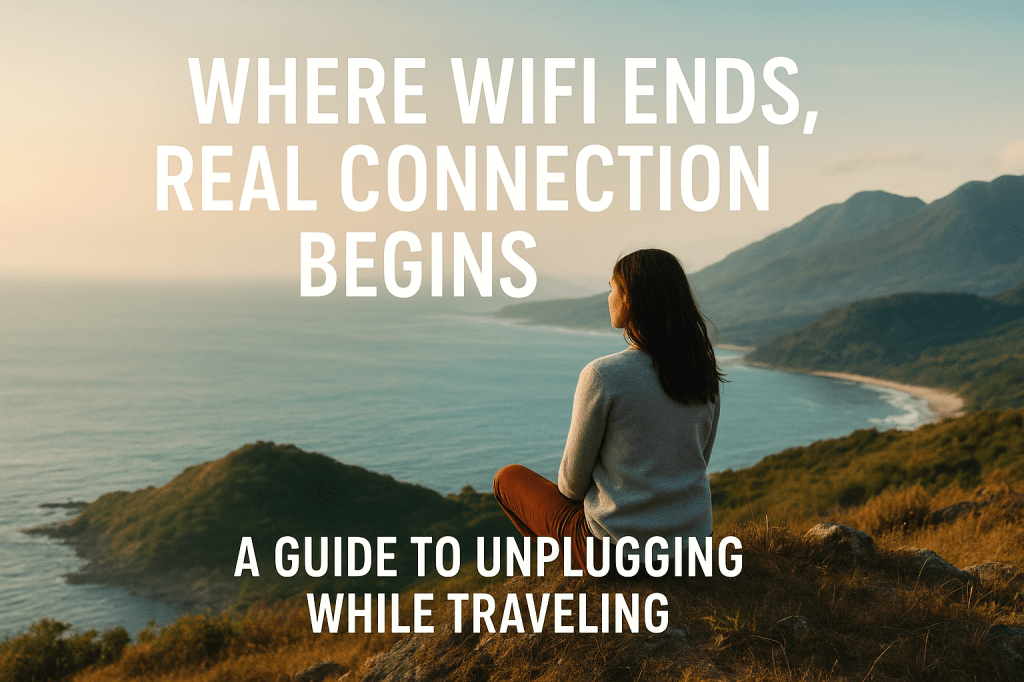
Because sometimes the best connection is no connection at all.
Why a Digital Sabbatical Matters
We live in an age where travel and technology are inseparable.
From booking flights on an app to sharing stories on Instagram, it’s rare to take a trip without a screen in hand. For digital nomads and remote workers, the line between traveling and working has blurred completely. Every new location becomes just another backdrop for the same laptop routine.
But what if travel could mean more than changing your Wi-Fi password?
A digital sabbatical is exactly that — an intentional break from being constantly connected. It’s about logging off not because you hate your work or the internet, but because you want to remember who you are without them.
Digital sabbaticals give your mind the same reset that vacations used to give before email followed you everywhere. You travel not to escape, but to reclaim attention, energy, and depth.
Digital Sabbatical vs. Digital Nomad Life
The phrases digital nomad and digital sabbatical sound similar, but they’re opposites in spirit.
| Digital Nomad | Digital Sabbatical |
|---|---|
| Works while traveling | Takes a complete break from work |
| Seeks mobility | Seeks mindfulness |
| Lives online | Lives offline |
| Measures productivity | Measures presence |
Being a digital nomad is about location freedom.
Taking a digital sabbatical is about mental freedom — the ability to stop chasing signals and simply be.
If the digital nomad asks, “Where can I work from next?”, the digital sabbatical asks, “Where can I rest and think again?”
1. Recognize the Signs You Need a Break
You don’t have to be burnt out to need a break — but burnout often starts quietly.
If any of these sound familiar, you might be due for a digital sabbatical:
- You spend vacations checking Slack or refreshing email “just in case.”
- Your first instinct in a new city is to find Wi-Fi, not a local café.
- You scroll through your travel photos more than you experience the moment.
- You return home feeling just as tired as when you left.
Constant connectivity erodes your ability to recharge.
It keeps your brain in a permanent “on” mode, flooded with alerts, micro-decisions, and distractions.
A digital sabbatical restores your attention span — that rare and valuable modern resource — by giving your mind space to be bored, curious, and creative again.
2. Choose Destinations That Help You Unplug
Your environment matters. The best digital sabbatical destinations make disconnection effortless.
Look for places where the pace of life naturally slows you down:
- Nature-first spots: Mountains, forests, coastal villages, or remote islands.
- Limited connectivity: Where Wi-Fi is weak and that’s a feature, not a bug.
- Cultures that value slowness: Places where conversation, food, and time flow differently.
Think of a week hiking in Patagonia, meditating in Chiang Mai, reading in a Portuguese hill town, or learning pottery in Oaxaca.
These are not productivity retreats — they’re presence retreats.
The fewer push notifications, the more space for reflection.
3. Set Boundaries Before You Go
Disconnection doesn’t happen by accident — it’s designed.
To take a true digital sabbatical, you’ll need to set expectations early and build systems that protect your offline time.
Before your trip:
- Tell clients, teammates, or family you’ll be offline for a defined period.
- Create a clear auto-responder: “I’ll be offline from [date] to [date]. I’ll respond when I return.”
- Turn off push notifications and uninstall work-related apps.
- Consider using a simple phone or leaving your laptop behind altogether.
Boundaries signal seriousness — to others and to yourself. Once you’re truly offline, your nervous system will take a few days to catch up. Expect restlessness at first, then relief.
4. Build a Slow-Travel Routine
A digital sabbatical isn’t about doing nothing. It’s about doing less but better.
When the noise of the internet fades, you’ll rediscover small rituals that give structure to your days.
Here’s what a slow-travel rhythm might look like:
- Morning: Wake naturally, stretch, journal, or walk before checking any screens.
- Afternoon: Explore on foot, learn a local craft, or read under a tree.
- Evening: Cook your own meal, watch the sunset, or talk with locals instead of scrolling.
You don’t have to meditate in silence or delete your social media accounts.
Just create a routine that lets curiosity lead, not notifications.
When travel becomes slower, the world becomes deeper.
5. Reflect, Don’t Just Rest
Unplugging is half the journey. The other half is reflection.
Without your digital feed curating thoughts for you, you’ll begin to notice your own again.
Ask yourself:
- What feels meaningful when I’m not documenting it?
- What activities make me lose track of time — in a good way?
- What digital habits serve me, and which simply fill space?
Keep a journal. Not a perfect one — just notes, sketches, quotes, questions.
When you write instead of scroll, you begin to reconnect with your internal world, not just your external one.
6. Reconnect Intentionally Afterward
Coming back online after a digital sabbatical can be jarring.
Suddenly your inbox is full, your feeds are noisy, and the stillness feels far away.
Before replugging completely, pause.
Review what changed while you were offline — and what changed within you.
You may find you want less than before: fewer notifications, fewer apps, fewer open tabs — but more time, clarity, and quiet.
Integrate what worked from your sabbatical into daily life:
- Keep screen-free mornings.
- Designate “no Wi-Fi weekends.”
- Take mini digital breaks each quarter — even a day can make a difference.
You don’t have to go off-grid to live more intentionally. Just give yourself regular space to reset.
The Real Destination: Presence
Digital sabbaticals aren’t about rejecting technology — they’re about rebalancing your relationship with it.
Technology connects us, but constant connection can cost us depth.
Traveling to disconnect is an act of rebellion in a world that rewards busyness.
It’s a way to reclaim your attention — the most valuable currency you own — and spend it where it matters most.
Because the point of travel isn’t to work from new places.
It’s to rediscover how it feels to be fully where you are.
Don’t just change your location. Change your pace. Travel to disconnect — and reconnect with what’s real.
 VD
VD 
Leave a comment