Most people read books the way they browse the internet—linearly, quickly, and with the hope that understanding will magically appear somewhere along the way. But real comprehension doesn’t work like that. Books (especially dense ones—non-fiction, psychology, philosophy, productivity, science) reward layered reading, not speed.
That’s where the 3-Pass Reading System comes in.
It’s a simple, repeatable framework that helps you:
- understand any book better,
- retain more of what you read,
- and actually apply the ideas in real life.
Whether you’re reading for personal growth, work, or curiosity, this method turns reading from a passive activity into a deliberate practice.
Why Most People Don’t Understand What They Read
It’s not because they’re bad readers.
It’s because they try to do everything at once: understand, analyze, remember, and apply.
That’s like trying to take notes, cook dinner, and have a deep conversation—all at the same time.
The 3-Pass Reading System breaks this chaos into manageable layers, each with its own purpose.
Think of it like zooming in:
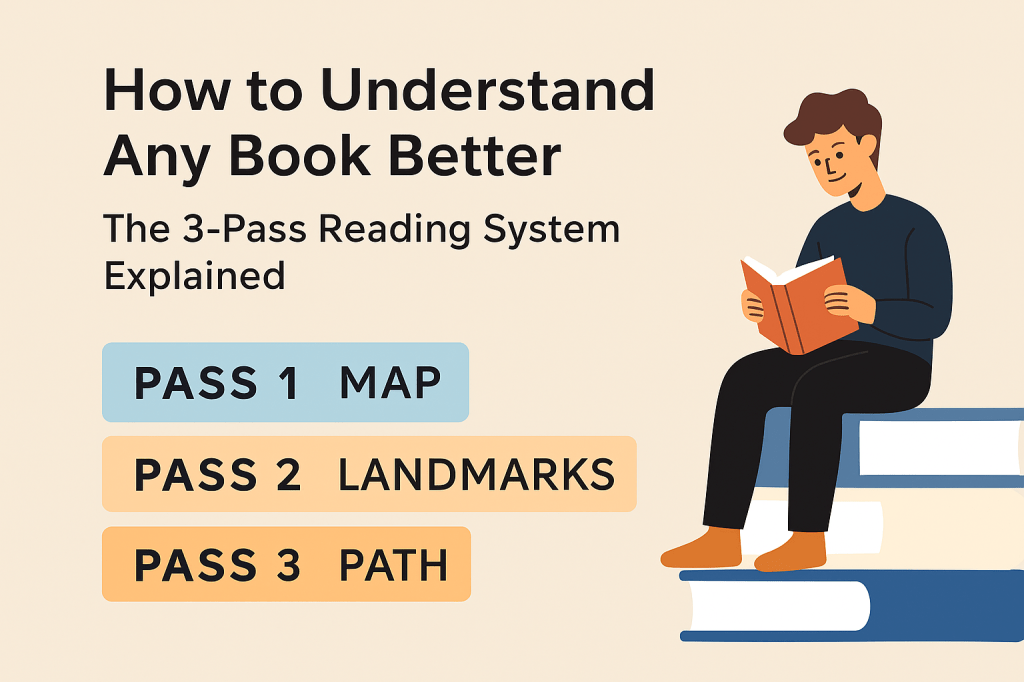
- Pass 1: The Map (big picture)
- Pass 2: The Landmarks (important details)
- Pass 3: The Path (your personal insights)
Here’s how it works.
Pass 1 — The Map
Goal: Understand what the book is about (without committing).
This is not “reading” in the traditional sense. It’s an orientation pass.
What you do:
- Read the table of contents
- Skim chapter titles and subheadings
- Read the back cover / introduction
- Flip through a few random pages
- Notice visuals, diagrams, summaries
What you’re looking for:
- What problem is the book trying to solve?
- What’s the core promise?
- How is it structured?
- Is this the right book for you right now?
Why this matters:
Pass 1 gives your brain a mental map.
Now, when you read the actual chapters, your mind already knows where things belong.
You understand faster, with less effort.
Time required: 5–10 minutes.
Pass 2 — The Landmarks
Goal: Read the book properly—but lightly.
This is your first real read, but not a deep one.
What you do:
- Read at a comfortable pace
- Don’t highlight too much (your future self will thank you)
- Mark only what feels important
- Notice patterns, repeated themes, key arguments
What you’re looking for:
- The author’s main ideas
- How they support those ideas
- The structure behind the reasoning
- 1–3 concepts that feel worth revisiting
Why this matters:
Pass 2 reveals the skeleton of the book.
You now know:
- what’s fluff,
- what’s essential,
- and what’s worth coming back to.
Most people stop here—and that’s why they forget 80% of what they read.
Time required: whatever is needed for a normal read.
Pass 3 — The Path
Goal: Extract wisdom you can use—then integrate it into your life.
This is the deep pass, but only for the sections that matter to you.
What you do:
- Return to your highlights
- Reread only the powerful sections
- Summarize ideas in your own words
- Ask reflective questions
- Apply insights to your life or work
What you’re looking for:
- What ideas actually matter to you?
- How do they connect to your life right now?
- What will you change because of this book?
Why this matters:
Pass 3 turns information into transformation.
This is where you build:
- better thinking,
- better habits,
- and a better version of yourself.
Time required: 20–40 minutes.
The Hidden Power of Multiple Passes
When you re-engage with the same book more than once, each layer builds on the previous one. The brain loves structure. The clearer the structure, the better the retention.
3 passes give you:
- a big-picture context
- meaningful details
- deep, personal understanding
It’s like learning a city:
- First you look at Google Maps (Pass 1)
- Then you drive around (Pass 2)
- Then you walk the streets and discover your own shortcuts (Pass 3)
That’s why this system works for almost any genre:
- Non-fiction
- Self-help
- Psychology
- Business
- Philosophy
- Technical books
When the 3-Pass System Works Best
You’ll benefit the most when:
- reading books that are idea-dense
- exploring topics you want to master
- doing professional or technical reading
- trying to develop a personal philosophy
- reading slowly and intentionally
If you’re reading fiction or leisure books, Pass 1 and 3 can be shortened—or skipped.
A Simple Example
Imagine you’re reading a book on habit formation.
Pass 1 (Map):
You skim the structure and see the author breaks habits into cues, routines, and rewards. Good to know.
Pass 2 (Landmarks):
You read the book and notice the pattern show up again and again. You highlight a few ideas.
Pass 3 (Path):
You focus only on the sections about building good habits.
You apply one idea to your morning routine.
Now the book lives inside your life—not just your shelf.
Final Thoughts
You don’t need to read faster.
You need to read smarter.
The 3-Pass Reading System helps you:
- understand complex books easily,
- remember more without extra effort,
- and transform reading into a tool for long-term growth.
The next time you pick up a book, resist the urge to dive in blindly.
Step back. Map it. Read it. Revisit it.
You’ll be amazed at how much deeper your reading becomes.
 VD
VD 
Leave a comment