Most people think recovery just happens. We sleep, we rest, we take a break — and our body and mind magically reset. But in reality, recovery is not automatic. It’s a trainable skill, just like strength, focus, resilience, or endurance.
If recovery were automatic, everyone would wake up refreshed, perform consistently, avoid burnout, stay injury-free, and balance intense work with meaningful rest. But that’s not what we see. Instead, modern life leaves most people tired, overstimulated, under-recovered, and chronically running on empty.
We don’t struggle because we’re weak — we struggle because recovery has become something we assume instead of something we practice.
And when you treat recovery like a passive process, you only get accidental results. When you train recovery as a skill, you unlock physical performance, mental clarity, emotional resilience, creativity, and long-term health.
Let’s explore why recovery requires intention — and how to build habits that help you bounce back faster and stronger.
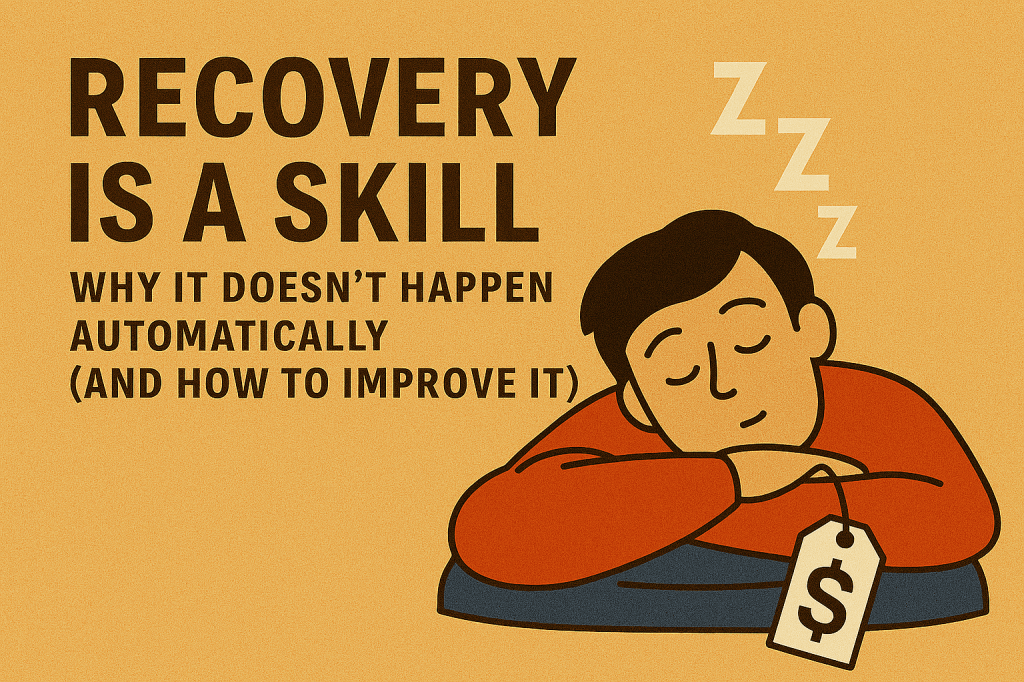
Why Recovery Doesn’t Happen Automatically
1. Modern life is designed for overstimulation
Our brains and bodies evolved for cycles of intense activity followed by long periods of natural rest — sunlight patterns, slow evenings, low noise, minimal distractions.
Today:
- We stare at screens late into the night
- We sit more and move less
- We’re always reachable and always “on”
- We scroll instead of resting
- We push productivity over restoration
Our environment is recovery-hostile.
2. Stress is cumulative
Stress isn’t good or bad — it’s a stimulus. Training, work deadlines, travel, and emotional challenges all create stress loads the body must process. Without intentional recovery, stress compounds.
Just like you must balance training loads with rest, you must balance life loads with recovery.
3. Rest is not the same as recovery
Many people think rest means collapsing on the couch, watching Netflix, or scrolling social media. But passive rest rarely creates biochemical recovery.
Rest is stopping. Recovery is rebuilding.
One is doing nothing; the other is doing something that restores you.
4. We glorify busyness
In many cultures, exhaustion is a badge of honor — a sign of effort or ambition. We admire people who grind endlessly, but rarely celebrate people who recover intelligently.
Yet elite performers understand this truth clearly:
Work and recovery are equal partners in high performance.
The Science of Recovery: What’s Actually Happening in the Body
During recovery, the body performs essential operations:
- Repairs tissue and muscle fibers
- Rebalances the nervous system
- Removes metabolic waste and inflammation
- Consolidates learning and memory
- Rebuilds energy stores (glycogen)
- Restores hormonal and immune balance
Without recovery, performance declines.
With optimized recovery, performance compounds.
Just like strength training triggers growth through stress followed by repair, life growth requires cycles of push and restore.
Signs You’re Under-Recovered
Under-recovery often shows up as:
| Physical | Mental / Emotional |
|---|---|
| Fatigue / heavy limbs | Brain fog |
| Frequent colds | Irritability |
| Poor sleep | Lack of motivation |
| Muscle soreness that lingers | Emotional reactivity |
| Decreased performance | Disinterest in things you usually enjoy |
Most people don’t need to train harder — they need to recover smarter.
How to Train Recovery Like a Skill
1. Build a daily recovery ritual
Micro-recovery beats occasional big recovery.
Start with a 10-minute daily practice such as:
- Stretching or mobility work
- Breathwork
- Meditation
- Gentle walking
- Journaling
- Hot shower followed by cold rinse
Consistency over intensity.
2. Prioritize high-quality sleep
Sleep is the ultimate recovery tool.
Protect it like performance fuel.
Sleep basics:
- Same sleep-wake time daily
- No screens 60 minutes before bed
- Cool, dark bedroom
- Morning sunlight exposure
If you only improved sleep, your recovery would transform.
3. Learn to switch off your nervous system
If your brain doesn’t downshift, your body can’t repair.
Tools that activate the parasympathetic “rest and restore” system:
- Slow breathing (inhale 4, exhale 6)
- Yoga or mobility work
- Nature time
- Turning off notifications
- Silence or stillness
4. Move lightly on recovery days
Recovery is active.
Walk. Stretch. Do mobility. Swim slowly.
Motion heals.
5. Refuel properly
Recovery depends on repair materials:
- Protein for rebuilding tissue
- Electrolytes and hydration
- Carbs after intense training to restore energy
- Anti-inflammatory whole foods
You can’t rebuild from nothing.
6. Protect mental and emotional recovery
Mental fatigue is real stress, not imaginary.
Powerful cognitive recovery habits:
- Digital boundaries
- Single-tasking instead of multitasking
- Time away from screens
- Quiet thinking time
- Saying no more often
Burnout rarely comes from effort — it comes from chronic effort without recovery.
7. Schedule recovery like training
What gets scheduled gets done.
Try this rule:
For every hour of high output work, schedule 10 minutes of recovery.
Or use the 80/20 performance cycle:
- 80% sustainable effort
- 20% intense peaks
- Followed by recovery block
Even elite athletes don’t perform at 100% intensity year-round.
The Mindset Shift That Changes Everything
Many people think:
“I’ll rest when I have time.”
But high performers think:
“I make time because recovery is what enables high performance.”
Recovery isn’t what happens after the real work.
Recovery is part of the real work.
It’s what allows the work to matter.
The Compounding Power of Skill-Based Recovery
When you practice intentional recovery, you experience:
- Higher energy and better performance
- Stronger immunity
- Reduced anxiety and stress
- Better sleep
- Faster physical adaptation
- Improved creativity and focus
- More emotional resilience
- Greater long-term success
Recovery compounds like interest — small daily deposits build exponential returns.
Final Thought: Train Recovery the Way You Train Strength
You wouldn’t expect muscle growth without rest days.
You wouldn’t expect clarity without sleep.
You wouldn’t expect peak performance without preparation.
So why expect recovery without practicing it?
Treat recovery like a skill:
- Plan it
- Train it
- Track it
- Protect it
- Improve it over time
Because when you learn to recover well, you don’t just feel better — you perform better, think better, connect better, and live better.
Recovery is not a break from life.
Recovery is what makes life sustainable.
 VD
VD 
Leave a comment