Most people think the fatigue of travel comes during the flight or the long drive.
But in reality, it begins hours before you even leave home.
Rushed packing.
Poor sleep the night before.
Sitting all day before sitting even longer.
Stress spikes.
Blood flow drops.
Hydration plummets.
By the time they board, most travelers are already exhausted.
What if the key to arriving energized wasn’t about what you do on the plane, but what you do before you ever leave the house?
Enter travel warm-ups — small, science-backed routines that prime your mind and body for movement, recovery, and presence. Think of them as your pre-flight (or pre-road-trip) ritual: a set of tiny habits that dramatically improve how you feel when you arrive.
These aren’t workouts. They’re not complicated.
They’re subtle shifts that help you travel better — not just travel more.
Let’s break them down.
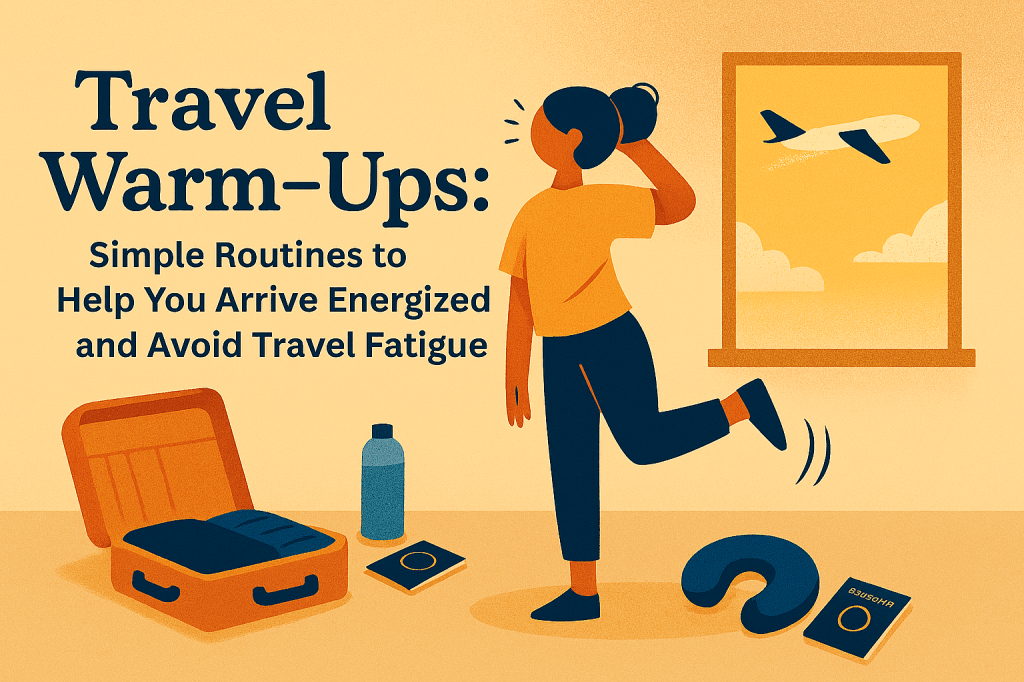
Why Travel Fatigue Happens (And Why It’s Preventable)
Travel fatigue isn’t just “being tired.”
It’s a combination of five predictable stressors:
- Poor blood circulation from long sitting
- Dehydration from dry airplane air and rushed routines
- Circadian disruption (even without crossing time zones)
- Stress spikes from logistics, rushing, and unpredictability
- Cognitive overload from constant decisions
The good news?
You can offset most of this before your trip even begins.
A simple travel warm-up routine can:
- stabilize your energy
- decrease inflammation
- boost circulation
- reduce anxiety
- keep your mind alert
- help you arrive present, not depleted
This is the overlooked 80/20 of travel wellness.
Your Pre-Travel Warm-Up: A Simple 4-Part Routine
This routine takes 10–20 minutes total.
It fits whether you’re leaving for a cross-country flight or a weekend drive.
1. Reset Your Body (5 minutes)
Movement before stillness.
Travel forces your body into long periods of sitting.
A quick mobility sequence pre-travel counterbalances that immobility.
Try this simple warm-up flow (no equipment, no sweat):
✔ Neck circles (10 each direction)
Releases tension that builds during seated travel.
✔ Shoulder rolls (10 forward, 10 back)
Prevents stiffness from carrying bags or wearing backpacks.
✔ Torso twists (20 gentle rotations)
Encourages spinal mobility and blood flow.
✔ Hip circles or figure-eights (10 each direction)
Crucial for combating hours of hip flexion.
✔ Calf raises (20 slow reps)
Stimulates circulation and reduces swelling during long flights.
✔ Forward fold hang (20–30 seconds)
Release your back and hamstrings; slow, deep breathing.
These movements are low-effort but high-impact.
Think of them as turning on your circulatory system before hours of stillness.
Your goal isn’t to exercise — it’s to create space in your body so the travel stress can’t compress you.
2. Hydrate Intentionally (2 minutes)
Hydration is your biggest travel superpower.
Most travelers start their trips dehydrated and get exponentially worse from there.
A simple hydration warm-up fixes this:
✔ Drink 300–500 ml of water
30–60 minutes before leaving (not right before boarding).
✔ Add electrolytes if it’s a long-haul day
Especially if you had caffeine earlier.
✔ Eat hydration-friendly foods
Fruit, cucumbers, or a quick greens powder shake can help stabilize minerals.
Why this matters:
Dehydration amplifies fatigue, stiffness, headaches, and jet lag.
Fixing it is low effort, big reward.
3. Calm Your Mind (3 minutes)
Presence begins before the journey does.
Travel stress isn’t always about the logistics.
It’s the mental load you carry into the trip.
A quick mental warm-up reduces anxiety and sharpens your presence.
Try this:
✔ 60 seconds of box breathing
4 seconds inhale → 4 hold → 4 exhale → 4 hold
Repeat four cycles.
✔ Set your travel intention (yes, really)
One sentence.
Examples:
- “I choose ease today.”
- “I’m arriving open and present.”
- “I travel with calm energy.”
✔ Visualize your arrival
30–60 seconds picturing yourself stepping into the new environment feeling relaxed, not frazzled.
This primes your nervous system for a smooth travel day.
4. Do a 5-Minute Packing Reset
Most travel stress is simply unmade decisions.
Instead of last-minute scrambling, build a quick, reliable system.
✔ Check your Big 4
These solve 80% of travel problems:
- Wallet
- Phone
- Passport/ID
- Charging cables
✔ Choose your “travel uniform”
Comfortable, layered, breathable clothing.
No decision fatigue.
✔ Pack one “energy anchor”
This is the underrated trick:
Bring one item that helps you feel grounded.
Examples:
- a book
- a playlist
- a favorite snack
- a travel pillow you actually like
- compression socks
- a small notebook
Tiny anchors create huge calm.
Bonus Warm-Ups for Long Trips
Use these if you’re traveling 4+ hours or crossing time zones.
✔ Light Snack Strategy
Eat something slow-release:
- nuts
- fruit
- hummus and veggies
- small oatmeal cup
Avoid heavy or sugary foods before travel.
They crash your energy mid-flight.
✔ Temperature Prep
Bring a layer, even in summer.
Cold cabins drain energy and increase stress hormones.
✔ Circadian Pre-Shift
If crossing time zones, start adjusting light exposure:
- Morning light = earlier body clock
- Evening light = later body clock
Just 10 minutes helps.
The Mini Warm-Up You Can Do at the Airport
If you’re short on time or rushed, do this 90-second version near your gate:
- 10 calf raises
- 10 shoulder rolls
- 20-second forward fold
- 10 deep breaths
This prevents most circulation issues and resets your nervous system.
Why These Warm-Ups Work (The Science in One Minute)
Movement → increases blood flow
More circulation = less swelling, stiffness, and inflammation.
Hydration → stabilizes energy
Combats dry cabin air, caffeine, and stress hormones.
Breathing → lowers cortisol
Calming your nervous system improves clarity and resilience.
Intentional packing → reduces cognitive load
Less decision-making = more energy for presence.
These are tiny tweaks that create outsized results — the travel equivalent of the 80/20 rule.
How You’ll Feel When You Arrive
People who use travel warm-ups consistently report:
- more alertness
- less stiffness
- fewer headaches
- reduced jet lag
- calmer mood
- smoother digestion
- clearer thinking
- more enjoyment of the destination
In short:
You arrive present, not depleted.
That’s the entire goal.
Your 10-Minute Travel Warm-Up (Printable Summary)
1. Body (5 minutes)
Neck circles → shoulder rolls → torso twists → hip circles → calf raises → forward fold
2. Hydration (2 minutes)
300–500 ml water + optional electrolytes
3. Mind (3 minutes)
Box breathing → set intention → visualize arrival
4. Packing Reset (1–2 minutes)
Big 4 → travel uniform → energy anchor
Final Thought
A great trip doesn’t start at your destination.
It starts with how you prepare your mind and body before you leave home.
Travel warm-ups don’t take long, don’t require equipment, and don’t feel like “work.”
But they dramatically improve how you feel during and after your journey.
Small actions.
Huge impact.
Arrive energized, grounded, and ready to be fully present wherever you land.
 VD
VD 
Leave a comment