Most people don’t have a time problem.
They have an energy problem.
They plan their days obsessively, optimize calendars, stack productivity tools—and still end the day exhausted, unfocused, and behind.
Time management assumes a dangerous lie: that every hour is equally usable.
It isn’t.
What determines output isn’t how much time you have, but how much usable energy you bring to that time. Ignore this, and no amount of planning will save you.
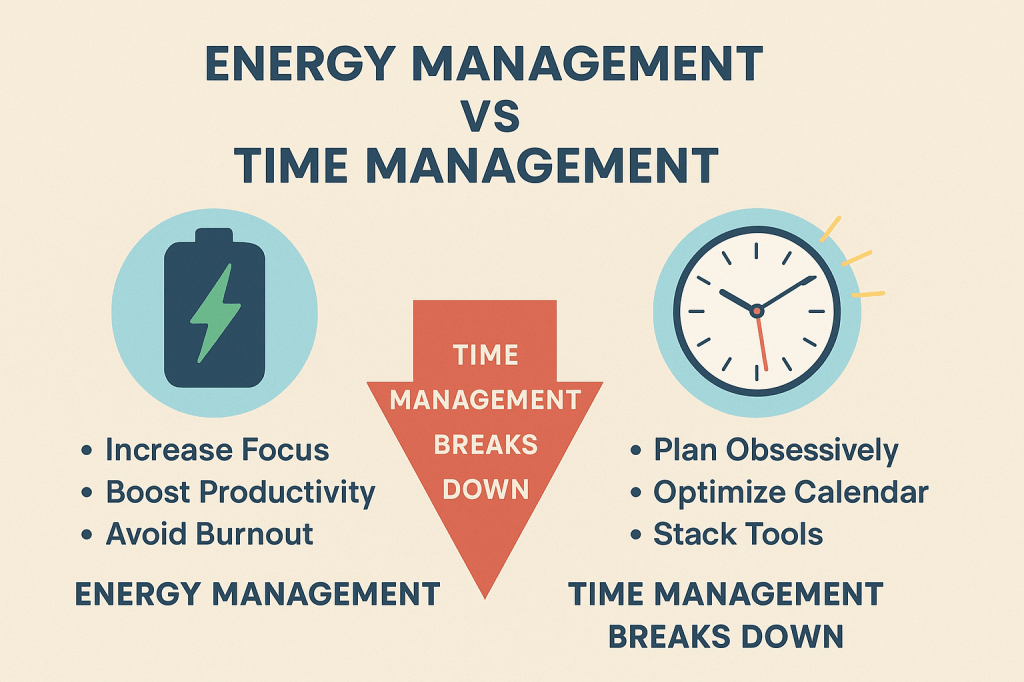
Why Time Management Breaks Down
Time management treats humans like machines:
- Same output per hour
- Same capacity all day
- Same performance regardless of context
Reality is messier.
Energy fluctuates based on:
- Sleep
- Stress
- Nutrition
- Movement
- Cognitive load
- Emotional friction
Two identical 60-minute blocks can produce wildly different results depending on your energy state.
Time management asks: What should I do next?
Energy management asks: What am I capable of right now?
Only one of those scales sustainably.
The Hidden Cost of Ignoring Energy
When energy drops but demands don’t, people compensate by:
- Forcing focus
- Overstimulating with caffeine
- Multitasking
- Working longer hours
This works short term—and quietly creates burnout.
Burnout isn’t laziness.
It’s chronic energy debt.
And like financial debt, it compounds.
What Energy Management Actually Means
Energy management is the practice of:
- Protecting high-energy states
- Deploying energy intentionally
- Recovering before depletion becomes damage
It’s not about doing less.
It’s about doing the right work at the right energy level.
High performers don’t grind harder. They align better.
The Four Types of Energy (And Why Time Ignores Them)
1. Physical Energy: The Foundation
This is non-negotiable. If your body is depleted, everything else collapses.
Physical energy depends on:
- Sleep quality (not just duration)
- Movement
- Nutrition
- Circadian rhythm alignment
Most productivity systems fail because they’re built on sleep deprivation and sedentary habits.
If you wake up tired, your calendar is already lying to you.
2. Cognitive Energy: The Bottleneck
Deep thinking, problem solving, and learning draw from a limited pool.
Cognitive energy is drained by:
- Context switching
- Decision overload
- Constant notifications
- Ambiguous tasks
Time management stacks tasks back-to-back.
Energy management batches cognitive intensity.
This is why one hour of deep work can outperform five hours of scattered effort.
3. Emotional Energy: The Silent Drain
Unresolved tension, unclear expectations, and low-grade anxiety leak energy constantly.
You feel it as:
- Procrastination
- Avoidance
- Irritability
- Mental fog
No productivity hack fixes emotional friction.
Only clarity, boundaries, and recovery do.
Ignoring this is how people “work all day” and accomplish nothing.
4. Environmental Energy: The Multiplier
Your environment either supports energy—or taxes it.
Consider:
- Noise
- Lighting
- Visual clutter
- Posture
- Digital interruptions
You don’t rise to the level of your intentions.
You fall to the level of your environment.
Energy-aware people design surroundings that reduce friction automatically.
Why Energy Management Beats Time Management
Time is fixed.
Energy is trainable, protectable, and renewable.
Time management optimizes scarcity.
Energy management builds capacity.
That’s why it:
- Scales better
- Feels easier
- Reduces burnout
- Improves focus naturally
You don’t need more hours.
You need better hours.
The Energy-First Workday (Practical Model)
Step 1: Identify Your High-Energy Windows
Track for one week:
- When focus feels effortless
- When thinking feels sharp
- When fatigue sets in
Most people have 2–4 hours of peak cognitive energy per day.
Those hours are prime capital. Treat them like it.
Step 2: Match Work to Energy, Not the Clock
- High energy → deep work, strategy, learning
- Medium energy → meetings, communication
- Low energy → admin, logistics, movement
Time management assigns tasks by availability.
Energy management assigns tasks by capability.
Step 3: Protect the Peaks Ruthlessly
Peak energy hours are not for:
- Meetings
- Notifications
- Low-leverage tasks
Every interruption during peak energy is a tax on your best work.
Guard these windows like money.
Recovery Is Part of Productivity (Not the Opposite)
Energy doesn’t replenish automatically.
Recovery requires:
- Real breaks (not phone scrolling)
- Movement
- Sleep
- Psychological detachment
Working through fatigue doesn’t build resilience.
It builds fragility.
The best performers recover before exhaustion – not after collapse.
Energy Leaks That Destroy Focus
If you fix nothing else, fix these:
- Poor sleep consistency
- Constant notifications
- Open-ended to-do lists
- Sitting all day
- Caffeine replacing rest
These are slow drains that make productivity feel permanently uphill.
Energy Management and Burnout Prevention
Burnout happens when:
- Energy out > energy in
- For too long
- Without recovery
Time management treats burnout as a scheduling issue.
Energy management treats it as a load management problem.
Athletes understand this instinctively. Knowledge workers rarely do – and pay the price.
You wouldn’t max out in the gym every day.
Why do it cognitively?
Why This Matters for FIRE
FIRE (Financial Independence, Retire Early) fails when:
- Health breaks down
- Burnout forces bad decisions
- Productivity collapses mid-career
Energy is a financial asset.
High, stable energy:
- Extends earning years
- Improves decision quality
- Reduces medical risk
- Preserves optionality
A burned-out path to FIRE is fragile.
An energy-aligned path compounds.
A Simple Energy Management System
Forget complexity. Use this:
Daily
- Sleep consistently
- Move at least once
- Do deep work early
- Stop before exhaustion
Weekly
- Review energy highs/lows
- Adjust task placement
- Reduce one recurring drain
Always
- Energy before efficiency
- Recovery before collapse
- Quality before quantity
That’s enough.
Common Misunderstandings
- “I’ll manage energy once I’m less busy.”
→ Energy management is how you survive being busy. - “This sounds like doing less.”
→ It’s doing less waste, not less work. - “I just need better discipline.”
→ Discipline without energy is self-punishment.
Final Thought
Time management asks how to squeeze more out of yourself.
Energy management asks how to work in alignment with how humans actually function.
One leads to burnout.
The other leads to sustained focus, better health, and long-term productivity.
You don’t need a better calendar.
You need a better energy system.
And once you build one, time stops being the bottleneck.
 VD
VD 
Leave a comment