Most people don’t fail at reading because they lack discipline.
They fail because reading, by itself, doesn’t complete the learning loop.
They finish books.
They feel informed.
Then—weeks later—they struggle to recall anything specific, let alone point to a real change in how they think or act.
This isn’t a personal flaw. It’s a systems problem.
Reading is often treated as a one-way input. But learning only compounds when reading feeds into thinking, action, and feedback. Without that loop, books become intellectual entertainment—stimulating, but disposable.
What works better is a flywheel.
Why Most Reading Doesn’t Stick
The brain is efficient to a fault. If information isn’t used, it’s discarded.
That’s why:
- Insights feel obvious when you read them
- Powerful ideas fade quickly afterward
- Books blur together over time
Passive reading creates familiarity, not mastery. And familiarity is a poor substitute for understanding.
Retention requires effort.
Application requires structure.
The solution isn’t more highlights, better apps, or larger note archives. It’s a system that forces ideas to collide with reality.
That system is the Reading Flywheel.
The Reading Flywheel (At a Glance)
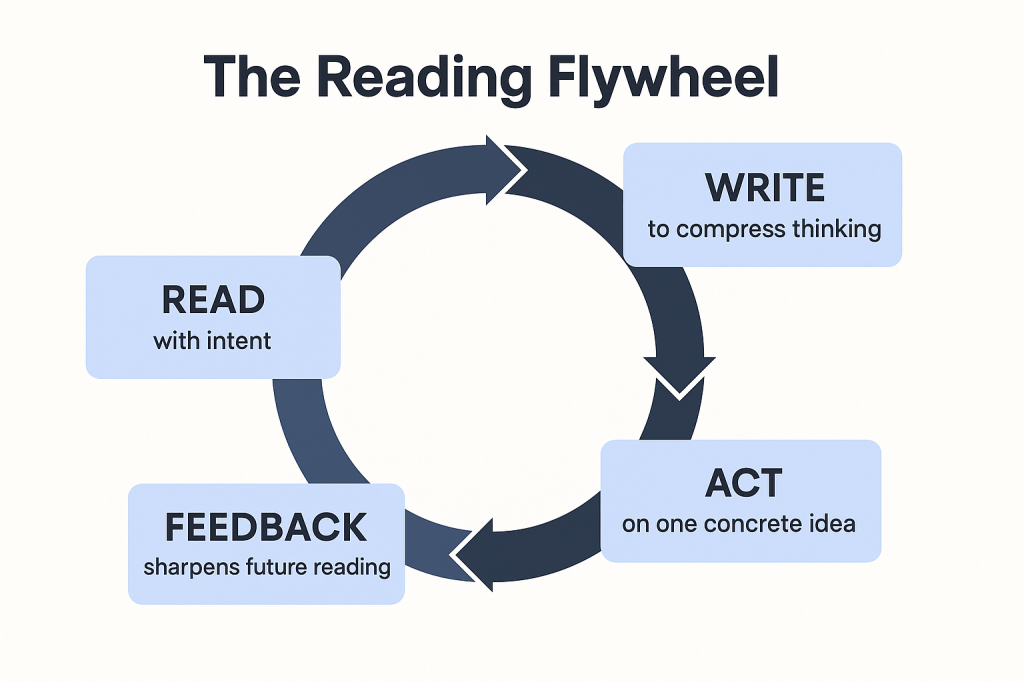
The flywheel has four parts:
- Read with intent
- Write to compress thinking
- Act on one concrete idea
- Feedback sharpens future reading
Each step reinforces the next. Momentum builds naturally. Over time, you remember more, read less wastefully, and extract real value from fewer books.
Let’s break it down.
Step 1: Read With a Job-to-Be-Done
Most people read with a vague goal: learn something, get smarter, stay informed. These goals are too abstract for the brain to prioritize.
Instead, every book should have a job.
Before you start, answer one question:
What problem do I want this book to help me think about better?
Examples:
- Improving sleep quality
- Making better career decisions
- Designing a more sustainable routine
- Rethinking money or freedom
This single step changes how you read. You stop collecting ideas and start filtering for relevance. You skim harder. You question more. You ignore what doesn’t serve the job.
If you can’t define the job in one sentence, pause. The book can wait.
Step 2: Write to Compress, Not Capture
Writing is where most reading systems go wrong.
People try to save ideas instead of distilling them. The result is long notes that feel impressive and are never revisited.
The purpose of writing after reading is simple:
force clarity through compression.
Here’s a lightweight rule that works:
The 5-Sentence Compression
After a reading session, write:
- The core idea in plain language
- Why it matters (to you, not in theory)
- One insight that surprised you
- One point you disagree with or question
- One possible application
Five sentences. No more.
If you can’t compress the idea, you don’t understand it yet. That struggle is the point. It’s what turns exposure into comprehension.
This kind of writing dramatically improves recall because it requires active reconstruction, not passive copying.
Step 3: Act on One Small Idea (Fast)
Books don’t change lives.
Behavior does.
You don’t need to apply everything. In fact, trying to do so guarantees you’ll do nothing.
Pick one idea and test it in the real world.
Examples:
- Adjusting a morning or evening routine
- Reframing one recurring decision
- Changing how you structure a conversation
- Running a one-week experiment
The key constraint: speed.
If nothing changes within 72 hours of finishing a book, the insight is already decaying. Action anchors memory. Experience creates context. Context creates recall.
Even a small action is enough to lock the idea in place.
Step 4: Feedback Is Where the Flywheel Spins
Once you act, the loop closes.
You notice:
- What worked
- What didn’t
- What was harder than expected
- What assumptions were wrong
This feedback changes how you read next time. You spot relevant ideas faster. You become more critical. You ask better questions.
Reading improves action.
Action improves reading.
This is the flywheel effect. Learning stops being linear and starts compounding.
Why This Works Better Than Traditional Note-Taking
Most people try to solve forgetting with storage:
- More highlights
- Better tagging
- Bigger “second brains”
But memory doesn’t improve because information is stored. It improves because information is used.
The Reading Flywheel works because it:
- Introduces productive friction (compression)
- Forces decision-making (action)
- Creates real-world hooks (feedback)
Instead of building an archive, you build judgment.
Common Failure Modes (Avoid These)
- Reading multiple books on the same topic simultaneously
- Waiting until the book is finished to act
- Saving ideas “for later” with no trigger
- Treating writing as documentation instead of thinking
If your system doesn’t force trade-offs, decisions, or experiments, it’s ornamental.
The Minimum Viable Reading Flywheel
If you’re busy, simplify aggressively:
- Read for 20 minutes
- Write 5 sentences
- Apply 1 idea this week
That’s it.
Consistency beats sophistication. A crude flywheel that turns regularly will outperform a perfect system that never leaves your notebook.
What Changes Over Time
When you use the Reading Flywheel consistently:
- You reread less because you remember more
- You abandon books faster—and feel better about it
- You stop chasing volume and start chasing relevance
- Your thinking sharpens across domains
Reading becomes less about consumption and more about calibration—updating how you see the world.
Final Thought
The goal isn’t to read more books.
It’s to become someone who thinks differently because of what they read.
The Reading Flywheel turns books into:
- Better decisions
- Faster learning
- Compounding insight over years, not weeks
Reading stops being a hobby.
It becomes an engine.
 VD
VD 
Leave a comment