We live in the most information-rich era in history.
Books are cheaper than ever. Articles are infinite. Podcasts run nonstop. Smart people openly share their frameworks, routines, and life lessons.
And yet, many of us feel less clear, not more.
We know more ideas than ever—but struggle to apply them. We feel busy improving ourselves, but our lives don’t change at the same pace.
The problem isn’t lack of curiosity or intelligence.
It’s that we’ve exceeded our idea carrying capacity.
What Is Idea Carrying Capacity?
Idea carrying capacity is the number of concepts, principles, or habits you can actively hold, apply, and benefit from at the same time.
Just like:
- Your body has a limited capacity for training stress
- Your calendar has a limited capacity for commitments
- Your budget has a limited capacity for expenses
Your mind has a limited capacity for active ideas.
When you exceed it, learning stops compounding—and starts interfering.
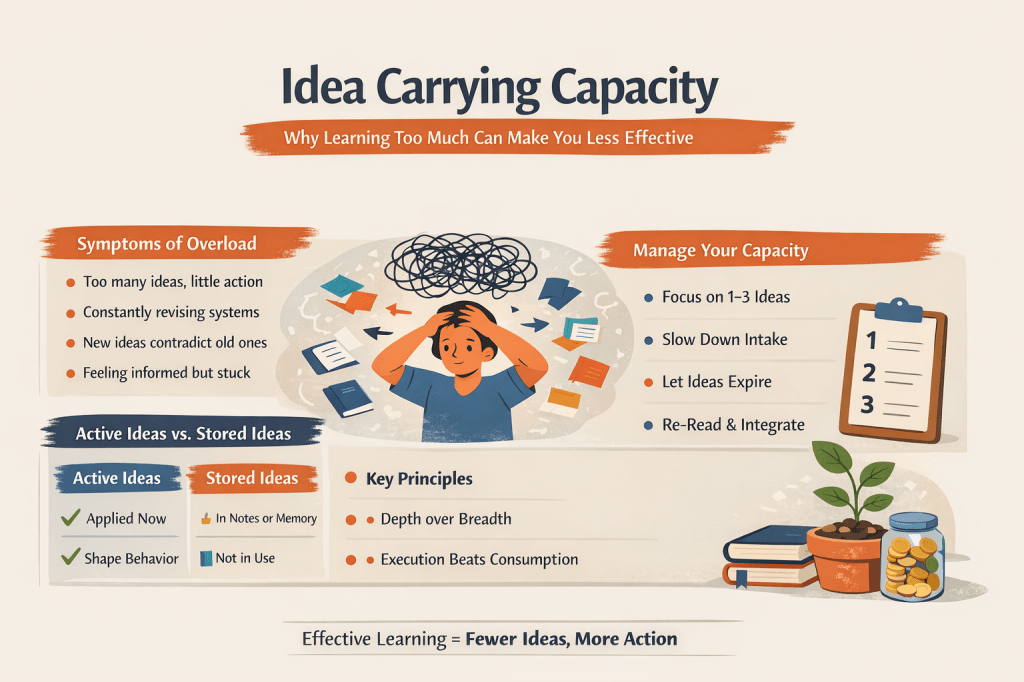
Why More Learning Often Leads to Less Action
At first, consuming ideas feels productive.
You’re reading.
You’re reflecting.
You’re improving your mental models.
But past a certain point, learning creates cognitive congestion.
Common signs you’ve crossed that line:
- You can explain many ideas but implement few
- You constantly tweak systems instead of using them
- Every new book contradicts the last one
- You feel informed, yet stuck
This isn’t laziness. It’s overload.
Your attention is fragmented across too many competing frameworks. Each new idea feels valuable—but together, they cancel each other out.
The Hidden Cost of Information Overload
Information overload isn’t just about volume.
It’s about simultaneity.
Trying to apply:
- multiple productivity systems
- several health habits
- different financial frameworks
- insights from your last few books
…at the same time creates constant internal context switching.
Instead of reinforcing each other, ideas compete for attention.
The result:
- shallow execution
- decision fatigue
- perpetual second-guessing
Learning turns into entertainment instead of transformation.
Ideas Are Investments, Not Trophies
Ideas don’t pay off the moment you acquire them.
Like investments, they need:
- time
- repetition
- friction with real life
But when you keep adding new ideas before old ones mature, you reset the compounding process.
You’re always planting seeds—and never harvesting.
This is why many people feel “busy improving” for years with little change to show for it.
They never let any single idea run long enough to produce returns.
Active Ideas vs. Stored Ideas
A useful distinction:
Active ideas
- Shape daily decisions
- Influence behavior
- Are being tested in real life
Stored ideas
- Live in books, notes, or memory
- Feel useful
- Don’t currently change behavior
The trap is treating stored ideas as progress.
Reading about sleep doesn’t improve sleep.
Understanding FIRE (Financial Independence, Retire Early) doesn’t create financial independence.
Knowing a fitness principle doesn’t build strength.
Only active ideas do work.
How Many Ideas Can You Actually Use at Once?
For most people, the number is surprisingly small.
At any given time:
- 1–3 active ideas is realistic
- 4–5 is usually too many
- Anything beyond that becomes noise
This doesn’t mean you should stop learning.
It means you should sequence learning instead of stacking it.
Depth beats breadth when the goal is real change.
Why Fewer Ideas Create Better Results
When you limit active ideas:
- attention concentrates
- habits stabilize
- feedback becomes clearer
You can actually observe:
- what works
- what breaks
- what needs adjustment
Instead of constantly upgrading systems, you start living inside them.
This is where learning turns into wisdom.
How to Respect Your Idea Carrying Capacity
The goal isn’t to learn less—it’s to learn at the speed of integration.
1. Choose a “current idea”
Designate one core concept to actively work with for the next few weeks:
- a habit
- a framework
- a principle
Everything else becomes background reading, not an action item.
2. Slow down idea intake
If you’re consuming ideas faster than you’re applying them, you’re accumulating idea debt.
After each book or article, ask:
“What is the one thing I will actually test?”
If the answer is “nothing,” pause before adding more inputs.
3. Let ideas expire
Not every idea deserves a permanent place in your life.
Some ideas are:
- context-specific
- season-dependent
- useful once, not forever
Allow ideas to leave your active set without guilt.
Letting go is part of clarity.
4. Re-read instead of adding
Rereading strengthens integration.
An idea revisited after experience:
- changes meaning
- gains nuance
- becomes actionable
This is why rereading often feels more valuable than novelty—it meets you where you are now.
The Long-Term Advantage of Limited Capacity
High-quality lives aren’t built from knowing everything.
They’re built from:
- a small number of well-chosen principles
- applied consistently
- over long periods of time
People who seem “wise” usually aren’t consuming more ideas.
They’re living inside fewer ones more deeply.
A Simple Rule of Thumb
If learning feels energizing but life isn’t changing, you’re over capacity.
Reduce inputs.
Stabilize execution.
Let ideas compound.
Because effectiveness doesn’t come from how much you know—it comes from how much you can actually carry.
 VD
VD 
Leave a comment