When people hear about FIRE – Financial Independence, Retire Early – they often fixate on the second part.
Early retirement.
Leaving work.
Never having a boss again.
But that framing misses the most valuable benefit of financial independence.
FIRE isn’t primarily about stopping work.
It’s about buying optionality.
And optionality changes the quality of your decisions long before you ever retire.
What Optionality Really Means
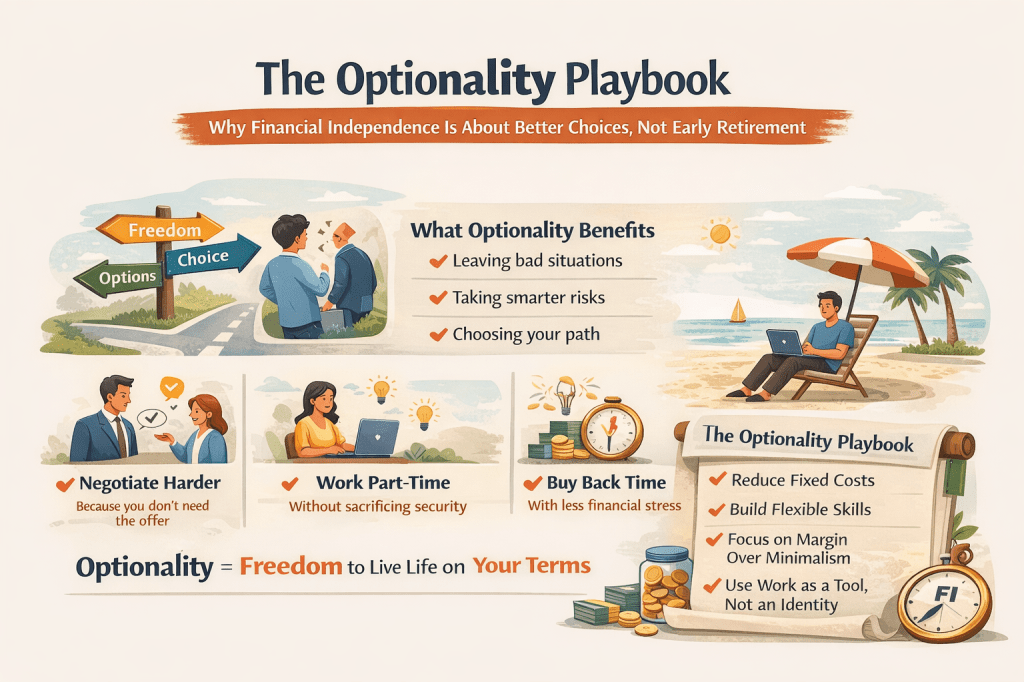
Optionality is the ability to choose without being forced.
It means:
- Saying no to bad opportunities
- Taking calculated risks
- Changing direction without panic
- Waiting instead of rushing
Money is powerful not because of what it buys—but because of what it allows you to decline.
Financial independence increases the number of doors you can walk through and the number you can safely ignore.
Why Early Retirement Is the Wrong Goal for Most People
Early retirement is a binary outcome:
- Working → Not working
Optionality is a spectrum:
- More leverage today
- Less pressure tomorrow
- Better decisions every year
Chasing early retirement alone can lead to:
- Burnout from extreme saving
- Unfulfilling “escape” plans
- Trading one form of constraint for another
Many people don’t actually want to stop working.
They want to stop feeling trapped.
Financial independence solves that problem.
The Real ROI of Financial Independence
The biggest returns from FIRE arrive before your FIRE date.
Optionality pays off when:
- You leave a toxic job without another lined up
- You negotiate harder because you don’t need the offer
- You downshift hours to protect health or family
- You take a pay cut for a role with more learning or meaning
- You say no to work that conflicts with your values
None of these require retirement.
They require financial breathing room.
FIRE as a Decision-Quality Upgrade
Think of financial independence as an operating system upgrade.
Before FI:
- Decisions are urgency-driven
- Short-term income dominates long-term thinking
- Fear subtly shapes choices
After partial FI:
- Decisions become strategy-driven
- You can zoom out
- You can afford patience
Optionality turns life from reactive to intentional.
Optionality Compounds (Just Like Money)
The earlier you build optionality, the more it compounds.
More optionality leads to:
- Better jobs → higher income
- Better health → lower future costs
- Better relationships → stronger support systems
- Better learning → higher leverage skills
These benefits reinforce each other.
Ironically, people who use FIRE to improve decisions often end up wealthier than those singularly focused on retiring early.
Why Coast FIRE and Flexible FIRE Are So Powerful
This is where concepts like Coast FIRE shine.
When your investments are set to grow on their own:
- Work becomes optional earlier
- Income becomes a choice, not a necessity
- You gain time leverage
You can:
- Work fewer days
- Choose less stressful roles
- Experiment with location, projects, or industries
Optionality isn’t about quitting.
It’s about rebalancing power.
The Optionality Playbook (Practical Principles)
1. Prioritize flexibility over optimization
Maximizing net worth at the expense of health, skills, or relationships reduces future options.
A slightly slower path with more resilience often wins long-term.
2. Reduce fixed costs aggressively
Low fixed expenses:
- Lower your “required income”
- Increase freedom immediately
- Make partial FI far more powerful
Optionality thrives when your lifestyle is light and adaptable.
3. Build skills that travel
Skills that compound optionality:
- Writing
- Technical literacy
- Communication
- Teaching
- Problem-solving
Portable skills matter more than titles.
They let you change environments without starting over.
4. Aim for margin, not minimalism
Optionality requires slack:
- Time buffers
- Energy buffers
- Financial buffers
Running life at 100% capacity leaves no room to maneuver.
Why FIRE Skeptics Often Miss the Point
Critics often say:
“Why sacrifice now for a future you might not reach?”
That criticism assumes FIRE is only about a distant finish line.
But when done well, FIRE:
- Improves life now
- Reduces stress now
- Expands choices now
The mistake isn’t pursuing FIRE.
The mistake is pursuing it narrowly.
Optionality Changes How You Experience Work
With optionality:
- Work becomes a tool, not an identity
- You can tolerate short-term discomfort strategically
- You stop clinging to bad situations
Paradoxically, many financially independent people:
- Enjoy work more
- Perform better
- Stay longer by choice
Freedom removes desperation—and desperation is what makes work miserable.
A Better Question Than “When Can I Retire?”
Instead of asking:
“When can I stop working?”
Ask:
“How can I increase my options this year?”
That might mean:
- Saving one extra year of expenses
- Reducing one major fixed cost
- Building one new skill
- Negotiating one flexible arrangement
Small optionality wins stack fast.
Financial Independence as a Lifestyle Upgrade
The deepest benefit of FIRE isn’t leisure.
It’s agency.
Agency over:
- Time
- Energy
- Location
- Values
Early retirement is just one possible outcome.
Optionality is the prize.
Final Thought
Financial independence isn’t about escaping work.
It’s about escaping forced decisions.
When money stops dictating every choice, you regain something far more valuable than free time:
The ability to choose your path—deliberately, calmly, and on your own terms.
That’s the real playbook.
 VD
VD 
Leave a comment