Most people don’t stop exercising after 30.
They stop adapting.
They keep training the way they did in their 20s—chasing intensity, aesthetics, or short-term performance—while their body quietly changes underneath them. For a while, it works. Then small signals start appearing: lingering soreness, recurring aches, slower recovery, lower energy. Eventually, progress stalls or injuries force a reset.
Training after 30 isn’t about doing less.
It’s about training with a longer time horizon.
The goal shifts from maximizing short-term output to building long-term capacity: a body that stays strong, mobile, resilient, and energetic for decades—not just months.
This guide lays out how to train after 30 if your priority is longevity, consistency, and a high-quality life.
The Fundamental Shift After 30: From Output to Capacity
In your 20s, fitness is forgiving. You can:
- Sleep poorly
- Skip warm-ups
- Push maximal intensity frequently
- Recover “by accident”
Your body absorbs mistakes and still adapts.
After 30, the margin for error shrinks. The same behaviors don’t fail immediately—they accumulate costs. Joints get irritated. Tendons complain. Fatigue lingers. Eventually, something breaks.
The core shift is this:
- Before 30: Optimize for output (more weight, faster times, visible gains)
- After 30: Optimize for capacity (what you can sustain year after year)
Capacity is the ability to train, travel, work, and live without constantly managing pain or exhaustion.
Think of your body as infrastructure. Poorly maintained infrastructure doesn’t collapse overnight—it degrades slowly, then suddenly.
Longevity training is preventative maintenance.
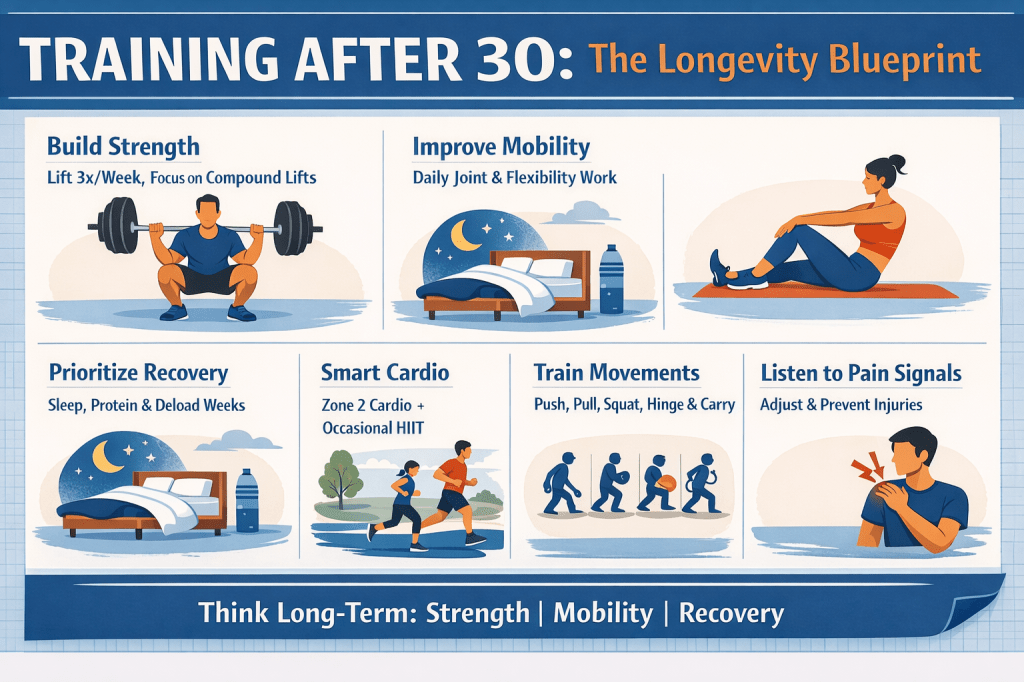
Principle 1: Strength Is the Foundation After 30
If you do only one thing for your body after 30, lift weights.
Strength is not about aesthetics alone. It underpins nearly every marker of healthy aging:
- Muscle mass (countering sarcopenia)
- Bone density
- Joint stability
- Insulin sensitivity
- Injury resistance
- Functional independence later in life
Muscle loss begins earlier than most people realize, and once it’s gone, it’s hard to regain. Strength training is the most effective intervention we have.
How to train strength after 30
You don’t need extreme programs. You need boring consistency.
- Frequency: 2–4 sessions per week
- Duration: 45–60 minutes
- Focus: Compound movements
- Squats or split squats
- Hinges (deadlifts, Romanian deadlifts)
- Pushes (push-ups, bench press, overhead press)
- Pulls (rows, pull-ups)
- Rep range: Mostly 5–10 reps
Train heavy enough to stimulate adaptation, but not so heavy that recovery dominates your life.
The goal isn’t personal records.
The goal is being meaningfully strong at 40, 50, and 60.
Principle 2: Mobility Is Strength’s Insurance Policy
Mobility is often misunderstood. It’s not about being flexible or contorting into extreme positions. It’s about owning usable ranges of motion.
After 30, mobility becomes protective.
Limited mobility changes how force is distributed through your body. When joints can’t move well, other tissues compensate—and compensation is where injuries live.
High-priority areas after 30
- Hips: Sitting reduces extension and rotation
- Thoracic spine: Essential for posture, breathing, and shoulder health
- Ankles: Often overlooked, but critical for knees and balance
- Shoulders: Necessary for overhead movement and long-term durability
A practical rule
If you lift 3 times per week, do mobility at least 3 times per week—even if it’s only 10 minutes.
Short, frequent sessions compound better than long, occasional ones.
Mobility doesn’t replace strength. It allows strength to stay safe.
Principle 3: Recovery Is an Active Skill
In your 20s, recovery feels automatic.
After 30, recovery becomes something you train.
This matters because physical stress and life stress draw from the same pool. Long work hours, screen time, travel, poor sleep, and cognitive load all reduce your capacity to recover from training.
When recovery lags, people often respond by pushing harder. That’s backwards.
The recovery fundamentals that matter most
- Sleep: The biggest lever. Everything else is secondary.
- Protein intake: Supports muscle repair and adaptation.
- Low-intensity movement: Walking, cycling, light cardio improve circulation and recovery.
- Planned deloads: Every 6–10 weeks, intentionally reduce volume or intensity.
If you feel constantly sore, mentally flat, or unmotivated, the issue is rarely discipline. It’s usually too much total stress for your current recovery capacity.
Progress comes from adapting to stress—not accumulating it endlessly.
Principle 4: Cardio for Longevity, Not Punishment
Cardio after 30 should support your life, not dominate it.
You don’t need endless high-intensity sessions unless performance is your goal. For longevity, cardio’s role is to:
- Support heart health
- Improve energy and mood
- Enhance recovery
- Build work capacity for daily life and travel
A longevity-oriented cardio approach
- Zone 2 cardio: 2–4 sessions per week
(brisk walking, cycling, easy jogging—where you can still hold a conversation) - Occasional intensity: 1 short session per week or less
(intervals, hill sprints, faster efforts)
If cardio consistently leaves you drained, it’s miscalibrated.
The goal is sustainable capacity, not suffering.
Principle 5: Train Movements, Not Just Muscles
Traditional bodybuilding splits optimize appearance. Longevity training optimizes function.
Instead of organizing training around body parts, organize it around movement patterns:
- Push
- Pull
- Hinge
- Squat
- Carry
- Rotate
This keeps your body balanced and adaptable to real-world demands—lifting luggage, hiking uneven terrain, long travel days, or simply aging without fear of movement.
A body trained for movement ages better than a body trained for symmetry.
Principle 6: Pain Is Information, Not a Badge of Honor
One of the most important mindset shifts after 30 is this:
Pain is feedback.
Some discomfort is normal when training. Persistent or escalating pain is not.
Pain often signals:
- Load increasing faster than tissue tolerance
- Volume exceeding recovery
- Mobility deficits
- Technique breakdown
Ignoring these signals doesn’t make you resilient—it makes you fragile.
Longevity comes from responding early, adjusting intelligently, and staying in the game.
A Simple Weekly Training Template
This is not a prescription—just a reference model.
Strength (3x/week)
- Full-body sessions
- Compound lifts
- Moderate volume
- 45–60 minutes
Movement & Cardio (3–5x/week)
- Walking
- Cycling
- Light cardio
- Mobility flows
Daily
- 5–10 minutes of joint prep or mobility
This is enough to build strength, preserve joints, and support an active, flexible lifestyle without consuming your schedule.
The Real Objective: Training That Disappears Into Your Life
The best training plan after 30:
- Doesn’t require constant motivation
- Doesn’t cause frequent setbacks
- Doesn’t compete with your career, relationships, or travel
- Supports energy, focus, and resilience
You’re not training for a season.
You’re training for decades of optionality.
Strength gives you confidence.
Mobility keeps movement pain-free.
Recovery keeps everything sustainable.
Train like you want to keep this body for a long time—because you do.
 VD
VD 
Leave a comment