Turning 40 doesn’t change your body overnight – but it does change the rules of the game.
Recovery slows. Small aches linger. Sleep becomes less forgiving. Energy is more variable. At the same time, responsibilities increase, schedules tighten, and stress becomes more chronic than acute.
The mistake many people make is responding to this shift with more intensity: harder workouts, stricter diets, aggressive optimization.
Longevity doesn’t reward intensity.
It rewards consistency, margin, and restraint.
After 40, health stops responding linearly. What actually compounds are not hacks or heroic efforts, but a specific set of habits that protect capacity over decades.
This is the longevity skillset—and it looks very different from what worked in your 20s and 30s.
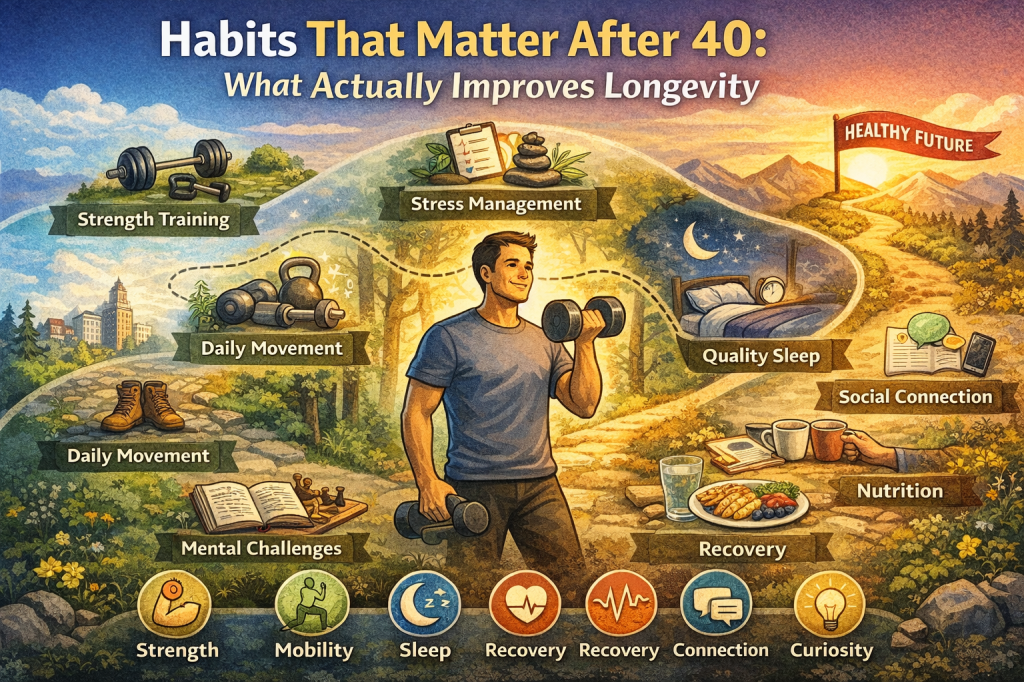
Longevity Is About Preserving Optionality
Longevity isn’t just about living longer. It’s about keeping options open.
Options like:
- Moving without pain
- Thinking clearly under stress
- Recovering quickly from setbacks
- Saying yes to physical and mental challenges
The goal is not peak performance.
The goal is durability.
And durability is built by habits that compound quietly, day after day.
1. Strength Training Becomes Non-Negotiable
After 40, strength isn’t about aesthetics. It’s about insurance.
Muscle mass and bone density naturally decline with age. Strength training is the most effective way to slow—or partially reverse—that process.
What actually matters:
- Lifting regularly (2–4x/week)
- Prioritizing compound movements
- Progressing slowly and sustainably
What doesn’t:
- Training to failure constantly
- Chasing personal records
- Exercising like you’re still 25
Strength preserves:
- Metabolic health
- Joint stability
- Fall resistance
- Independence later in life
This is not optional for longevity. It’s foundational.
2. Mobility and Joint Care Compound More Than Flexibility
Flexibility is passive.
Mobility is usable range of motion.
After 40, joints—not muscles—often become the limiting factor. Hips, ankles, shoulders, and the spine quietly dictate how much you can do.
Longevity habits here include:
- Daily joint movement
- Controlled strength through full ranges
- Regular exposure to loaded mobility
Ten minutes a day compounds more than one intense session a week.
Pain-free movement today prevents forced inactivity tomorrow.
3. Recovery Is a Skill, Not a Given
In your 20s, recovery happens automatically.
After 40, recovery must be designed.
This includes:
- Sleep quality (not just duration)
- Stress management
- Training volume regulation
- Active recovery
If recovery lags, everything else suffers:
- Hormones
- Immune function
- Cognitive clarity
- Motivation
Longevity rewards people who treat recovery as seriously as effort.
4. Sleep Quality Becomes a Force Multiplier
Sleep is the highest-leverage habit after 40.
Poor sleep accelerates aging across every system:
- Metabolic health
- Cardiovascular risk
- Cognitive decline
- Emotional regulation
What compounds:
- Consistent sleep/wake times
- Morning light exposure
- Evening wind-down rituals
- Reducing late-night stimulation
Sleep isn’t passive downtime.
It’s active repair.
5. Energy Management Beats Time Management
After 40, energy—not time—is the constraint.
Longevity habits prioritize:
- Matching demanding tasks to peak energy windows
- Building breaks into the day
- Avoiding chronic overstimulation
This applies to:
- Work
- Training
- Social commitments
- Travel
People who age well are not the busiest.
They are the best at protecting their energy.
6. Nutrition Becomes Simpler—and More Forgiving
Longevity nutrition after 40 is less about rules and more about defaults.
What compounds:
- Sufficient protein
- Whole foods most of the time
- Stable blood sugar
- Eating patterns you can sustain indefinitely
What matters less than people think:
- Perfect macros
- Constant restriction
- Extreme diets
Longevity diets are boring, repeatable, and flexible.
Consistency beats purity.
7. Stress Load Matters More Than Stress Events
Stress isn’t the enemy.
Unrecovered stress is.
After 40, chronic stress quietly degrades:
- Sleep
- Hormones
- Inflammation
- Decision quality
Longevity habits include:
- Saying no earlier
- Reducing background stressors
- Creating decompression rituals
- Designing calmer defaults
The goal isn’t zero stress.
It’s stress you can recover from.
8. Social Health Is Physical Health
Longevity research consistently shows that strong social ties rival exercise and diet in importance.
What compounds:
- Regular, low-friction social contact
- Shared physical activity
- Conversations without devices
Isolation accelerates decline—even in otherwise healthy people.
Longevity is not a solo project.
9. Cognitive Challenge Slows Mental Aging
The brain ages like the body: use it or lose it.
But passive consumption doesn’t count.
What compounds cognitively:
- Learning new skills
- Navigating unfamiliar environments
- Deep reading
- Problem-solving under mild difficulty
Novelty + effort preserves:
- Memory
- Processing speed
- Cognitive flexibility
Comfort is the enemy of mental longevity.
10. Identity-Level Habits Outperform Hacks
The most important shift after 40 is internal.
People who age well stop asking:
“What should I do?”
And start asking:
“Who am I becoming?”
Longevity habits stick when they align with identity:
- “I’m someone who trains for life.”
- “I protect my sleep.”
- “I move daily.”
- “I recover intentionally.”
Identity compounds faster than motivation.
What Doesn’t Compound After 40
Equally important is knowing what to stop chasing:
- Extreme workouts
- Aggressive optimization
- Constant novelty
- Short-term body recomposition goals
These extract returns early—but charge interest later.
Longevity favors low drama systems.
The Longevity Mindset Shift
Before 40, effort is rewarded quickly.
After 40, restraint is rewarded quietly.
Longevity isn’t about doing more.
It’s about doing enough, consistently, for decades.
Small habits, protected fiercely, beat ambitious plans abandoned annually.
Final Thought
Longevity isn’t built in a year.
It’s built in ordinary weeks repeated well.
Strength.
Movement.
Sleep.
Recovery.
Relationships.
Curiosity.
These habits don’t feel impressive day to day—but they compound into freedom later.
After 40, the question isn’t how hard you can push.
It’s how long you can stay capable.
 VD
VD 
Leave a comment