At some point on the path to FIRE (Financial Independence, Retire Early) something strange happens.
You’re doing everything “right.”
You’re saving consistently.
You’re investing automatically.
You’re no longer making obvious financial mistakes.
And yet, it feels like nothing is moving.
Your net worth inches up, stalls, or even dips depending on the market. The excitement you felt in the early days has faded. FIRE still matters to you—but it no longer feels urgent or energizing.
This is not failure.
This is not a lack of discipline.
This is not a sign that your plan is broken.
This is the FIRE middle—the most common, least discussed, and most psychologically challenging phase of the journey.
Understanding why this phase feels slow—and how to work with it instead of against it—can be the difference between quietly succeeding and burning out right before the compounding kicks in.
The Three Phases of the FIRE Journey
Most FIRE content focuses on the beginning or the end.
The beginning is exciting:
- You discover FIRE.
- You optimize spending.
- You increase your savings rate.
- Progress is visible and motivating.
The end is aspirational:
- Work becomes optional.
- Your portfolio does most of the work.
- Financial stress fades into the background.
But almost no one talks about the middle.
The middle is where:
- Your habits are already optimized.
- Your savings rate has stabilized.
- Progress depends less on behavior changes and more on time.
And time, unlike optimization, is emotionally unsatisfying.
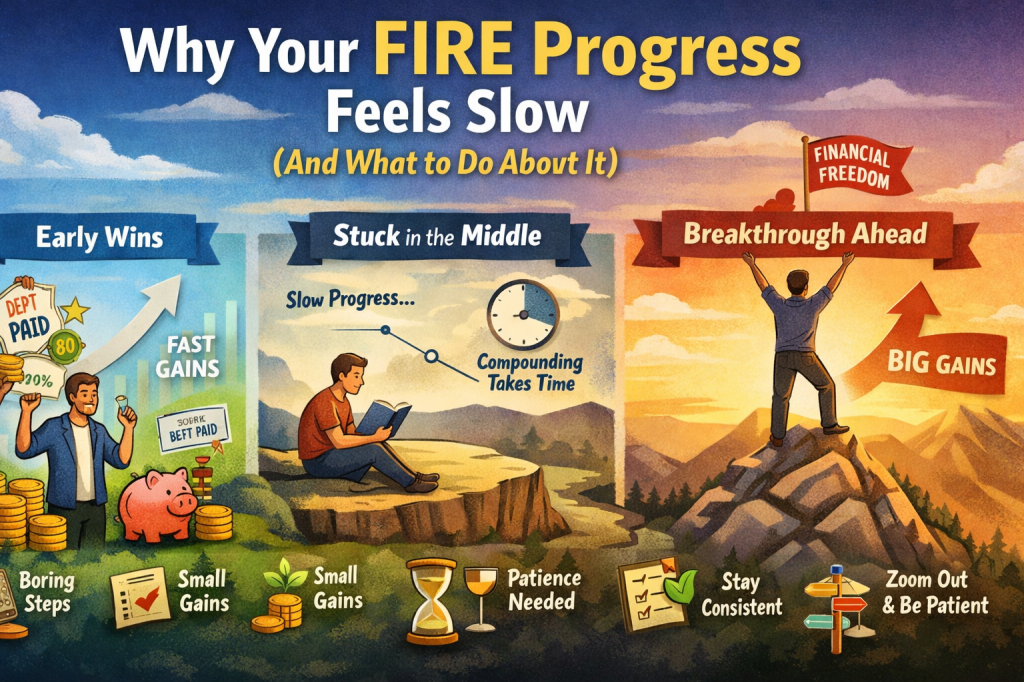
Why FIRE progress feels slow (even when it isn’t)
1. Compounding is back-loaded by design
Investment growth is not linear. It’s exponential—and exponential growth is deceptive.
Early in the journey:
- Your contributions matter more than your returns.
- Market gains feel insignificant.
- Progress feels earned.
Later:
- Returns dwarf contributions.
- Growth accelerates dramatically.
- Progress feels effortless.
The problem is that most people live in the quiet part of the curve.
This creates a psychological mismatch. You’re putting in steady effort, but the visible results haven’t arrived yet. It feels like pushing a heavy flywheel that refuses to spin—right up until it does.
When FIRE feels slow, it’s often because you’re standing in the exact place where patience matters most.
2. Your Reference Point Has Shifted
Early wins are obvious:
- Eliminating debt
- Cutting recurring expenses
- Doubling your savings rate
- Building an emergency fund
Later wins are subtle:
- Staying invested during volatility
- Not upgrading your lifestyle when income rises
- Maintaining consistency year after year
These don’t feel like progress. They feel like maintenance.
But maintenance is what prevents catastrophic regression.
FIRE plans don’t fail because people don’t know what to do.
They fail because people abandon boring systems in search of excitement.
3. Net Worth Is a Terrible Short-Term Motivator
Net worth is:
- Slow to change
- Influenced by external forces
- Volatile in the short term
Checking it too often creates the illusion of stagnation—even when the long-term trajectory is solid.
This leads to unnecessary anxiety, over-optimization, and strategy hopping. You start solving problems that don’t exist because the primary metric you’re watching moves too slowly to provide feedback.
The issue isn’t your progress.
It’s your measurement cadence.
4. You’ve Already Pulled the Easy Levers
The first 80% of FIRE progress comes from:
- Awareness
- Basic financial literacy
- Avoiding obvious mistakes
The remaining 20% comes from:
- Patience
- Emotional regulation
- Not self-sabotaging
By the time FIRE feels slow, it’s often because there are fewer levers left to pull. That’s not stagnation—it’s maturity.
Common Mistakes During the FIRE Middle
When progress feels slow, many people react in ways that increase risk without increasing expected returns.
- Chasing higher-risk investments “to speed things up”
- Constantly changing asset allocation
- Obsessively tweaking spreadsheets
- Comparing themselves to outliers or internet success stories
These behaviors feel productive, but they introduce fragility.
FIRE is not about maximum speed.
It’s about maximum survivability.
What to Do When FIRE Feels Stuck
1. Shift From Outcome Tracking to Process Tracking
Instead of asking:
“How close am I to FIRE?”
Ask:
“Am I executing my system consistently?”
Track inputs you control:
- Savings consistency
- Spending aligned with values
- Investment discipline
- Skill development
- Health and energy maintenance
Outcomes compound because inputs are boring and repeatable.
2. Measure Optionality, Not Just Net Worth
FIRE is not a single number. It’s a spectrum of freedom.
Signs of real progress include:
- You can say no to bad work
- You feel less urgency around income
- You can take time off without panic
- Your baseline expenses are stable or shrinking
These are indicators of financial independence in motion, even if the finish line is years away.
3. Build Rewards Into the Middle
Delayed gratification without reinforcement breaks people.
The solution isn’t spending more—it’s rewarding consistency without permanently increasing costs.
Examples:
- Time-boxed lifestyle upgrades
- Travel experiments
- Skill sabbaticals
- Schedule flexibility trials
Think in terms of lifestyle prototyping, not consumption. FIRE is about designing a life you actually want to live, not postponing life indefinitely.
4. Zoom Out the Time Horizon
Monthly check-ins amplify noise. Annual reviews reveal trends.
Instead of reacting to short-term fluctuations:
- Review annually
- Rebalance deliberately
- Recalculate your FIRE projections every few years
FIRE doesn’t require constant supervision.
It requires staying invested—financially and emotionally.
5. Learn to Interpret Boredom Correctly
If your FIRE plan feels boring, repetitive, and uneventful, that’s not a problem.
That’s a sign that:
- You’ve removed drama from money
- You’re no longer reacting emotionally
- Your system is doing the work
The goal of FIRE isn’t excitement.
It’s inevitability.
The Real FIRE Breakthrough
The breakthrough doesn’t come from a sudden spike in net worth.
It comes when:
- You stop checking constantly
- You stop trying to “hack” the timeline
- You trust boring systems over clever moves
At some point, FIRE progress stops needing your attention.
That’s not a plateau.
That’s lift-off preparation.
Final Thought
If your FIRE progress feels slow, it’s likely because you’ve already done the hard part. What remains isn’t optimization—it’s endurance.
Time, paired with consistency, is undefeated.
Stay boring.
Stay patient.
Let compounding finish the job.
 VD
VD 
Leave a comment