Most people who fail at FIRE don’t quit.
They stall.
They save diligently. They invest regularly. They read the blogs. Years pass—and freedom still feels far away. Motivation fades. Doubt creeps in. FIRE starts to feel like a mirage instead of a plan.
This isn’t bad luck. It’s not market returns either.
It’s usually a handful of predictable mistakes that quietly slow progress without triggering alarm bells.
FIRE rarely collapses dramatically.
It backfires slowly.
Let’s break down the most common traps that delay financial independence—and how to avoid each one.
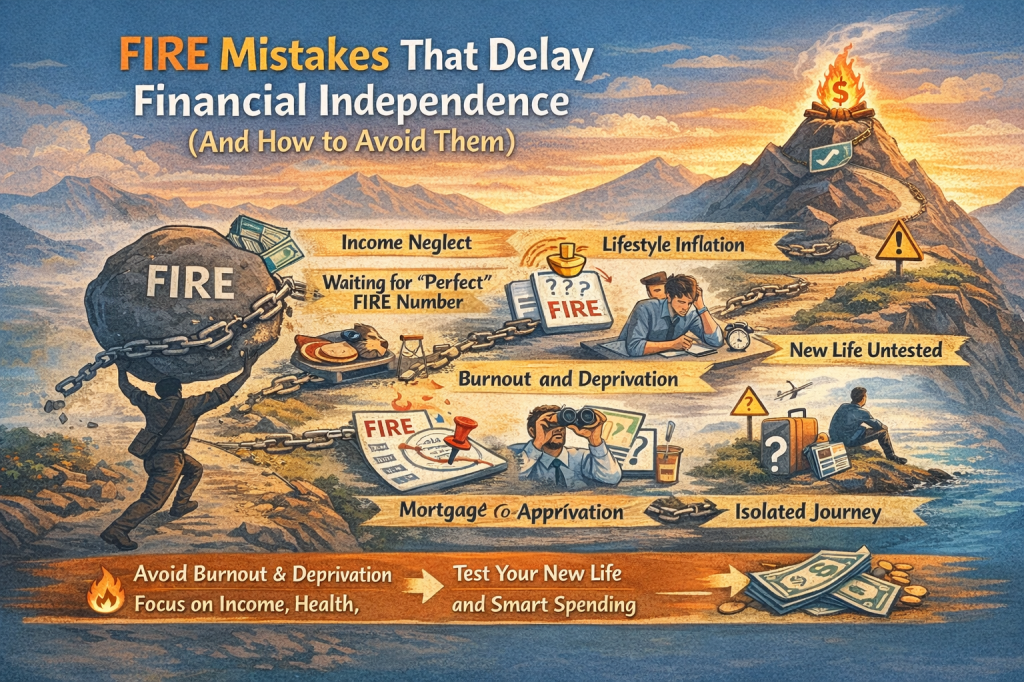
Mistake #1: Optimizing Expenses Instead of Income (Too Long)
Cutting expenses is seductive.
It’s controllable. Immediate. Quantifiable. You can feel virtuous while doing it. But there’s a hard ceiling.
You can only cut so much before quality of life drops or the math stops working.
The mistake isn’t frugality.
The mistake is over-indexing on frugality once it’s no longer the bottleneck.
If you:
- Already save 30–40%
- Live reasonably simply
- Have cut obvious waste
Then obsessing over another $50/month is not leverage. It’s distraction.
How it delays FIRE
- Income stagnates
- Savings rate plateaus
- Net worth growth slows relative to effort
What to do instead
Treat income like a skill, not a fixed input.
Focus on:
- Skill stacking
- Role changes
- Geographic arbitrage
- Negotiation
- Leverage through systems, not hours
The fastest FIRE years are usually income-expansion years, not expense-minimization years.
Mistake #2: Waiting for the “Perfect” FIRE Number
Many people treat their FIRE number like a sacred destination.
Hit it exactly—or don’t move at all.
This all-or-nothing thinking is one of the biggest psychological drags in the community.
How it delays FIRE
- Keeps you locked into jobs you hate
- Prevents intermediate lifestyle upgrades
- Turns FIRE into a distant, brittle goal
Meanwhile, the highest leverage phase of FIRE—the transition—is ignored.
What to do instead
Think in gradients, not finish lines.
Examples:
- Coast FIRE
- Barista FIRE
- Semi-retirement
- Time independence before full financial independence
Each step buys you:
- More energy
- Better health
- Optionality
- Better decision-making
Ironically, people who allow partial freedom often reach full freedom faster.
Mistake #3: Treating FIRE as a Math Problem Only
The spreadsheets work. The projections are correct.
And still, people burn out.
Why? Because FIRE is not just math. It’s psychology + behavior + energy management.
Ignoring that reality is expensive.
How it delays FIRE
- Burnout leads to bad career decisions
- Health issues increase expenses and reduce earning power
- Motivation collapses halfway through the journey
A technically sound plan that you can’t sustain will fail.
What to do instead
Design FIRE as a lifestyle upgrade, not a deprivation phase.
Ask:
- Does this plan improve my life now?
- Is my health compounding or deteriorating?
- Would I willingly live this way for 10 years?
If the answer is no, the plan is flawed—even if the math checks out.
Mistake #4: Over-Optimizing Investments, Under-Optimizing Behavior
People love debating:
- Asset allocation
- Withdrawal rates
- Market timing
- Tax strategies
These matter—but far less than behavior.
How it delays FIRE
- Paralysis from over-analysis
- Chasing complexity instead of consistency
- Ignoring savings rate, career moves, and lifestyle design
A simple, boring investment plan executed for decades beats a clever one you keep tweaking.
What to do instead
Lock in:
- A simple allocation you understand
- Automatic contributions
- Low fees
- Minimal tinkering
Then redirect energy to:
- Earning more
- Spending intentionally
- Staying healthy enough to enjoy freedom
Behavior compounds. Optimization rarely does.
Mistake #5: Lifestyle Inflation Disguised as “Rewarding Yourself”
Lifestyle inflation doesn’t announce itself.
It sneaks in under respectable labels:
- “I earned this”
- “This improves my quality of life”
- “It’s only a little more”
Sometimes that’s true. Often it’s rationalization.
How it delays FIRE
- Raises the FIRE number silently
- Increases financial fragility
- Makes freedom more expensive every year
The danger isn’t spending more—it’s locking in fixed costs.
What to do instead
Spend aggressively on:
- Health
- Time savings
- Experiences with high memory ROI
Be ruthless with:
- Recurring subscriptions
- Housing bloat
- Status purchases
- Convenience creep
Freedom comes from low fixed costs, not low joy.
Mistake #6: Ignoring Health as a FIRE Variable
Many FIRE plans assume:
- Stable energy
- Stable health
- Stable cognition
That’s optimistic after 35.
Health neglect doesn’t just reduce quality of life—it delays FIRE directly.
How it delays FIRE
- Medical expenses rise
- Productivity drops
- Career longevity shortens
- Decision quality degrades
A burned-out, injured, sleep-deprived high earner is fragile.
What to do instead
Treat health like financial infrastructure.
Minimum effective habits:
- Strength training
- Cardio base
- Sleep consistency
- Stress management
- Mobility
Health compounds just like money—and depreciates faster when ignored.
Mistake #7: Planning for a Life You Haven’t Tested
Many people design a FIRE lifestyle entirely in their heads.
They assume:
- They’ll enjoy endless free time
- They’ll travel indefinitely
- They’ll “figure it out later”
Reality often disagrees.
How it delays FIRE
- Fear increases near the finish line
- Goalposts move
- People keep working “just one more year”
Uncertainty kills momentum.
What to do instead
Prototype your future life early.
Examples:
- Take extended sabbaticals
- Work remotely from different locations
- Test lower-cost lifestyles temporarily
- Practice semi-retirement now
Familiarity reduces fear.
Fear is what keeps people stuck past their number.
Mistake #8: Confusing Net Worth With Freedom
A high net worth does not guarantee freedom.
Liquidity, flexibility, and optionality matter more.
How it delays FIRE
- Money locked in illiquid assets
- High ongoing obligations
- Dependence on a single income stream
You can be “wealthy” and still trapped.
What to do instead
Optimize for:
- Cash flow flexibility
- Low burn rate
- Transferable skills
- Geographic freedom
Freedom is the ability to say no—not just a number on a spreadsheet.
Mistake #9: Trying to Reach FIRE Alone
FIRE culture often glorifies self-reliance.
But isolation makes everything harder.
How it delays FIRE
- Fewer opportunities
- Less perspective
- Higher emotional load
- More second-guessing
Progress slows when every decision feels heavy.
What to do instead
Build a small FIRE-adjacent network:
- People slightly ahead of you
- People experimenting differently
- People who normalize long timelines
You don’t need a community.
You need reference points.
The Meta-Mistake: Treating FIRE as Sacrifice Instead of Strategy
The biggest delay comes from a mindset error:
Seeing FIRE as something you endure instead of something you design.
When FIRE feels like punishment now for happiness later, motivation erodes.
When FIRE feels like a series of upgrades—time, health, autonomy—it accelerates.
The Real Shortcut to FIRE
There is no hack.
But there is a pattern.
People who reach FIRE faster tend to:
- Increase income early
- Avoid fixed-cost creep
- Invest simply and consistently
- Protect health aggressively
- Use partial freedom as fuel
- Design lives they don’t want to escape from
FIRE backfires when it becomes rigid, joyless, or purely theoretical.
Done right, it should feel like momentum—not deprivation.
Final Thought
If your FIRE plan makes your current life worse, it’s probably delaying your freedom—not accelerating it.
Freedom isn’t a switch you flip someday.
It’s a gradient you climb—one smart constraint at a time.
 VD
VD 
Leave a comment