Most travel advice is built for people who travel once or twice a year.
Frequent travelers have a different problem.
It’s not inspiration. It’s friction.
Packing takes too long. Airports are exhausting. Logistics bleed energy. Small annoyances compound until travel—something meant to expand your life—starts shrinking it.
Efficient travel isn’t about hacks.
It’s about systems.
Frequent travelers don’t think trip by trip. They design setups that improve with repetition. Every journey becomes easier than the last.
Here’s how they do it.
The Core Principle: Reduce Decisions, Not Options
Travel fatigue rarely comes from distance or time zones.
It comes from decision overload.
- What to pack?
- What to wear?
- How to get from the airport?
- Where to stay?
- What to do first?
Frequent travelers don’t eliminate choice. They pre-decide.
Every system below follows the same rule:
Make the default good enough, so you don’t have to think.
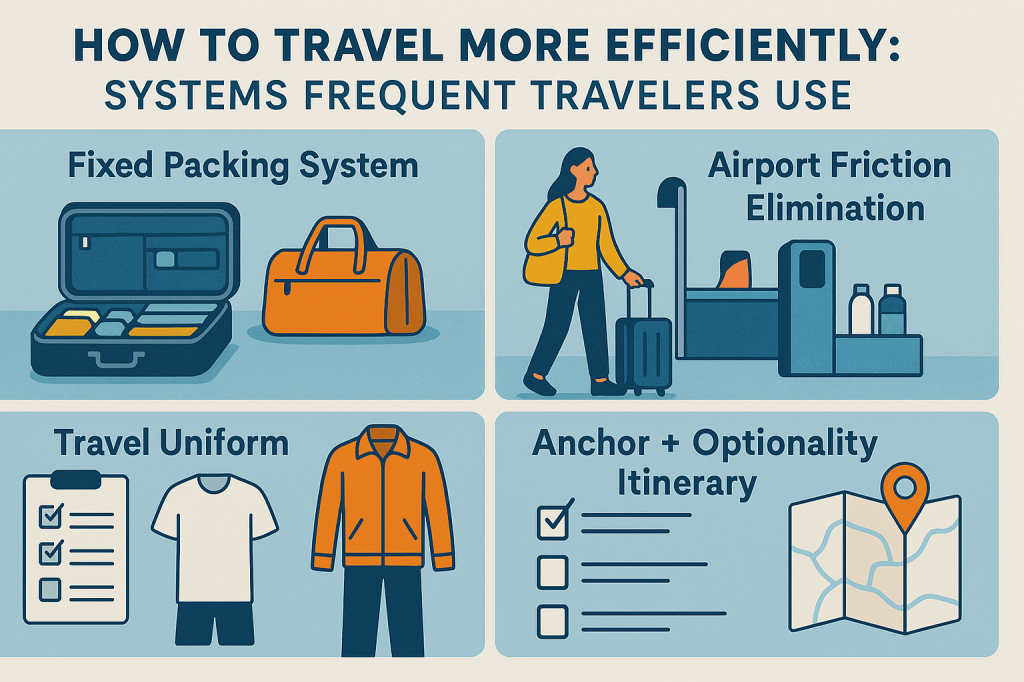
System 1: The Fixed Packing System (Not a List)
Most people pack from scratch every trip.
That’s inefficient.
Frequent travelers use a fixed packing system, not a checklist.
How it works
- One bag, always
- Same categories, same layout
- Gear never fully “unpacks” at home
Think of packing as inventory management, not preparation.
Core components
- A permanent toiletry kit
- A tech pouch that never changes
- A capsule wardrobe built around layering
- One “variable” slot for climate or activity-specific items
The goal is not minimalism.
It’s predictability.
Packing time should approach zero.
System 2: The Travel Uniform
Decision fatigue starts before you leave the house.
Frequent travelers eliminate it with a travel uniform.
Why this matters
- Fewer choices under stress
- Easier layering
- Faster security checks
- Less cognitive load
What a travel uniform looks like
- Neutral colors
- Comfortable shoes you can walk all day in
- One jacket that works across climates
- Clothes that tolerate repetition
The best travel outfit is boring—and reliable.
Efficiency beats expression in transit. Save creativity for the destination.
System 3: The “Arrival Day” Rule
Most trips are sabotaged on day one.
Jet lag. Decision fatigue. Over-ambition.
Frequent travelers treat arrival day as a buffer, not an experience.
Arrival day rules
- No major plans
- No tight schedules
- One simple objective: reset your body
Typical arrival flow:
- Drop bags
- Walk outside
- Eat something local and simple
- Get daylight exposure
- Sleep early
This single rule improves:
- Energy
- Mood
- Trip longevity
You don’t lose a day.
You gain the rest of the trip.
System 4: Default Lodging Criteria
Searching for accommodation is one of the highest-friction parts of travel.
Frequent travelers don’t optimize endlessly. They use minimum viable criteria.
Example criteria
- Walkable neighborhood
- Natural light
- Kitchen access
- Quiet at night
- Near public transport
Once criteria are met, they stop searching.
The mistake is trying to find the perfect place.
The system is finding a good-enough default fast.
Time saved here is better spent exploring—or resting.
System 5: Airport Friction Elimination
Airports are predictable chaos.
Frequent travelers don’t fight it. They design around it.
Key strategies
- Same bag size every time
- Liquids and electronics always accessible
- Pre-check / fast track where available
- Early arrival with zero rushing
Efficiency here isn’t about speed.
It’s about calm.
Rushing multiplies stress. Calm conserves energy.
System 6: The First-Hour Routine
What you do in the first hour sets the tone for the entire stay.
Frequent travelers use a repeatable first-hour routine.
Typical elements
- Walk the neighborhood
- Buy groceries or water
- Locate coffee or food
- Identify one anchor location (park, café, market)
This accomplishes three things:
- Orientation
- Psychological grounding
- Immediate autonomy
Once you know where you are and how to meet basic needs, everything feels easier.
System 7: Travel Energy Management
Most people plan travel around sights.
Frequent travelers plan around energy.
Key idea
Energy is finite. Protect it early.
Practical rules
- One major activity per day
- Movement beats sitting
- Eat simply while adjusting
- Schedule rest before you need it
Efficiency isn’t cramming more in.
It’s avoiding recovery debt.
Trips should end with energy—not exhaustion.
System 8: The “Anchor + Optionality” Itinerary
Over-planning kills spontaneity.
Under-planning creates anxiety.
Frequent travelers use a hybrid approach.
How it works
- One anchor activity per day (museum, hike, meeting)
- Everything else is optional
Anchors create structure.
Optionality preserves freedom.
This system adapts to:
- Weather
- Mood
- Energy
- Unexpected opportunities
Rigid itineraries break. Flexible ones improve.
System 9: The Digital Travel Stack (Minimal)
More apps ≠ better travel.
Frequent travelers keep their digital stack lean and intentional.
Core tools only
- Maps (offline enabled)
- One notes app
- Booking confirmation folder
- Expense tracking (optional)
Everything else is noise.
If an app doesn’t reduce friction every trip, it doesn’t belong.
System 10: The Return-Home Reset
Most people unpack once—and forget what failed.
Frequent travelers close the loop.
After every trip
- Remove unused items
- Replace what ran out
- Note friction points
- Adjust the system
This is where efficiency compounds.
The bag improves.
The routine sharpens.
The trip gets easier.
Why Systems Matter More Than Hacks
Travel hacks expire.
Systems compound.
A good system:
- Reduces cognitive load
- Improves consistency
- Scales with frequency
- Survives bad days
That’s why frequent travelers look calm while everyone else looks rushed. They’re not better at travel. They’ve just removed friction.
The Real Payoff: Travel That Gives Energy Back
Efficient travel isn’t about saving minutes.
It’s about preserving:
- Attention
- Health
- Curiosity
- Enjoyment
When logistics fade into the background, travel becomes what it should be: a net positive.
Not something you recover from.
Final Thought
If every trip feels equally exhausting, you don’t need better destinations.
You need better systems.
Design travel the way you design finances or health:
build once, refine often, let repetition do the work.
That’s how frequent travelers make every trip easier than the last.
 VD
VD 
Leave a comment