Longevity advice is broken.
Not because we don’t know enough—but because we chase too much.
Cold plunges, supplements, wearables, protocols, optimization stacks. Most people collect habits instead of building health. The result? Burnout, inconsistency, and a sense that staying healthy requires a second job.
It doesn’t.
Longevity isn’t about doing everything.
It’s about doing the few things that matter, consistently, for decades.
This article is about the longevity baseline: the minimum effective habits that actually improve healthspan—the years you live healthy, capable, and independent.
If you do nothing else, do these.
First: What “Minimum Effective” Really Means
Minimum effective doesn’t mean minimal effort.
It means:
- The lowest input
- That produces most of the outcome
- With high consistency
A habit that works 90% of the time beats a perfect protocol you follow 10% of the time.
Longevity compounds. Consistency is the multiplier.
The Longevity Baseline (High-Level)
If you strip longevity down to first principles, almost everything reduces to five levers:
- Movement
- Strength
- Sleep
- Nutrition
- Stress & recovery
Everything else is secondary.
Let’s go through each—practically.
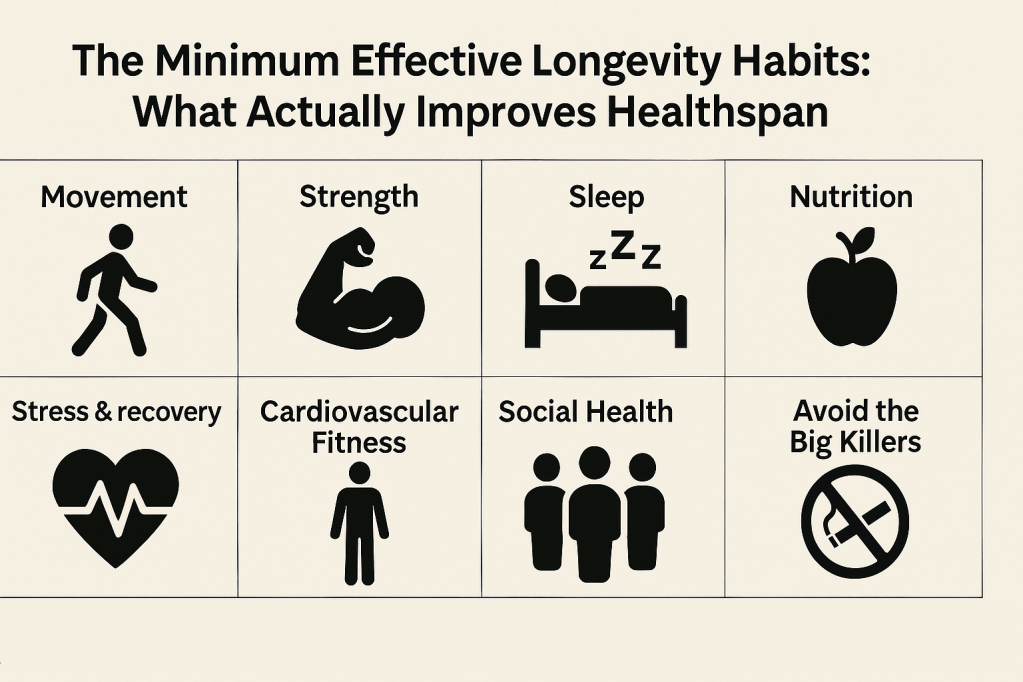
1. Daily Movement (Non-Negotiable)
If you do nothing else for longevity, move every day.
Not workouts.
Movement.
Why it matters
Daily movement improves:
- Insulin sensitivity
- Cardiovascular health
- Joint function
- Mood and cognition
- All-cause mortality risk
Sitting is one of the strongest predictors of early decline—even if you exercise.
Minimum effective dose
- 7,000–10,000 steps per day
- Spread throughout the day, not all at once
Walking is the most underrated longevity habit because it:
- Requires no recovery
- Scales across age
- Supports every other system
If your job is sedentary, walking isn’t optional—it’s corrective.
2. Strength Training (Aging Insurance)
Muscle is not about aesthetics.
It’s about survival.
After age 30, you lose muscle every year unless you fight back. Muscle loss is directly tied to:
- Frailty
- Falls
- Metabolic disease
- Loss of independence
Strength is a longevity skill.
Minimum effective dose
- 2–3 full-body sessions per week
- Focus on compound movements:
- Squat or hinge
- Push
- Pull
- Carry
No need for complexity.
No need for exhaustion.
Your goal isn’t to be sore.
It’s to be strong enough to age slowly.
3. Cardiovascular Fitness (Don’t Skip This)
You can’t out-lift a weak heart.
Cardiorespiratory fitness is one of the strongest predictors of lifespan—stronger than many biomarkers doctors test.
Minimum effective dose
- 150 minutes per week of moderate cardio
or - 75 minutes per week of higher-intensity work
This can be:
- Brisk walking
- Cycling
- Zone 2 training
- Occasional intervals
You don’t need to suffer.
You need to breathe hard—sometimes.
4. Sleep: The Force Multiplier
Sleep is not a recovery tool.
It’s the system upgrade.
Poor sleep worsens:
- Insulin resistance
- Inflammation
- Cognitive decline
- Injury risk
- Emotional regulation
If sleep is broken, everything else underperforms.
Minimum effective baseline
- 7–8 hours in bed
- Consistent sleep/wake times
- Morning light exposure
- Screens off 60–90 minutes before bed
Forget supplements.
Fix timing, light, and consistency first.
Most “sleep problems” are lifestyle problems in disguise.
5. Nutrition: Boring, Simple, Effective
Longevity nutrition is not about extremes.
It’s about energy balance, protein sufficiency, and food quality—over years.
Minimum effective rules
- Eat mostly whole foods
- Prioritize protein at every meal
- Maintain a stable, healthy body weight
- Stop eating when “satisfied,” not stuffed
You don’t need:
- Superfoods
- Perfect macros
- Constant restriction
You do need repeatable defaults.
If your diet requires willpower, it will fail long-term.
6. Body Composition Matters (More Than Weight)
Weight alone is a blunt tool.
For longevity, what matters is:
- Muscle mass
- Visceral fat
- Waist-to-height ratio
Excess fat—especially around the abdomen—is strongly linked to:
- Cardiovascular disease
- Diabetes
- Cognitive decline
Minimum effective focus
- Preserve muscle via strength training
- Avoid slow, creeping weight gain
- Use waist circumference as a reality check
Longevity is not about being thin.
It’s about being metabolically healthy.
7. Stress Regulation (Not Stress Elimination)
Stress isn’t the enemy.
Unmanaged stress is.
Chronic stress accelerates aging through:
- Hormonal disruption
- Inflammation
- Sleep degradation
- Poor decision-making
Minimum effective practices
- Daily low-level decompression (walking, breathing, quiet)
- Weekly longer reset (nature, long movement, solitude)
- Boundaries around work and screens
You don’t need to meditate for an hour.
You need regular nervous system downshifts.
8. Social Health (The Overlooked Multiplier)
Longevity isn’t solo.
Strong social ties reduce mortality risk as much as quitting smoking. Isolation accelerates decline—mentally and physically.
Minimum effective baseline
- Regular contact with people you trust
- Shared movement or meals
- A sense of belonging somewhere
This isn’t about being extroverted.
It’s about not being alone with everything.
9. Avoid the Big Killers (Unsexy but Critical)
Longevity isn’t only about what you add.
It’s also about what you avoid consistently.
Non-negotiables
- Don’t smoke
- Limit alcohol
- Manage blood pressure
- Get basic preventive screenings
These aren’t exciting.
They’re effective.
Ignoring them wipes out gains from everything else.
What You Can Safely Ignore (For Now)
You don’t need to:
- Track dozens of biomarkers
- Wear five devices
- Cycle supplements
- Chase constant optimization
Those are marginal gains after the baseline is solid.
Most people skip the foundation and obsess over the roof.
That’s backwards.
The Longevity Formula (Simple Version)
If you want a checklist:
- Walk daily
- Lift 2–3× per week
- Do some cardio
- Sleep consistently
- Eat simply
- Maintain muscle
- Manage stress
- Stay socially connected
- Avoid obvious self-harm
That’s it.
Do this for 30 years and you’ll outperform 95% of people chasing shortcuts.
Final Thought: Longevity Is Boring—And That’s the Point
The habits that extend healthspan are not exciting.
They don’t sell well on social media.
They don’t feel heroic.
They don’t make you special.
They work.
Longevity isn’t built in dramatic moments.
It’s built in unremarkable days repeated thousands of times.
Get the baseline right.
Everything else is optional.
 VD
VD 
Leave a comment