Most health advice focuses on optimization.
More supplements.
Smarter workouts.
Better tracking.
But many of the biggest health returns don’t come from adding more. They come from fixing what’s quietly broken by modern life.
Three habits shape your health every single day, whether you pay attention to them or not:
- how you hold your body
- how you breathe
- how you move through space
Posture, breath, and walking form a foundational health trifecta. They influence pain, energy, metabolism, stress, and long-term resilience. Yet they’re rarely treated as skills worth training.
They feel too basic to matter.
They’re anything but.
Why fundamentals matter more than hacks
You can exercise regularly and still feel stiff, tired, and inflamed.
You can eat well and still feel stressed and low-energy.
You can sleep enough and still wake up unrefreshed.
Often, the issue isn’t effort—it’s baseline dysfunction.
Posture, breathing, and walking operate below conscious awareness, but they affect:
- nervous system tone
- joint loading
- circulation
- recovery
- daily energy expenditure
Fixing them doesn’t require more discipline.
It requires better defaults.
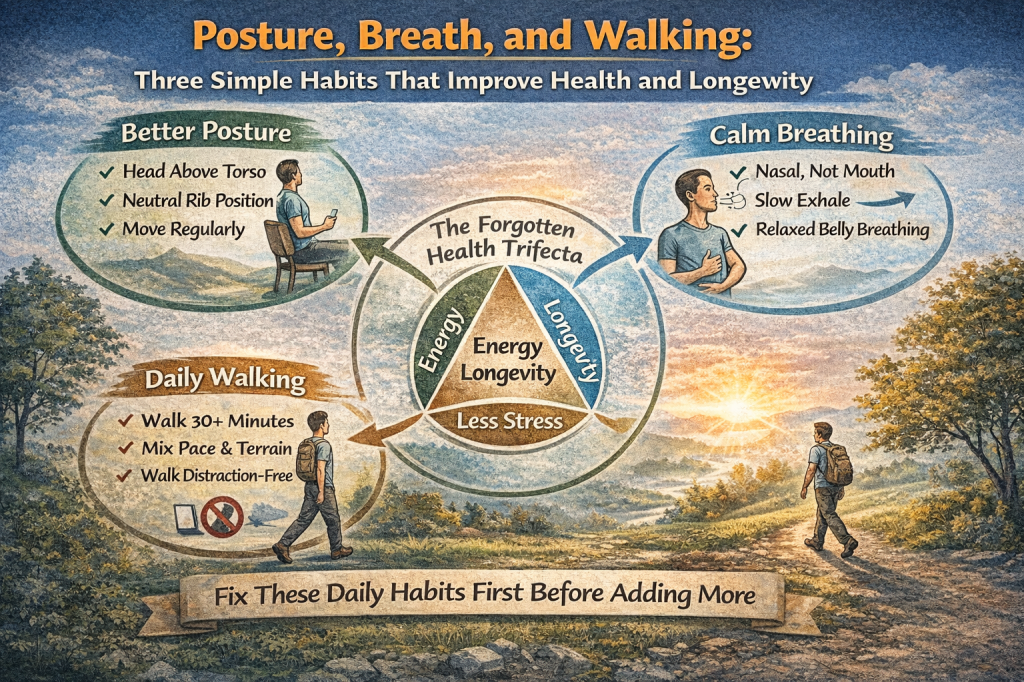
1. Posture: How you carry yourself all day
Posture isn’t about standing up straight.
It’s about how your body organizes itself against gravity.
Most modern posture problems come from the same source:
- long hours sitting
- screens at eye level
- minimal movement variety
Over time, this leads to:
- forward head posture
- rounded shoulders
- compressed hips
- reduced spinal mobility
These aren’t cosmetic issues. They affect breathing capacity, joint health, and even mood.
Why posture affects longevity
Poor posture:
- increases joint wear
- reduces lung expansion
- creates chronic low-grade tension
- alters gait mechanics
Good posture:
- distributes load efficiently
- reduces unnecessary muscle activity
- improves balance and coordination
- supports healthier movement patterns
Think of posture as energy efficiency for your body.
Minimum effective posture habits
You don’t need perfect posture. You need recoverable posture.
Focus on three things:
1. Head over torso
Your head should stack roughly over your ribcage—not drift forward. Even small corrections reduce neck strain dramatically.
2. Ribs down, not flared
Many people over-correct posture by arching their lower back. A neutral rib position supports both the spine and breathing.
3. Movement breaks > static perfection
No posture is good if you hold it too long. Changing positions regularly matters more than sitting “correctly.”
Posture improves fastest when paired with walking and breathing—not isolated drills.
2. Breath: The fastest way to change your nervous system
Breathing is automatic, but how you breathe matters.
Most people breathe:
- shallowly
- through the mouth
- into the upper chest
- faster than necessary
This subtly keeps the nervous system in a low-grade stress state.
Why breathing affects healthspan
Your breath directly influences:
- heart rate variability
- blood pressure
- carbon dioxide tolerance
- sleep quality
- stress resilience
Chronic over-breathing (even mild) is associated with:
- anxiety
- fatigue
- poor sleep
- reduced exercise tolerance
Breathing well isn’t about exotic techniques.
It’s about restoring normal function.
Minimum effective breathing habits
1. Nasal breathing as default
Breathing through your nose:
- filters air
- slows breathing rate
- improves oxygen utilization
- supports better sleep
If you can’t comfortably breathe through your nose at rest, that’s a signal—not a failure.
2. Slow the exhale
Longer exhales activate the parasympathetic nervous system.
A simple pattern:
- inhale through the nose
- slow, relaxed exhale
- no force
You don’t need counts or apps. Just unhurried breathing.
3. Let the belly move
Diaphragmatic breathing isn’t exaggerated belly breathing—it’s natural expansion.
If your shoulders rise with every breath, you’re working harder than necessary.
3. Walking: The most underrated longevity habit
Walking is often dismissed as “not real exercise.”
That’s a mistake.
Walking is:
- the most natural human movement
- low injury risk
- metabolically meaningful
- neurologically calming
It’s also the movement most compatible with long life.
Why walking improves longevity
Regular walking:
- improves insulin sensitivity
- supports cardiovascular health
- reduces all-cause mortality
- improves joint health
- enhances mood and cognition
But beyond the physiology, walking restores movement variability—something gyms can’t replicate.
Minimum effective walking habits
1. Walk daily, not occasionally
Consistency beats intensity. Thirty minutes daily is more powerful than long weekend sessions.
2. Walk at varied speeds
Mix:
- relaxed strolling
- purposeful brisk walking
- occasional hills or uneven terrain
Variety trains coordination and resilience.
3. Walk without distraction sometimes
Phones flatten posture and shallow breath. Even 10 minutes of device-free walking improves awareness and gait quality.
Walking isn’t just exercise—it’s movement hygiene.
Why these three habits work best together
Posture, breath, and walking reinforce each other.
- Better posture allows deeper breathing
- Better breathing reduces tension that distorts posture
- Walking integrates posture and breath into functional movement
This creates a virtuous cycle:
- less pain
- better energy
- calmer nervous system
- improved recovery
You don’t need to train them separately.
You need to notice them together.
The modern health paradox
Many people:
- train hard
- track metrics
- optimize nutrition
Yet still feel:
- stiff
- stressed
- tired
That’s because high-intensity inputs don’t fix low-level dysfunction.
Posture, breath, and walking operate all day.
They shape the environment your health exists in.
Longevity is about reducing friction
Healthspan isn’t built only in workouts.
It’s built by:
- how easily you move
- how calmly you breathe
- how naturally your body rests between efforts
These habits reduce friction in the system.
Less friction means:
- better recovery
- fewer injuries
- more sustainable training
- higher baseline energy
This is what makes them powerful after 30, 40, and beyond.
A simple daily checklist
You don’t need routines. You need awareness.
Once or twice a day, ask:
- Is my head stacked over my body?
- Am I breathing through my nose?
- Have I walked today?
That’s it.
No apps. No gear. No optimization spiral.
Why these habits age well
Unlike extreme protocols, these habits:
- scale with age
- require no equipment
- adapt to injury or illness
- compound quietly over decades
They don’t peak and decline.
They mature.
Final takeaway
If you care about long-term health, start with what you do most often.
You sit.
You breathe.
You walk.
Improve those—and everything else gets easier.
Posture, breath, and walking aren’t glamorous.
They’re foundational.
And in health, foundations matter more than anything built on top of them.
 VD
VD 
Leave a comment