Most people don’t lose mobility overnight.
They lose it quietly—one skipped movement at a time.
A little stiffness in the morning. A joint that takes longer to warm up. A range of motion you stop using because it feels unnecessary. None of it feels urgent. Until one day it is.
Joint health isn’t something you “fix” later.
It’s something you invest in daily, whether you realize it or not.
Joints age faster than muscles
Muscles respond quickly to training.
Joints do not.
You can regain strength in weeks, but joint capacity is built—or lost—over years. Unlike muscles, joints rely on:
- Regular movement to circulate nutrients
- Full ranges of motion to maintain cartilage health
- Low-load repetition rather than intensity
When joints don’t move, they don’t get fed.
This is why people who “work out” can still feel stiff, fragile, or limited. Strength without mobility is incomplete insurance.
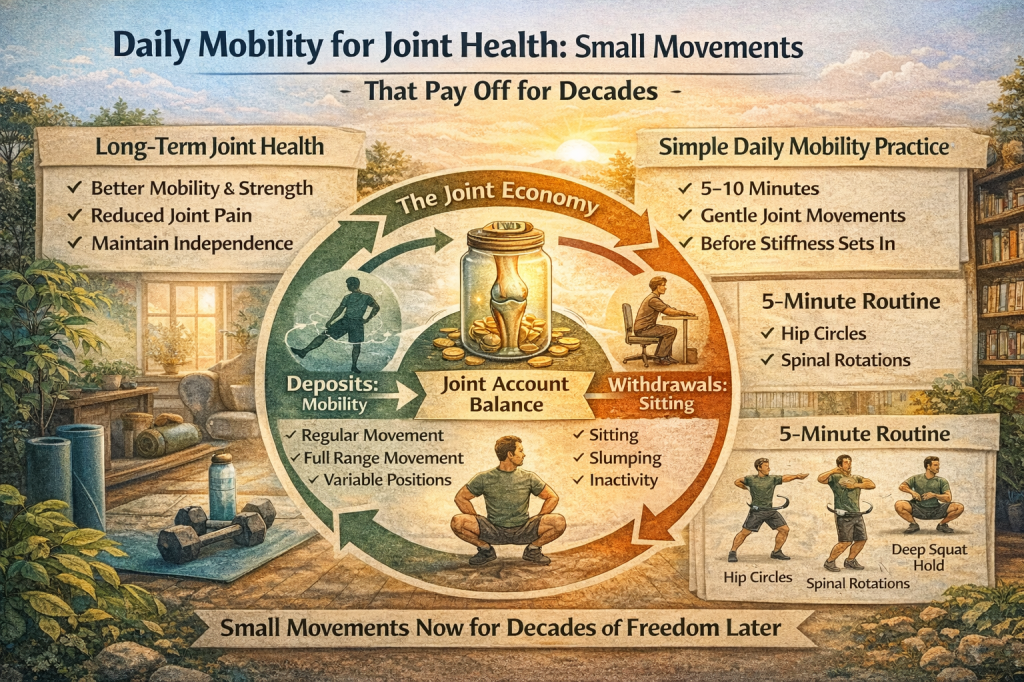
The Joint Economy: Deposits and Withdrawals
Every day, your joints run a balance sheet.
Deposits:
- Gentle movement
- Full-range motion
- Variety of positions
- Frequent low-intensity loading
Withdrawals:
- Prolonged sitting
- Repetitive postures
- High-intensity training without recovery
- Ignoring small discomforts
Most people only notice the account when it’s overdrawn.
Daily mobility is how you stay in surplus.
Why daily beats occasional
Mobility doesn’t respond well to “sessions.”
A long stretch once a week can’t undo six days of immobility. Joints adapt to what they experience most often, not what you do occasionally.
That’s why:
- Five minutes daily beats 45 minutes weekly
- Consistency beats intensity
- Integration beats isolation
Mobility works best when it’s woven into life, not scheduled like a workout.
The real goal of mobility (it’s not flexibility)
Flexibility is passive.
Mobility is usable range of motion under control.
You don’t just want to reach positions—you want to own them.
Good mobility means:
- You can squat without warming up
- You can reach overhead without compensation
- You can rotate without strain
- You feel confident moving through space
This is what protects joints long-term: strength at end ranges, not extreme stretching.
The high-risk joints people ignore
Most joint problems don’t start where the pain shows up.
The usual suspects:
- Hips → affect knees and lower back
- Thoracic spine → affects shoulders and neck
- Ankles → affect knees, hips, and gait
- Shoulders → compensate for poor posture and spinal rigidity
Daily mobility should prioritize these transfer joints—the ones that quietly determine how the rest of your body moves.
Movement is nutrition for joints
Joints don’t have a direct blood supply like muscles. They rely on movement to:
- Circulate synovial fluid
- Deliver nutrients
- Remove waste
Think of motion as lubrication.
No movement → dry joints
Varied movement → resilient joints
This is why small, frequent movements matter more than heroic efforts.
The minimum effective daily mobility practice
You don’t need a routine.
You need a baseline.
A good daily mobility practice:
- Takes 5–10 minutes
- Touches major joints
- Moves through full, comfortable ranges
- Feels refreshing, not exhausting
Examples:
- Hip circles
- Spinal rotations
- Shoulder CARs (controlled articular rotations)
- Ankle dorsiflexion work
- Squat holds
If it feels like “exercise,” you’re probably doing too much.
Mobility is a longevity skill
Loss of mobility is rarely about pain first.
It’s about:
- Avoidance
- Fear of movement
- Shrinking confidence
Once people stop trusting their bodies, activity drops—and everything else follows.
Maintaining joint health preserves:
- Independence
- Travel freedom
- Ability to train
- Daily comfort
This is why mobility isn’t about athletic performance. It’s about keeping options open.
Why sitting is so expensive for joints
Sitting isn’t just inactivity—it’s repetition.
Hours of:
- Hip flexion
- Spinal compression
- Shoulder protraction
- Neck forward posture
The body adapts to what it does most.
Daily mobility acts as a counterbalance, reminding joints that they’re meant to move through more than one position.
Movement snacks vs Mobility sessions
Joint health thrives on:
- Frequency
- Variety
- Low friction
Examples of joint-friendly movement snacks:
- 10 squats while waiting for coffee
- Shoulder circles between meetings
- Hip stretches after sitting
- Ankle mobility while brushing teeth
These add up faster than structured routines—and stick longer.
The Mistake: Waiting for pain
Pain is a lagging indicator.
By the time joints hurt:
- Range of motion is already lost
- Compensations are ingrained
- Nervous system is protective
Daily mobility is preventative maintenance, not rehab.
If you wait until something hurts, you’re no longer investing—you’re repairing.
Mobility and Strength are partners, not rivals
Mobility without strength is unstable.
Strength without mobility is brittle.
The best long-term strategy:
- Strength training for capacity
- Daily mobility for range and resilience
You don’t need more workouts.
You need better distribution of movement across your day.
Designing a Sustainable Mobility Habit
To make mobility last decades, it must be:
- Easy to start
- Hard to skip
- Context-linked
Good triggers:
- After waking up
- After long sitting
- Before sleep
- Before training
- During breaks
Remove the decision. Attach it to existing routines.
The Compounding Payoff
Daily mobility pays dividends you don’t notice immediately:
- Fewer aches
- Better posture
- Easier movement
- More confidence
- Lower injury risk
And one day, years later, you realize:
You move better than people half your age.
That’s the return.
Final thought: Move today for the body you want later
You don’t need perfect joints.
You need joints that keep working.
Daily mobility isn’t flashy.
It won’t impress anyone.
It doesn’t show up in photos.
But it quietly determines how long you stay capable, confident, and free in your body.
Small movements, done daily, pay off for decades.
And like all good investments, the best time to start was yesterday.
The second best time is today.
 VD
VD 
Leave a comment