Deep work doesn’t begin when you sit down to work.
It begins before you try to focus.
Most people treat focus like a switch. You close distractions, open a document, and expect your mind to lock in. When it doesn’t, you assume something is wrong: a lack of discipline, motivation, or willpower.
But focus doesn’t work like a switch.
It works like movement.
You wouldn’t sprint without warming up. You wouldn’t lift heavy without preparation. And yet, every day, we expect the brain to go from notifications, context switching, and low-grade stress straight into sustained concentration.
That mismatch is why deep work feels hard.
The solution isn’t more effort.
It’s better transitions.
Why Focus Feels So Elusive
At any given moment, your mind is usually in one of three modes:
- Reactive mode
Responding to messages, notifications, requests, and small urgencies. - Diffuse mode
Light thinking, daydreaming, wandering attention, mental background noise. - Focused mode
Sustained attention on a single cognitively demanding task.
Deep work requires a deliberate shift into the third mode.
Most people skip that step.
They try to jump directly from reactive or diffuse thinking into focus. The result is friction: rereading the same sentence, checking email “one last time,” organizing files instead of doing the work. It looks like procrastination, but it’s often just an unprepared mind resisting the transition.
The brain isn’t lazy. It’s protective.
Sudden cognitive demand without preparation feels threatening.
This is why motivation-based advice fails. Motivation doesn’t create smooth transitions. Rituals do.
Focus as a State, Not a Trait
We often talk about focus as if it’s a personality trait: I’m good at focusing or I’m easily distracted. In reality, focus is a temporary state, influenced by context, environment, energy, and preparation.
If focus were purely a trait, it wouldn’t fluctuate so dramatically across the day.
You already experience this:
- Some sessions feel effortless
- Others feel like pushing through mud
The difference is rarely discipline.
It’s usually how you entered the work.
This is where mental warm-ups matter.
The Thinking Warm-Up
A mental warm-up is a short, repeatable ritual that prepares your mind for focused work.
Not hype.
Not motivation.
Not elaborate productivity systems.
Just enough preparation to:
- Clear mental noise
- Clarify direction
- Signal that you’re entering a different mode of thinking
Think of it as the cognitive equivalent of mobility work before training. You’re not trying to exhaust yourself. You’re trying to reduce resistance.
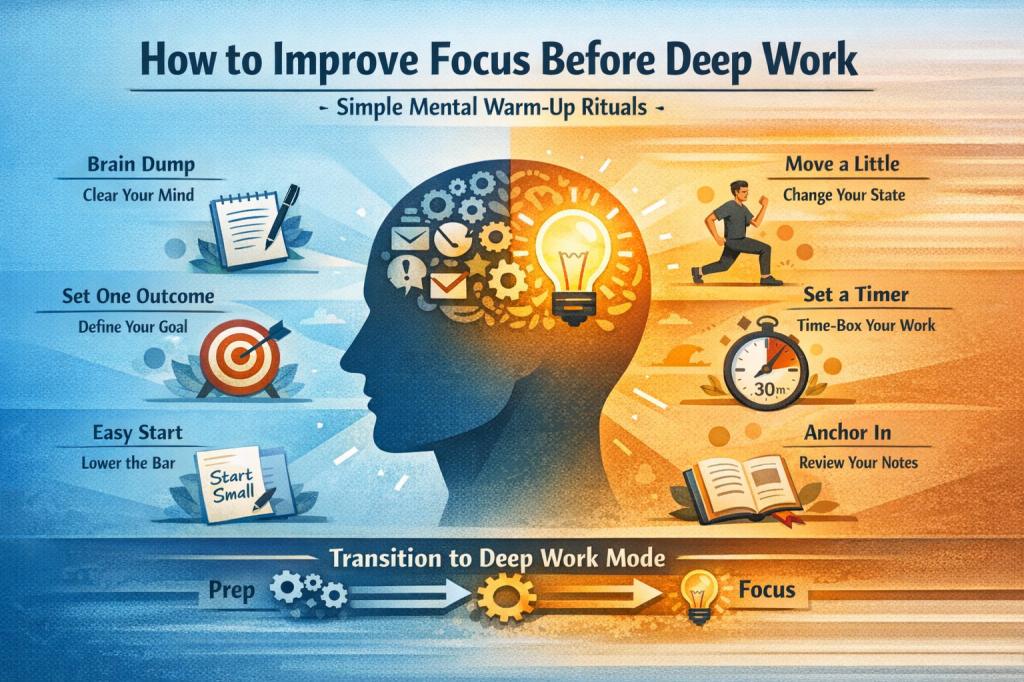
Below are simple warm-up rituals you can mix and match. You don’t need all of them. One or two done consistently is enough.
1. The Brain Dump: Clear the Mental Cache
Time: 2–3 minutes
Before your mind can narrow, it needs to unload.
Open a blank page and write down:
- Everything that’s on your mind
- Open loops, worries, reminders
- Tasks you don’t want to forget
- Anything that might interrupt you later
Don’t organize. Don’t solve. Just extract.
This works because the brain is constantly scanning for unfinished business. When thoughts stay internal, they demand attention. Once they’re externalized, the brain relaxes.
You’re not solving problems.
You’re reducing background noise.
Think of it as clearing RAM before running a heavy program.
2. Define a Single Outcome (Not a Task)
Time: 1 minute
Vagueness is the enemy of focus.
“Work on project” is not focus-friendly.
Neither is “research” or “write.”
Instead, define one concrete outcome for the session:
- “Draft the introduction and outline”
- “Fix the authentication bug”
- “Write 500 rough words without editing”
- “Create three examples”
Clarity reduces cognitive load. The brain resists uncertainty. When it knows what “done” looks like, it’s more willing to engage.
Deep work doesn’t require big goals.
It requires clear ones.
3. Lower the Starting Bar (On Purpose)
Time: 30 seconds
One of the biggest focus killers is starting too ambitiously.
We often expect our first few minutes to be sharp, elegant, and productive. That expectation creates pressure, and pressure creates avoidance.
Instead, deliberately lower the bar:
- Write a bad paragraph
- Open the file and add comments
- Sketch a rough outline
- Re-read what you wrote last time
This bypasses perfectionism and activates momentum.
Depth usually follows action—not the other way around.
4. Change State Through the Body
Time: 2–5 minutes
Mental states are deeply tied to physical ones.
If you’ve been sitting, scrolling, or reacting for hours, your body is in a different mode than deep thinking requires. Trying to focus without changing state is like shifting gears without using the clutch.
Simple physical transitions help:
- A short walk
- Light mobility or stretching
- Standing for the first few minutes
- Slow nasal breathing
You’re not exercising.
You’re signaling a transition.
This mirrors a broader principle you already know from health and longevity: movement precedes clarity.
5. Time-Box the Session
Time: 30 seconds
Open-ended work invites resistance.
Set a clear container:
- 30 minutes
- 45 minutes
- 60 minutes (max)
Tell yourself: I only need to focus until the timer ends.
This creates psychological safety. The brain is more willing to commit when effort feels bounded.
Ironically, shorter time boxes often produce deeper work than long, undefined sessions.
6. Start With a Familiar Anchor
Time: varies
Instead of starting cold, begin with something adjacent:
- Review notes from the last session
- Re-read the last paragraph you wrote
- Skim your outline or problem statement
This reactivates context and lowers the cost of re-entry.
Think of it as warming up with lighter weights before a heavy lift.
Designing Your Personal Focus Ritual
Your mental warm-up should be:
- Short (5–10 minutes total)
- Repeatable
- Boring in a good way
Example:
- Brain dump (2 minutes)
- Define one outcome (1 minute)
- Short walk or breathing (3 minutes)
- Start with a low-bar task
That’s it.
The power isn’t in the individual steps.
It’s in the consistency.
Over time, the ritual itself becomes a cue: this is when focus happens.
Why Rituals Beat Motivation
Motivation is volatile.
Rituals are reliable.
When you rely on motivation, you ask, Do I feel ready?
When you rely on rituals, you ask, What’s the next step?
This is the same principle that applies to:
- Financial independence (systems beat willpower)
- Health and fitness (habits beat intensity)
- Learning (process beats volume)
Focus is no different.
You don’t need to feel ready to do deep work.
You need to be prepared.
Focus Is a Skill You Train Indirectly
The paradox of focus is that trying harder often makes it worse.
Effort helps during the work itself, but preparation determines whether effort is even possible.
Mental warm-ups:
- Reduce resistance
- Shorten time to depth
- Make deep work feel lighter, not forced
Over weeks and months, this compounds. Focus becomes more accessible, not because you’re stronger, but because you’ve removed friction.
The Real Goal: Sustainable Depth
Deep work shouldn’t feel heroic.
It should feel repeatable.
If your system requires constant discipline, it will fail under stress, travel, fatigue, or life changes. If it relies on small, reliable transitions, it adapts.
This is the same logic you apply elsewhere:
- Train for longevity, not exhaustion
- Design finances for flexibility, not extremes
- Learn for application, not accumulation
Focus deserves the same long-term thinking.
Final Thought
The biggest myth about deep work is that it starts with effort.
It doesn’t.
It starts with entry.
Warm up your thinking the way you warm up your body.
Prepare instead of forcing.
Lower friction instead of raising discipline.
Depth will follow.
 VD
VD 
Leave a comment