Modern travel culture rewards novelty.
New countries. New cities. New stamps in the passport. The unspoken metric of a “good” traveler is how many places they’ve been—and how quickly they move on.
But something subtle gets lost when travel becomes a checklist.
The more places you chase, the harder it becomes to actually experience them.
Over time, many travelers discover a counterintuitive truth:
returning to the same destination often delivers more value than constantly seeking new ones.
This is the essence of slow travel—not moving slowly for its own sake, but staying long enough for depth to emerge.
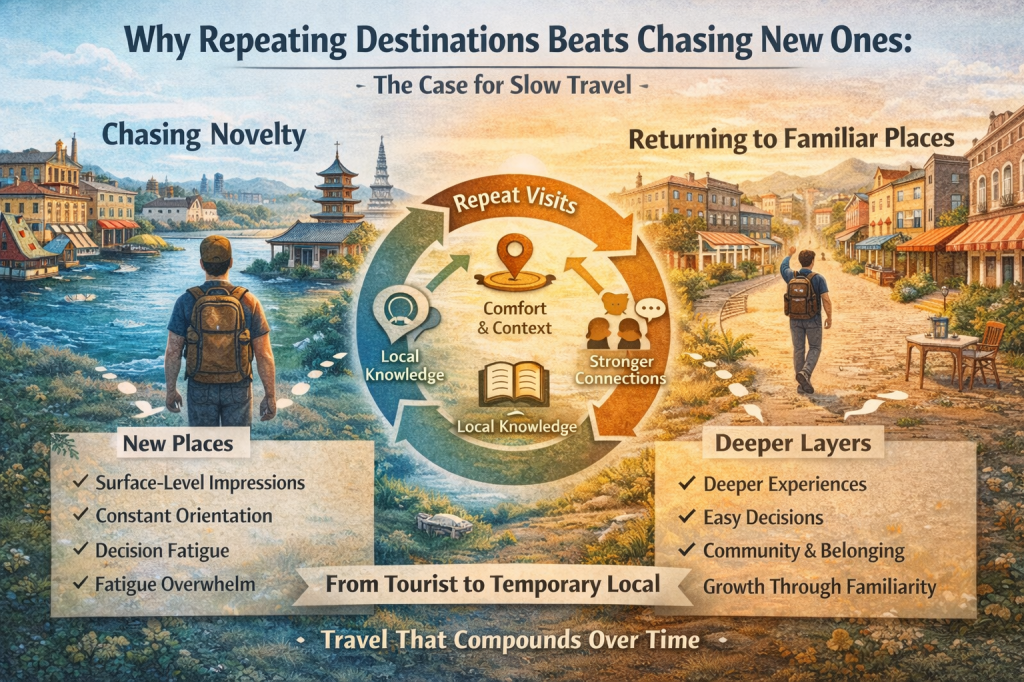
The Hidden Cost of Novelty-Driven Travel
New places are exciting, but novelty has a cost.
Every new destination demands:
- Orientation
- Logistics
- Cultural decoding
- Decision-making
- Constant vigilance
You’re always:
- Figuring out neighborhoods
- Learning transit systems
- Choosing where to eat
- Avoiding tourist traps
This cognitive overhead is invisible—but expensive.
When travel becomes a sequence of first days, you spend most of your energy adjusting, not living.
The result:
- Shallow impressions
- Fatigue disguised as excitement
- Memories that blur together
Novelty feels productive, but it’s often mentally inefficient.
Familiarity is a Force Multiplier
Repeating destinations flips the equation.
Once familiarity sets in:
- Logistics fade into the background
- Decisions become automatic
- Cognitive load drops dramatically
This frees attention for what actually matters:
- People
- Routines
- Nuance
- Presence
Instead of asking Where am I?
You start asking How do people live here?
Depth replaces surface.
The Compounding Effect of Place
Returning to the same place isn’t repetitive—it’s layered.
Each visit adds:
- Context
- Memory
- Emotional texture
- Pattern recognition
You stop seeing a city as landmarks and start seeing it as a system:
- Which streets wake up early
- Which cafés locals use daily
- Which seasons change the mood
- Which rhythms never show up in guidebooks
This is the same compounding logic you already apply elsewhere:
- Reading books more than once
- Building long-term health habits
- Developing skills over years
Why wouldn’t travel compound too?
From Tourist to Temporary Local
The biggest difference between fast and slow travel isn’t speed—it’s identity.
Fast travel:
- You are a visitor
- People respond accordingly
- Interactions stay transactional
Repeat travel:
- You become familiar
- Faces recognize you
- Conversations deepen
Shopkeepers remember you.
Servers stop handing you menus.
Neighbors nod instead of stare.
This shift unlocks experiences novelty never can:
- Invitations
- Local recommendations
- Unfiltered opinions
- Cultural trust
Belonging doesn’t happen on a schedule—but it never happens quickly.
Why Slow Travel Feels More Restorative
Many people travel to “relax,” then return more exhausted than when they left.
That’s not a failure of travel—it’s a failure of pace.
Constant movement keeps the nervous system on alert:
- New sounds
- New risks
- New decisions
Repeating destinations creates psychological safety. Familiar environments lower stress, even if they’re far from home.
This is why people instinctively return to:
- The same beach
- The same mountain town
- The same neighborhood abroad
The body recognizes comfort before the mind explains it.
Decision Fatigue Is the Silent Travel Killer
Every new place demands hundreds of micro-decisions:
- Where to stay
- Where to eat
- How to get around
- What’s “worth it”
Decision fatigue erodes presence.
In repeat destinations:
- Favorite routes are known
- Default cafés exist
- “Good enough” options are already tested
You stop optimizing and start living.
This mirrors your broader philosophy: systems beat constant decision-making—whether in finance, health, or travel.
The Economics of Repeating Places
Slow travel isn’t just richer—it’s often cheaper.
Returning to the same destinations unlocks:
- Long-stay discounts
- Off-season familiarity
- Trusted housing
- Better negotiation leverage
You learn:
- Which areas are overpriced
- When prices spike
- Where value hides
Repeat travelers rarely overpay—not because they’re frugal, but because they’re informed.
Knowledge compounds economically, not just experientially.
Familiar Places Reveal New Versions of You
A new place shows you who you are reacting.
A familiar place shows you who you are becoming.
Returning to the same destination years later reveals:
- How your interests changed
- What you notice now
- What no longer excites you
- What suddenly matters more
The place stays relatively constant.
You don’t.
This makes repeat travel uniquely reflective. It becomes a mirror, not just an escape.
Novelty vs Depth: A False Dichotomy
This isn’t an argument against new places.
It’s an argument against only new places.
The most satisfying travel rhythms often combine:
- A few anchor destinations you return to
- Occasional new places explored slowly
Think of it like reading:
- You reread your best books
- You still discover new ones
Depth and novelty don’t compete—they complement.
Why Repeating Places Builds Better Memories
Counterintuitively, repeating places often creates stronger memories.
Why?
- Context anchors experiences
- Familiarity sharpens contrast
- Small changes stand out
Your memory isn’t overwhelmed by first impressions. It has space to encode nuance.
That’s why:
- A single café can hold dozens of distinct memories
- A familiar walk feels different in different seasons
- The same street carries emotional layers
Novelty gives you moments.
Repetition gives you stories.
Travel as a Skill, not Consumption
Fast travel treats places like content.
Slow travel treats them like teachers.
When you repeat destinations, you develop transferable skills:
- Cultural literacy
- Language intuition
- Social confidence
- Adaptability without stress
These skills compound across locations. The more depth you’ve built somewhere, the easier depth becomes everywhere else.
You’re not just visiting places—you’re upgrading how you travel.
Designing a Repeat-Travel Strategy
If you want to experiment with this approach, start small.
Try:
- Returning to one place you enjoyed instead of choosing a new one
- Staying longer than feels “efficient”
- Visiting during a different season
- Living in a residential neighborhood, not a tourist zone
Ask different questions:
- What does a normal week look like here?
- Where do people go when nothing special is happening?
- What routines would I keep if I stayed longer?
You’re no longer collecting experiences.
You’re building a relationship with a place.
Why this matters beyond travel
The impulse to chase novelty isn’t limited to travel.
It shows up in:
- Careers
- Hobbies
- Learning
- Relationships
Repeating destinations is a reminder of a deeper principle:
depth often beats breadth over time.
The richest experiences aren’t always the newest ones. They’re the ones you return to with more awareness.
Final thought: Travel that grows with you
Chasing new places can be thrilling.
Repeating places can be transformative.
One gives you highlights.
The other gives you texture.
Slow travel isn’t about doing less—it’s about experiencing more of what you already chose.
And in a world obsessed with novelty, choosing depth is quietly radical.
 VD
VD 
Leave a comment