Motivation is unreliable.
It shows up when conditions are perfect and disappears when they aren’t. It spikes after a podcast, fades after a long day, and collapses under stress—the exact moments when consistency matters most.
Yet most advice still assumes motivation is the engine of change.
That’s the mistake.
People who make progress over decades don’t feel more motivated. They build systems that work even when motivation is low.
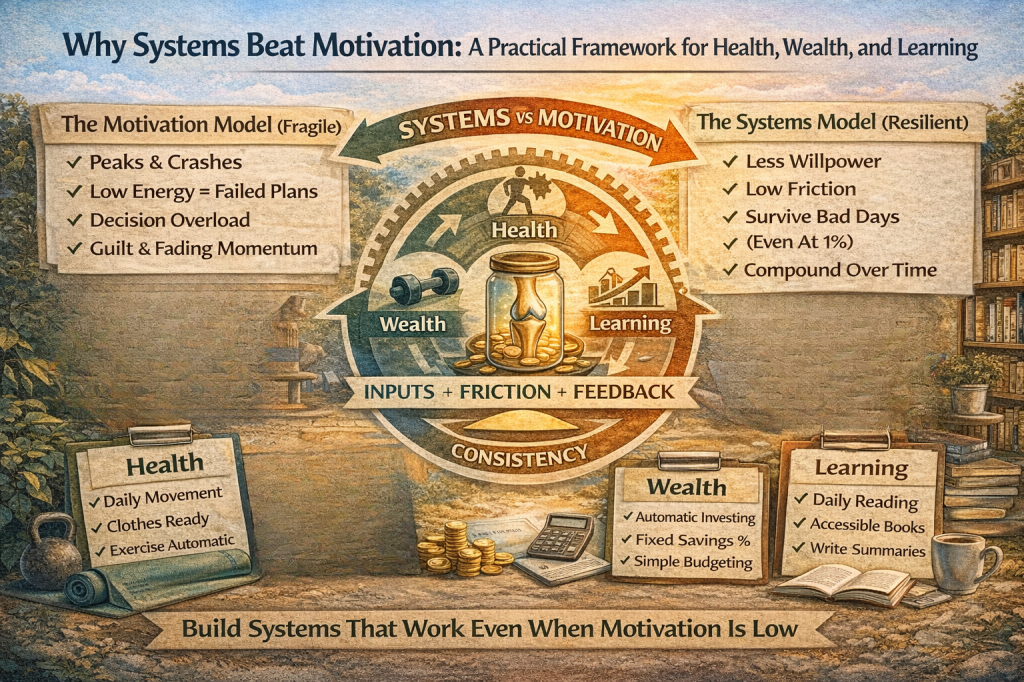
This isn’t just true in one area of life. The same principle governs health, wealth, and learning. When you design systems instead of chasing motivation, progress becomes predictable instead of emotional.
The Motivation Trap
Motivation feels powerful because it’s intense.
But intensity is the wrong metric for long-term results.
Motivation:
- Is reactive
- Depends on mood and energy
- Fails under friction
- Encourages all-or-nothing behavior
This leads to familiar cycles:
- Strong starts
- Inconsistent follow-through
- Guilt during gaps
- “Starting over” again and again
The problem isn’t discipline. It’s architecture.
Systems: The Quiet Advantage
A system is anything that:
- Reduces decision-making
- Lowers friction
- Makes the default behavior the right one
Good systems:
- Operate automatically
- Don’t require willpower
- Survive bad days
- Improve outcomes quietly
Motivation gets credit.
Systems do the work.
Why Systems Win Long-Term
Systems outperform motivation for three reasons:
1. They Reduce Cognitive Load
Every decision drains energy.
Systems pre-decide:
- When
- How
- Where
- Under what conditions
This frees mental bandwidth for deeper thinking instead of constant self-negotiation.
2. They Work at Low Energy
Motivation assumes high energy.
Systems assume:
- Stress
- Fatigue
- Imperfect days
A system that only works when you feel good is not a system.
3. They Compound
Systems scale with time.
Small behaviors repeated daily create non-linear results. Motivation produces spikes. Systems produce curves.
The Unified Framework: Inputs, Friction, Feedback
Across health, wealth, and learning, effective systems share the same structure:
- Inputs – what you regularly do
- Friction – what makes it easier or harder
- Feedback – what reinforces continuation
If any of these break, consistency breaks.
Let’s apply this framework across domains.
Health: Systems Over Workout Motivation
The Motivation Model (Fragile)
- “I’ll work out when I feel like it”
- “I need a full session”
- “If I miss a day, I failed”
Result: inconsistency, guilt, injury cycles.
The Systems Model (Durable)
Inputs
- Daily movement, not workouts
- Minimum viable habits (walks, mobility, short strength)
Friction
- Clothes ready
- No travel time
- Movement integrated into the day
Feedback
- Immediate energy boost
- Reduced pain
- Identity: “I’m someone who moves daily”
This is why movement snacks beat gym motivation.
Wealth: Systems Over Financial Willpower
The Motivation Model (Fragile)
- Manual budgeting
- Periodic savings bursts
- Guilt-driven frugality
Result: burnout, rebound spending, fragile plans.
The Systems Model (Durable)
Inputs
- Automatic investing
- Fixed savings percentages
- Regular income reviews
Friction
- Money moved before you see it
- Fewer spending decisions
- Low fixed costs
Feedback
- Visible net-worth growth
- Reduced financial stress
- Optionality increasing over time
This is why FIRE (Financial Independence, Retire Early) works best as infrastructure, not restraint.
Learning: Systems Over Inspiration
The Motivation Model (Fragile)
- Reading when inspired
- Highlighting without revisiting
- Consuming more than integrating
Result: information overload, shallow retention.
The Systems Model (Durable)
Inputs
- Small daily reading
- Rereading
- Writing or teaching summaries
Friction
- Book always accessible
- Fewer books at once
- Clear reading intent
Feedback
- Better recall
- Clear thinking
- Ideas connecting across domains
This is how learning compounds instead of evaporating.
Why Most People Fail at Systems
Not because systems don’t work—but because they build the wrong ones.
Common mistakes:
- Over-engineering
- Too many rules
- High maintenance
- Dependence on perfect days
A good system is boring, resilient, and slightly underwhelming.
If it feels impressive, it’s probably fragile.
The Rule of Minimum Effective Systems
The best systems answer one question:
What’s the smallest action that keeps the habit alive?
Examples:
- One set instead of a full workout
- One page instead of a chapter
- One automated transfer instead of manual budgeting
Consistency beats intensity every time.
Designing Systems That Survive Life
To last decades, systems must:
- Tolerate interruptions
- Restart easily
- Scale up or down
- Adapt to new seasons
This is why rigid routines fail and flexible systems survive.
Your life will change.
Your systems must expect that.
Identity Is the Hidden System Layer
The most powerful systems don’t feel like discipline.
They feel like identity.
When behavior aligns with self-image:
- Motivation becomes irrelevant
- Consistency feels natural
- Feedback loops strengthen
“I’m someone who…” beats “I should…”
Systems shape identity through repetition—not intention.
The Cross-Domain Advantage
Here’s the real leverage: systems transfer.
Once you learn to:
- Automate finances
- Integrate movement
- Design learning loops
You can apply the same thinking anywhere:
- Relationships
- Career
- Creativity
- Travel
- Recovery
This is why systems thinking is a meta-skill.
Why This Matters Long-Term
Motivation peaks and crashes.
Systems age well.
They:
- Reduce stress
- Increase optionality
- Protect energy
- Enable consistency without heroics
Over time, this creates a quiet but enormous gap between people who rely on motivation and people who design systems.
A Simple Starting Point
If you want to apply this today, pick one domain and ask:
- What’s the smallest daily input that matters?
- How can I reduce friction?
- What immediate feedback can I notice?
Don’t optimize.
Just stabilize.
Final Thought: Design for Low Motivation Days
Your best days don’t define your future.
Your worst days do.
Systems exist for the days when:
- You’re tired
- You’re busy
- You don’t care
Build for those days—and progress becomes inevitable.
Motivation is a spark.
Systems are the engine.
And engines, not sparks, take you where you want to go.
 VD
VD 
Leave a comment