Most people think learning slows down because of lack of time, motivation, or discipline.
In reality, learning plateaus most often happen to smart, curious, self-directed people—the ones who read widely, think deeply, and genuinely care about improving themselves.
They don’t stop learning.
They stop getting better.
This isn’t a willpower problem.
It’s a systems problem.
The Strange Frustration of “Still Learning, Still Stuck”
Early learning feels intoxicating.
You read a book.
You have insights.
You apply a few ideas.
Your thinking sharpens.
Progress feels obvious.
Then, quietly, something changes.
- You keep reading, but ideas blur together
- You recognize concepts, but struggle to explain or apply them
- You consume more, yet feel less clear
- Learning feels busy instead of cumulative
You’re active—but not advancing.
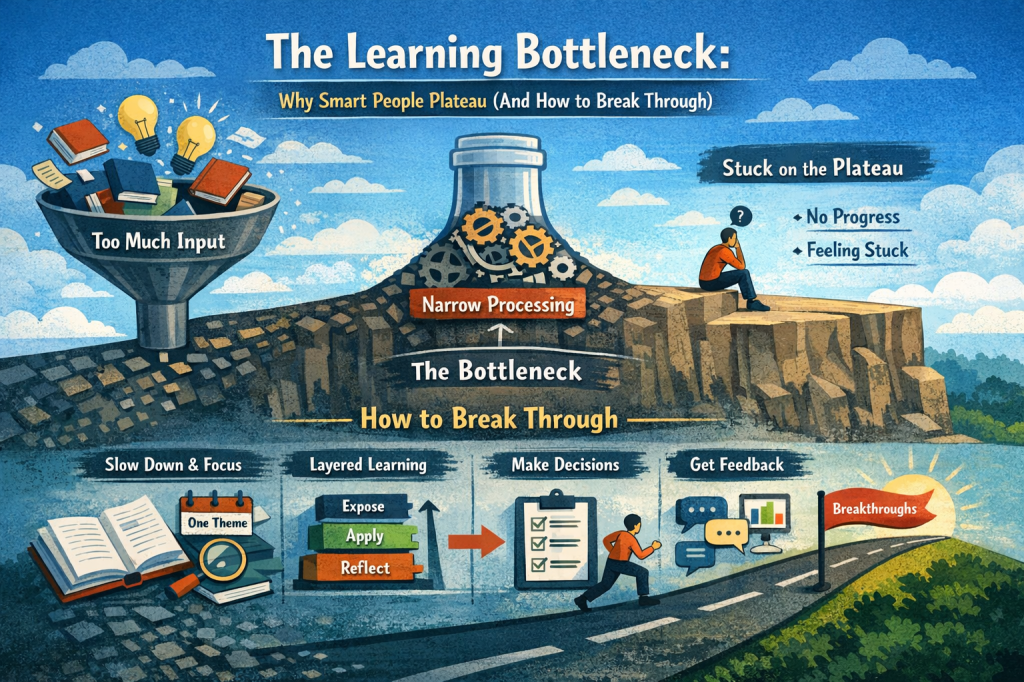
This is the learning bottleneck.
And it’s subtle enough that most people never realize it’s happening.
What the Learning Bottleneck Actually Is
Think of learning as a production system:
- Input → books, podcasts, articles, courses
- Processing → thinking, connecting, testing, reflecting
- Output → better decisions, new skills, changed behavior
Most smart people optimize input.
They read more.
They find better sources.
They consume higher-quality information.
Very few optimize processing.
Eventually, input outpaces processing capacity—and learning stalls.
The bottleneck isn’t information access.
It’s integration bandwidth.
Why Smart People Plateau Faster Than Everyone Else
Ironically, intelligence accelerates the problem.
1. Early success hides structural flaws
High cognitive ability lets you learn quickly without a system—at first. You can absorb patterns intuitively, make connections on the fly, and apply ideas without much structure.
Until volume increases.
What worked at 5 books a year breaks at 30.
2. Recognition masquerades as understanding
Smart readers are excellent at recognizing ideas they’ve seen before.
“That makes sense.”
“I’ve heard this.”
“Yes, exactly.”
Recognition feels like mastery. It isn’t.
If you can’t explain an idea simply or apply it under constraints, it hasn’t been integrated.
3. Breadth outpaces depth
Finance, health, psychology, philosophy, productivity, travel.
Each domain is useful. Together, they create cognitive fragmentation unless deliberately integrated.
Breadth without consolidation creates mental noise, not wisdom.
4. Passive learning dominates
Reading and listening feel productive—and they are, up to a point.
But passive exposure alone doesn’t force your brain to reorganize itself. Without friction, learning remains shallow.
The Real Constraint: Cognitive Carrying Capacity
Your mind has a finite capacity to integrate ideas at any given time.
When you exceed it:
- Retention drops
- Insights decay faster
- Application disappears
- Learning becomes entertainment
This is why consuming more content often leads to less clarity.
You don’t need better sources.
You need better throughput.
Signs You’ve Hit the Learning Bottleneck
You may be plateaued if:
- You remember that you’ve read something, but not what changed
- You reread the same books without new insights
- You collect frameworks but rarely use them
- You feel intellectually “full” but practically unchanged
- You keep preparing and refining—but delay acting
These aren’t personal failures.
They’re signals that your learning system hasn’t evolved.
The Breakthrough Shift: From Volume to Throughput
The solution isn’t learning more.
It’s increasing learning throughput—the percentage of what you consume that turns into usable change.
This requires redesigning how you learn, not what you learn.
1. Slow Down to Speed Up
This feels backward, but it’s foundational:
Learning faster requires learning slower.
Instead of:
- Five books at once
Try: - One book, read deeply
Instead of:
- Constant novelty
Try: - Strategic repetition
Instead of:
- “What should I read next?”
Try: - “What haven’t I integrated yet?”
Depth compounds. Novelty resets.
Most breakthroughs come from revisiting ideas with more context, not discovering new ones.
2. Learn in Layers, Not Streams
Most people learn in streams:
Read → move on → repeat.
High performers learn in layers:
- Exposure – First read, broad understanding
- Compression – Summarize in your own words
- Connection – Link ideas to existing mental models
- Application – Test one behavior or decision
- Reflection – Ask what actually changed
Each layer multiplies retention.
Without layers, learning leaks.
3. Impose Artificial Constraints
Unlimited learning creates shallow learning.
Useful constraints include:
- One active learning theme per month
- One primary book at a time
- One question you’re trying to answer
- One behavior you’re testing
Constraints force prioritization.
Prioritization forces integration.
Paradoxically, less freedom creates more progress.
4. Replace Notes With Decisions
Notes feel productive.
Decisions create change.
After any meaningful learning session, ask:
- What will I do differently this week?
- What belief just shifted?
- What would this look like in practice?
If nothing changes, learning hasn’t occurred—no matter how insightful it felt.
The purpose of learning is not accumulation.
It’s calibration.
5. Build Feedback Loops
Learning without feedback is speculation.
Feedback turns ideas into skills.
Effective feedback loops include:
- Writing publicly (forces clarity)
- Teaching someone else (reveals gaps)
- Testing ideas under real constraints
- Making predictions and reviewing outcomes
Feedback closes the loop between theory and reality.
A Better Mental Model for Learning
Think of learning like strength training:
- Reading = lifting
- Reflection = recovery
- Application = adaptation
If you lift without recovery, you don’t get stronger—you get fatigued.
Learning works the same way.
More volume without integration leads to burnout, not mastery.
The Real Goal of Learning
Not being well-read.
Not collecting frameworks.
Not intellectual identity.
The real goal is better decisions over time.
Learning that doesn’t improve decisions becomes high-quality entertainment—respectable, stimulating, and ultimately stagnant.
Why Plateaus Are a Good Sign
A plateau doesn’t mean you’ve reached your limit.
It means your old learning strategy has paid out.
Beginner systems stop working at intermediate levels.
Intermediate systems fail at advanced ones.
The mistake is assuming the problem is motivation—when the system simply needs an upgrade.
Final thought: Learning is a Skill, not a Trait
Smart people don’t stop improving because they lack ability.
They stop because they keep using systems designed for beginners.
Redesign the system—and progress resumes.
Learning doesn’t plateau.
Systems do.
 VD
VD 
Leave a comment