Most people treat learning like consumption.
They read what’s popular, watch what’s recommended, and jump between ideas based on interest or urgency. The result is a steady stream of information—but surprisingly little long-term change.
Investors would never behave this way with money.
They don’t invest randomly.
They don’t chase every opportunity.
They think in terms of allocation, risk, time horizon, and compounding.
Learning works the same way.
Your attention is capital.
Your time is the holding period.
Your knowledge and skills are the returns.
Once you start treating learning like investing, clarity replaces overload—and growth becomes more predictable.
Attention is the Scarcest Learning Resource
The bottleneck in learning isn’t access to information.
It’s attention.
You can’t read everything.
You can’t follow every idea.
You can’t deeply process unlimited inputs.
Every hour spent learning one thing is an hour not spent learning something else. That trade-off exists whether you acknowledge it or not.
Investors call this opportunity cost.
Learners usually ignore it.
The result is a bloated learning portfolio: lots of exposure, little depth, and weak compounding.
The Difference Between Learning and Investing
Most learning habits resemble day trading:
- Chasing novelty
- Reacting to trends
- Consuming without conviction
- Rarely holding anything long enough to compound
Investing, by contrast, emphasizes:
- Long time horizons
- High-conviction positions
- Selectivity
- Patience
The same shift transforms learning.
Growth doesn’t come from more inputs.
It comes from better allocation.
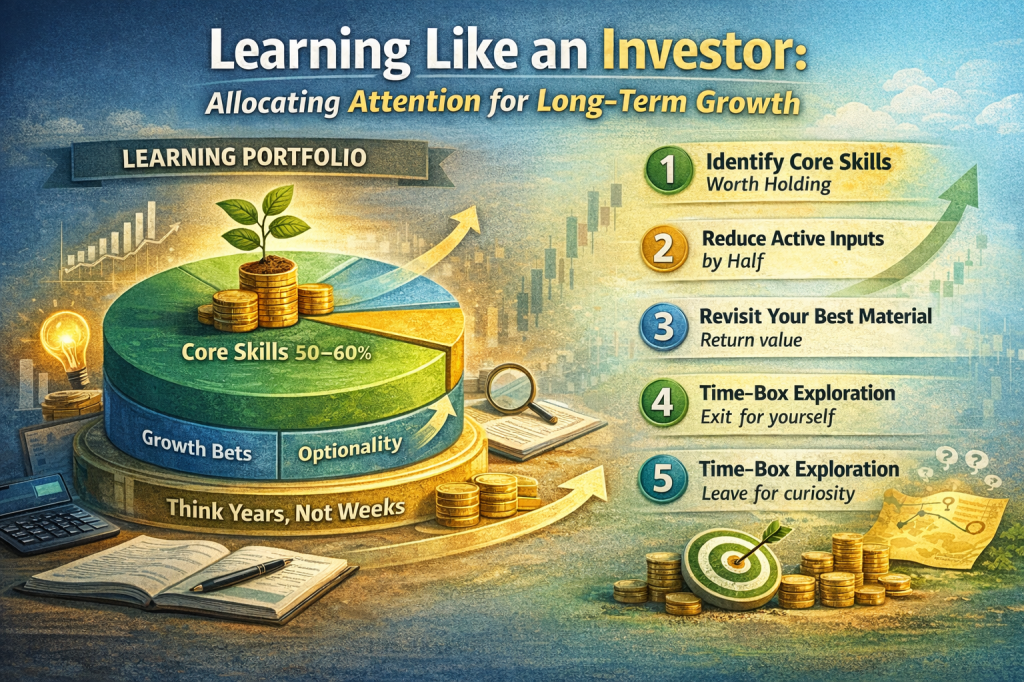
The Learning Portfolio: A Useful Mental Model
Think of your learning like a portfolio with three core buckets:
- Core Holdings – foundational skills and ideas
- Growth Bets – high-upside, uncertain topics
- Cash & Optionality – unstructured curiosity and rest
Most people overload the second bucket and neglect the first.
1. Core Holdings: The Compounding Base
Core holdings are ideas and skills that:
- Apply across domains
- Improve decision-making
- Compound over decades
- Rarely become obsolete
Examples:
- Clear thinking and reasoning
- Writing
- Reading deeply
- Basic economics and incentives
- Health fundamentals
- Learning how to learn
These deserve the largest allocation of attention.
Why core holdings matter
Just like index funds, they don’t look exciting—but they quietly outperform everything else.
They:
- Improve how you interpret new information
- Increase the return on future learning
- Reduce the cost of mistakes
If learning feels scattered, your core allocation is probably too small.
Practical allocation rule
If you learn 10 hours a week:
- 50–60% should go to core skills
- Revisit them regularly
- Re-read the best material instead of constantly seeking new inputs
Repetition is not stagnation.
It’s how compounding works.
2. Growth Bets: High Upside, High Uncertainty
Growth bets are new topics, emerging fields, or unfamiliar skills.
They’re exciting.
They promise leverage.
They’re also risky.
Examples:
- New technologies
- Niche frameworks
- Trend-driven ideas
- Skills outside your current competence
These deserve limited but intentional exposure.
The common mistake
Most people allocate too much here:
- Skimming endlessly
- Jumping between topics
- Never holding long enough to see returns
That’s like constantly buying stocks and selling them after a week.
A better approach
- Take small positions
- Time-box exploration
- Look for signal, not completeness
- Promote only a few ideas to “core” status
Most ideas are optional.
A few are transformational.
Your job is to find the latter without drowning in the former.
3. Cash & Optionality: Leaving Room for Curiosity
Every good portfolio has liquidity.
In learning, this looks like:
- Unstructured reading
- Wandering curiosity
- Periods of rest and reflection
- Not learning anything new at all
This isn’t wasted time. It’s optionality.
It allows you to:
- Notice patterns
- Integrate ideas
- Recover from cognitive overload
- Spot opportunities worth investing in
Ironically, over-optimizing learning kills insight.
Time Horizon Changes Everything
Investors who think in weeks behave very differently from those who think in decades.
The same applies to learning.
Ask yourself:
- Will this matter in 5 years?
- Will I still use this skill in 10 years?
- Does this improve my judgment or just my knowledge?
Long-term learning favors:
- Principles over tactics
- Depth over breadth
- Fewer sources, revisited often
Short-term learning favors:
- Hacks
- News
- Constant updates
Neither is inherently wrong—but confusing the two leads to frustration.
Compounding Requires Holding
Compounding only works if you hold.
In learning, holding looks like:
- Revisiting ideas
- Applying them repeatedly
- Teaching or writing about them
- Letting them reshape how you think
Most people sell too early.
They read a book once, extract a few notes, and move on—before the idea has time to integrate.
The second and third pass are where returns appear.
Diversification vs Diworsification
Diversification reduces risk—up to a point.
Beyond that, it becomes diworsification: spreading attention so thin that nothing compounds.
Signs of over-diversification:
- You read constantly but feel stagnant
- Ideas sound familiar but don’t change behavior
- You can explain concepts but not apply them
A focused learning portfolio feels calmer.
You know what you’re working on—and what you’re intentionally ignoring.
Rebalancing Your Learning Portfolio
Investors rebalance periodically. Learners should too.
Every few months, ask:
- What am I spending most of my learning time on?
- What’s producing real returns?
- What’s just entertainment?
- What deserves a bigger allocation?
- What should be cut entirely?
Cutting is uncomfortable.
It’s also where growth accelerates.
Risk Management in Learning
Some learning carries hidden risk:
- Burnout from overload
- Anxiety from constant comparison
- Shallow knowledge that creates false confidence
Good investors manage downside first.
Good learners do the same by:
- Limiting inputs
- Prioritizing recovery
- Leaving white space
- Avoiding perpetual “beginner mode”
Sustainable learning beats aggressive learning every time.
The Long-Term Advantage
People who learn like investors don’t necessarily learn more.
They learn better.
They:
- Accumulate durable knowledge
- Build rare skill combinations
- Avoid burnout
- Adapt faster over time
Their advantage compounds quietly.
Not because they know everything—but because they invested wisely and held patiently.
A Simple Starting Framework
If you want to apply this immediately:
- Identify 2–3 core skills worth holding for a decade
- Reduce active learning inputs by half
- Revisit your best material instead of chasing new content
- Time-box exploration
- Leave room for rest and curiosity
You don’t need more information.
You need a better allocation.
Final Thought
Learning isn’t about keeping up.
It’s about positioning yourself for long-term growth.
Treat your attention like capital.
Be selective.
Think in years, not weeks.
The returns won’t be obvious at first—but they will compound in ways most people never experience.
 VD
VD 
Leave a comment