Most desk-related injuries don’t begin with pain.
They begin with adaptation.
Your body quietly reorganizes itself around long hours of sitting, screens, and stillness. Nothing feels “wrong” at first. You get work done. You feel productive. Then one day, stiffness appears. Energy dips. A small ache shows up in your neck, hips, or lower back—and doesn’t fully leave.
These are not acute injuries. They don’t come from accidents or obvious trauma. They develop slowly, beneath the threshold of awareness, until they feel inevitable.
They aren’t.
This article is about the hidden injuries of sitting all day—the subtle, compounding changes desk life creates—and how to reverse them early, before they harden into chronic problems.
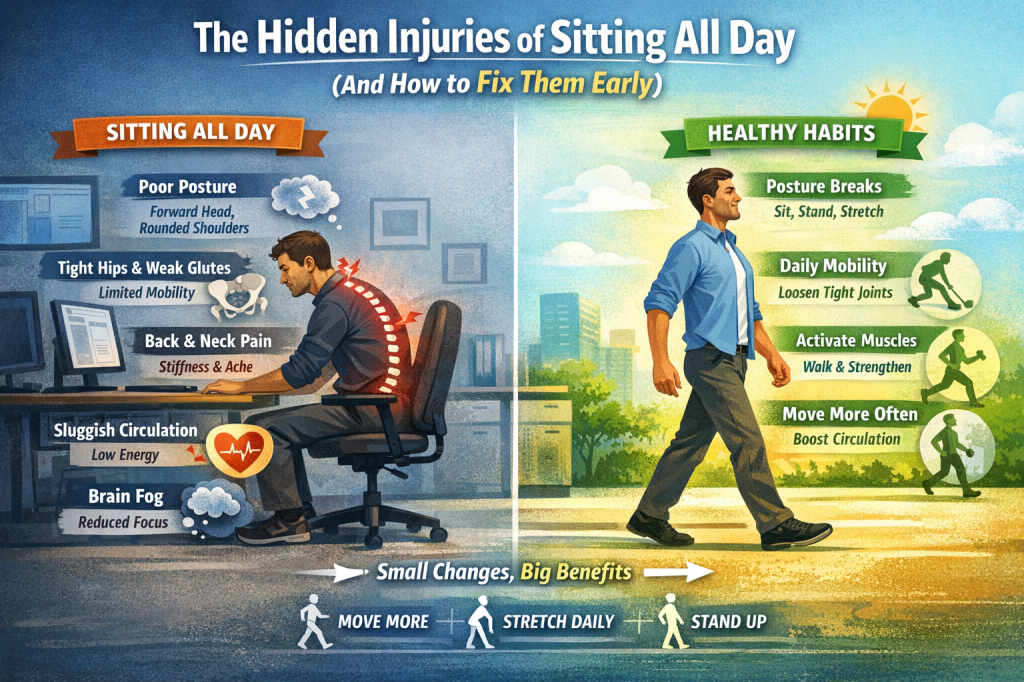
The real issue isn’t sitting – It’s Uninterrupted Sitting
Sitting itself isn’t the enemy. Humans have always rested, squatted, and sat.
The problem is duration without variation.
When you sit for hours at a time:
- Muscles stop contracting
- Joints stop moving through range
- Circulation slows
- Nervous system input narrows
Over time, your body adapts to what it does most. It becomes efficient at stillness.
That efficiency comes at a cost.
The injuries of desk life are rarely dramatic. They are losses of capacity—mobility you no longer use, strength you no longer need, awareness you no longer practice.
1. Postural Drift: When “Neutral” Disappears
One of the earliest and most overlooked injuries of desk life is postural drift.
Your head gradually moves forward.
Your shoulders roll inward.
Your upper back stiffens into a fixed curve.
At first, this posture feels temporary. Then it feels familiar. Eventually, it feels normal.
What’s really happening
Posture isn’t a position—it’s a habit.
Extended sitting shifts load patterns:
- Neck extensors weaken
- Chest and anterior shoulder muscles shorten
- Upper back mobility decreases
- Deep spinal stabilizers disengage
Breathing mechanics often change as well, becoming shallower and more chest-dominant. This increases fatigue and tension even without obvious pain.
Why it matters
Postural drift increases stress on the cervical spine and shoulders, reduces movement efficiency, and narrows your available breathing capacity. Over time, this contributes to headaches, neck discomfort, and chronic upper-body tension.
How to reverse it early
You don’t need perfect posture. You need postural variety.
- Short posture resets every hour (30–60 seconds)
- Gentle thoracic extension or rotation movements
- Occasional floor sitting, kneeling, or standing breaks
The goal isn’t correction—it’s change. Frequent small changes prevent one posture from becoming permanent.
2. Joint Range Loss: Mobility You Didn’t Notice You Lost
Another hidden injury of sitting all day is gradual loss of joint range.
The most affected areas:
- Hips
- Ankles
- Thoracic spine
- Shoulders
You rarely notice this loss because modern life stops asking for it. Chairs replace squats. Cars replace walking. Screens replace reaching and rotation.
Until one day:
- Getting up feels stiff
- Walking feels less fluid
- Simple movements feel constrained
What’s really happening
Joints stay healthy through movement across full ranges.
Without that:
- Cartilage hydration decreases
- Connective tissue stiffens
- Motor control degrades
This isn’t aging. It’s underuse.
How to reverse it early
You don’t need long mobility sessions. You need frequent exposure.
- 2–5 minute “mobility snacks” during the day
- Hip extension and rotation drills
- Ankle dorsiflexion work
- Thoracic rotation done even while seated
Consistency matters more than intensity. Small doses done daily maintain range better than long sessions done occasionally.
3. Muscle Inhibition: Strength Loss You Can’t Feel
Desk life doesn’t just weaken muscles—it teaches your nervous system to ignore them.
Commonly inhibited muscles include:
- Glutes
- Deep core stabilizers
- Upper back musculature
Other muscles compensate, often the ones least suited for the job.
What’s really happening
Your nervous system prioritizes efficiency. If certain muscles aren’t needed, they stop being recruited.
Over time, this leads to:
- Lower back strain
- Neck and shoulder tightness
- Hip and knee discomfort
- Reduced movement confidence
This is why people can “exercise regularly” and still feel fragile.
How to reverse it early
You don’t need heavy training to wake these muscles up.
- Intentional glute engagement during walks
- Light pulling and rowing movements
- Standing up frequently instead of prolonged sitting
- Slow, controlled transitions between positions
Strength isn’t just about force—it’s about availability. Muscles you can’t access don’t protect you.
4. Circulation and Metabolic Drag
One of the most underestimated effects of sitting all day is circulatory stagnation.
Prolonged sitting reduces:
- Blood flow
- Lymphatic movement
- Glucose uptake in muscles
Even regular workouts don’t fully offset long periods of uninterrupted sitting.
What’s really happening
Muscle contraction acts as a pump. When muscles stay still, circulation slows.
Over time, this contributes to:
- Low energy
- Slower recovery
- Increased metabolic risk
- A general sense of sluggishness
How to reverse it early
Movement doesn’t need to be intense to be effective.
- Stand or walk every 30–60 minutes
- Take short walks after meals
- Move lightly between calls or tasks
Think of movement as maintenance, not exercise. Exercise builds capacity; movement preserves function.
5. Nervous System Flattening
One of the least discussed injuries of desk life isn’t muscular or joint-related—it’s neurological.
Screen-based work is visually intense but physically monotonous. The nervous system adapts by reducing sensitivity and responsiveness.
What this looks like
- Brain fog
- Reduced coordination
- Low-grade fatigue
- Difficulty fully relaxing or fully focusing
- Poor sleep quality
Your nervous system thrives on varied input: movement, balance, touch, and changing environments.
How to reverse it early
- Outdoor walks, especially on uneven terrain
- Occasional barefoot movement
- Shifting visual focus between near and far
- Exposure to natural light earlier in the day
Movement isn’t just physical stimulus—it’s neurological nourishment.
Why These Injuries Are Easy to Ignore
These injuries persist because they:
- Develop slowly
- Rarely hurt immediately
- Feel “normal” in desk-based cultures
- Are often mislabeled as aging
But most chronic pain doesn’t start with damage. It starts with adaptation without recovery.
By the time pain appears, the system has already changed.
The Reversal Principle: Small, Early, and Consistent
The encouraging news is that these injuries are highly reversible, especially when addressed early.
You don’t need:
- Perfect ergonomics
- A standing-desk obsession
- Extreme fitness routines
You need movement variability built into your day.
A simple daily framework
- Move briefly every hour
- Change positions often
- Walk daily
- Strength train 2–3 times per week
- Maintain joint range intentionally
This isn’t optimization—it’s insurance.
Health Slack: The concept that changes everything
Think of these habits as building health slack.
Slack is what prevents small stresses from becoming big problems.
Just as financial slack absorbs unexpected expenses, physical slack absorbs:
- Long workdays
- Travel
- Poor sleep
- Periods of stress
Without slack, minor disruptions become injuries.
Desk life doesn’t have to mean body decline
Sitting all day doesn’t doom your health.
Ignoring movement does.
The real danger isn’t your job—it’s assuming that one workout can undo a sedentary day.
The earlier you intervene, the less you’ll need to repair later.
Your future body will never thank you loudly.
But it will move more freely, recover faster, and stay capable longer.
That’s the quiet reward of fixing invisible injuries before they become visible.
 VD
VD 
Leave a comment