Most travel advice optimizes for time and money.
Flights, deals, itineraries, bucket lists.
Very little optimizes for energy.
That’s why so many trips look perfect on paper but feel strangely draining in practice. You come home tired, disoriented, and in need of recovery—sometimes more exhausted than before you left.
The problem isn’t poor planning or lack of motivation.
It’s that most people travel without an energy budget.
Just like money, energy is finite, replenishes slowly, and compounds—both positively and negatively. Sustainable travel isn’t about doing less. It’s about spending energy intentionally so exploration doesn’t turn into exhaustion.
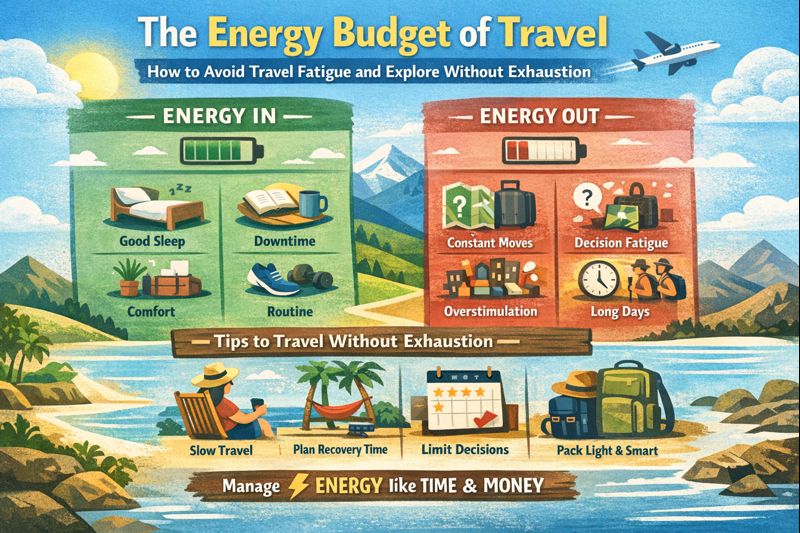
Travel Fatigue is an Energy Problem, not a Willpower Problem
When people feel exhausted while traveling, they usually blame:
- jet lag
- bad sleep
- too much walking
- age
These explanations are incomplete.
The real driver of travel fatigue is unaccounted energy leakage:
- constant decision-making
- unfamiliar environments
- sensory overload
- logistical friction
- frequent transitions
Even enjoyable activities draw from the same limited energy pool.
This mirrors a broader pattern you may recognize from daily life: when energy is ignored, people default to managing time instead. As explored in Energy Management vs Time Management: How to Increase Focus, Productivity, and Avoid Burnout, optimizing schedules without managing energy leads to predictable burnout.
Travel simply makes the problem more visible.
The Energy Budget Framework
Think of each day of travel like a simple balance sheet.
Energy in
- Sleep quality
- Familiar routines
- Low-friction logistics
- Quiet time
- Predictable movement
Energy out
- Walking and physical exertion
- Novelty and unfamiliarity
- Decisions and navigation
- Social interaction
- Packing, transit, and transitions
Travel fatigue occurs when energy outpaces recovery for too many consecutive days.
The goal of sustainable travel isn’t to eliminate energy spending—it’s to avoid chronic deficits that accumulate unnoticed.
Where Most Travelers Overspend Energy
1. Novelty Overload
Novelty is expensive.
New cities, languages, foods, customs, currencies, and transit systems all demand continuous background processing. Even moments that look like “relaxation” still require adaptation.
This explains why:
- short trips often feel disproportionately tiring
- returning to familiar destinations feels easier and more enjoyable
Repetition isn’t laziness—it’s energy efficiency.
Fix:
Treat novelty like a premium expense. Spend it deliberately, not constantly.
2. Constant Movement Disguised as Efficiency
Frequent location changes are one of the highest hidden energy costs in travel:
- packing and unpacking
- check-ins and check-outs
- transit logistics
- recalibrating to new neighborhoods
Moving every two or three days feels efficient. It rarely is.
As seen in Slow Travel: Why Staying Longer Saves Money and Creates Richer Experiences, staying longer doesn’t just improve depth—it dramatically reduces cognitive and physical load.
Fix:
Stay longer than feels optimal. Energy savings compound faster than boredom.
3. Decision Fatigue Masquerading as Freedom
Travel replaces routine with near-constant choice:
- where to eat
- what to see
- how to get there
- whether something is “worth it”
Choice feels empowering at first. Over time, it becomes draining.
This mirrors the core idea behind Why Systems Beat Motivation: A Practical Framework for Health, Wealth, and Learning. When systems disappear, decision fatigue quietly erodes energy.
Fix:
Reintroduce defaults:
- repeat breakfast spots
- fixed walking routes
- “no-decision” mornings
- predetermined rest days
Freedom increases when decisions decrease.
How to Travel Without Exhaustion
1. Budget Energy Before You Budget Money
Before optimizing flights or attractions, ask:
- How many high-energy days can I realistically sustain in a row?
- Where are my built-in recovery points?
- What activities are optional versus non-negotiable?
This approach aligns with the systems mindset in Designing a life that travels well: A Framework for Sustainable, Location-Flexible Living — travel designed as a repeatable lifestyle, not a one-off event.
Energy-aware planning doesn’t reduce adventure. It prevents regret.
2. Reduce Friction, Not Exploration
Comfort is often misunderstood as indulgence. In reality, it’s leverage.
Small friction reductions:
- staying in walkable neighborhoods
- choosing accommodation near daily needs
- packing less
- maintaining familiar movement routines
These changes dramatically lower energy expenditure without reducing experience.
Less friction = more usable curiosity.
3. Embed Recovery During the Trip
Most people delay recovery until they get home. That’s too late.
Recovery should be embedded, not postponed:
- slow mornings
- walking or mobility rituals
- low-stimulation afternoons
- familiar meals
This reflects the broader insight from Recovery is a skill: Why It Doesn’t Happen Automatically (and How to Improve It) — rest doesn’t occur by accident, especially in unfamiliar environments.
4. Travel at the Speed of Adaptation
Your body and nervous system need time to normalize:
- sleep cycles
- movement patterns
- sensory input
When adaptation lags behind movement, exhaustion compounds.
This is why slow travel isn’t just emotionally calmer—it’s physiologically sustainable. The same logic applies to training, learning, and work, as you’ve explored across domains.
A Simple Rule for Sustainable Travel
If you remember one principle, let it be this:
Plan trips around how much energy you want to preserve, not how much you want to see.
A successful trip isn’t measured by:
- landmarks visited
- photos taken
- days packed
It’s measured by how you feel when you return:
- not depleted
- not needing recovery
- still curious
That’s travel that compounds.
Travel is not a sprint. It’s a practice.
The best travelers aren’t the ones who see the most places.
They’re the ones who:
- arrive with energy
- stay present
- leave without burnout
Travel that exhausts you isn’t freedom—it’s consumption.
When travel fits within your energy budget, it stops taking from your life—and starts enriching it.
Related Reading
You may also enjoy:
 VD
VD 
Leave a comment