Most fitness advice is optimized for how you look in the next 12 weeks.
Visible abs. Bigger arms. A lower number on the scale.
Very little of it is optimized for how you’ll move, recover, and function decades from now.
That’s why many people reach their 40s and 50s technically “fit,” yet struggle with joint pain, recurring injuries, declining energy, and workouts that feel harder every year. The issue isn’t effort or discipline. It’s that most training programs are designed around the wrong outcome.
Longevity training starts with a different question:
What kind of body do you want to live in at 60—not just display at 30?
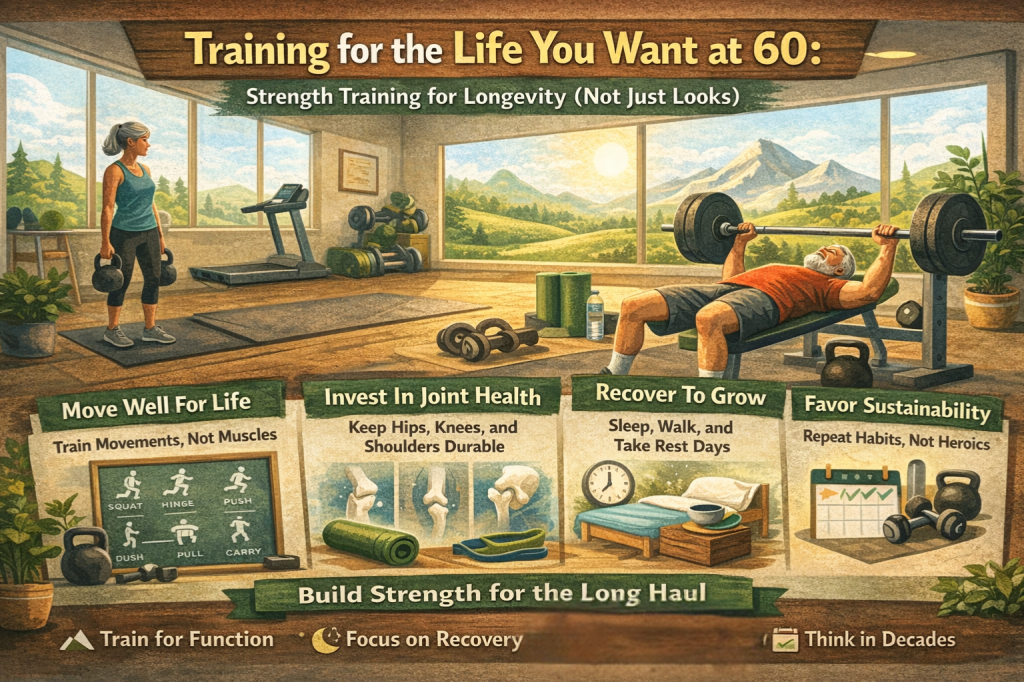
Longevity Training is a Different Game
Aesthetic-focused training prioritizes:
- short-term intensity
- visible muscle
- metabolic stress
- novelty
Longevity-focused training prioritizes:
- joint integrity
- strength retention
- recovery capacity
- consistency over decades
Both approaches can build muscle. Only one builds durability.
The difference mirrors how financial independence works. Short bursts of intensity can produce visible gains, but long-term freedom comes from systems that are sustainable. In the same way that Financial Independence is a Skill, Not a Number, physical independence is a skill built through repeatable habits—not heroic effort.
Why Strength Training Is the Backbone of Longevity
Cardio improves endurance. Mobility improves range of motion. But strength is what preserves independence.
As we age, we naturally lose:
- muscle mass
- bone density
- power output
Without intervention, this leads to:
- increased fall risk
- slower recovery
- reduced confidence in movement
- shrinking activity choices
Strength training is the most reliable way to slow—and partially reverse—this decline. Not by chasing personal records, but by maintaining enough strength to support daily life.
That’s the core idea behind Training for Longevity: How to Exercise for Long-Term Health, Not Just Looks: the goal isn’t peak performance, it’s preserving capacity.
The Real Goal: Physical Optionality
At 60, success doesn’t look like a certain physique.
It looks like optionality:
- lifting luggage without hesitation
- getting up from the floor easily
- hiking, traveling, or playing without fear of injury
- recovering quickly from exertion
Strength expands choices. Weakness quietly removes them.
This mirrors the logic behind The Optionality Playbook: Why Financial Independence Is About Better Choices, Not Early Retirement. In both cases, the win isn’t optimization—it’s freedom.
The Longevity Strength Framework
1. Train Movements, Not Muscles
Longevity training prioritizes fundamental movement patterns:
- squat
- hinge
- push
- pull
- carry
- rotate
These patterns show up everywhere: getting out of a chair, lifting groceries, climbing stairs, traveling, aging.
Exercises will change over time. Movement patterns won’t.
This is why How to Build a Fitness Practice (Not Just a Workout Routine) emphasizes consistency over novelty. A practice adapts with you. A routine breaks when life changes.
Practical shift:
Focus on mastering patterns you’ll need for the rest of your life.
2. Build Strength Before Chasing Intensity
Exhaustion is often mistaken for effectiveness.
But intensity without strength is fragile.
A solid strength base:
- stabilizes joints
- improves movement efficiency
- reduces injury risk
- makes other activities easier
After 30, recovery capacity naturally declines. Ignoring that reality leads to cycles of progress and setback, something explored in How to Train After 30: A Complete Guide to Strength, Mobility, and Longevity.
Practical shift:
Progress loads gradually. Let control and technique lead.
3. Train the Joints You Want to Keep
Muscle adapts quickly. Joints adapt slowly.
Longevity training respects this mismatch.
Key areas that deserve consistent attention:
- hips
- knees
- shoulders
- spine
Joint-focused movement supports long-term resilience and reduces the wear-and-tear effect of modern sedentary life, a theme explored in Daily Mobility for Joint Health: Small Movements That Pay Off for Decades and The Science of Movement: Why Sitting Is the New Smoking.
Practical shift:
Treat joint health as a primary goal, not an afterthought.
Why “Looking Fit” Often Masks Fragility
It’s possible to look strong while being structurally vulnerable:
- limited range of motion
- weak stabilizers
- poor balance
- inconsistent recovery
This is why aesthetic-only training often leads to recurring injuries and plateaus. The body sends warning signs long before breakdown occurs—stiffness, lingering soreness, declining enthusiasm.
Learning to read those signals early is part of staying healthy long-term, as outlined in Your Body’s Dashboard: Early Physical Signs of Burnout You Shouldn’t Ignore.
Longevity training prioritizes signals over selfies.
Recovery is Not Optional
Strength doesn’t come from training itself. It comes from recovering from training.
Without adequate recovery, workouts become physical debt rather than investment.
Key recovery pillars:
- high-quality sleep
- consistent nutrition
- stress regulation
- low-intensity movement
Recovery doesn’t happen automatically, especially as responsibilities increase with age. It has to be practiced intentionally, as described in Recovery Is a Skill: Why It Doesn’t Happen Automatically (and How to Improve It).
Training Volume That Ages Well
The best training plan is the one you can repeat for decades.
Longevity-friendly volume tends to be:
- moderate intensity
- submaximal loads
- consistent frequency
This aligns with the philosophy behind The Minimum Effective Longevity Habits: What Actually Improves Healthspan — doing enough to stimulate adaptation without overwhelming recovery.
A practical baseline for many people:
- 2–4 strength sessions per week
- full-body or upper/lower splits
- leaving 1–2 reps in reserve
Progress comes from consistency, not exhaustion.
Strength Training as an Energy Investment
Strength improves:
- posture
- walking efficiency
- daily movement economy
A stronger body spends less energy on basic tasks. Over time, that adds up.
This is the same principle explored in Energy Management vs Time Management: How to Increase Focus, Productivity, and Avoid Burnout. When energy improves, everything else becomes easier—work, travel, learning.
Strength and Travel Resilience
Travel exposes physical weaknesses quickly:
- long walks
- carrying bags
- disrupted routines
People who train only for appearance feel this acutely.
People who train for function don’t.
Practices like those in Travel Warm-Ups: Simple Routines to Help You Arrive Energized and Avoid Travel Fatigue work best when supported by a foundation of strength. Strength becomes portable insurance.
Redefining Progress After 40
Eventually, progress stops looking like:
- heavier lifts
- higher volume
And starts looking like:
- fewer aches
- faster recovery
- stable performance year-round
This shift reflects what actually matters for healthspan, as discussed in Habits That Matter After 40: What Actually Improves Longevity. Durability beats intensity.
What Training for 60 Actually Looks Like
A longevity-oriented week might include:
- compound lifts with moderate loads
- joint-focused mobility
- walking or zone-2 cardio
- intentional recovery days
Nothing flashy. Everything repeatable.
That’s why simplicity outperforms complexity over time—a theme echoed in Biohacking Simplicity: Small Habits, Big Health Gains.
The Long View
Training for the life you want at 60 isn’t about discipline. It’s about alignment.
When training supports:
- travel
- work
- learning
- independence
…it stops competing with life and starts reinforcing it.
The same principle applies across domains: sustainability always outperforms intensity.
A Simple Test for Any Training Program
Ask:
- Can I do this when life is busy?
- Can I do this when energy is low?
- Can I do this while traveling?
- Can I do this for the next 20 years?
If not, the program is probably optimized for the wrong goal.
Final Thought
The body you want at 30 is optional.
The body you need at 60 is not.
Train accordingly.
 VD
VD 
Leave a comment