From January 9th to 12th, I walked through the forests of Guru Ghasidas National Park in Chhattisgarh.
It wasn’t the longest trek I’ve done.
It wasn’t the hardest.
And it wasn’t the most scenic in the conventional, Instagram sense.
But it was my first solo, multi-day hike, and because of that, it quietly reshaped how I think about self-reliance, energy management, and what “enough” actually means.
The trek began from Raipur — my hometown — which made the experience feel grounded from the start. There was no long-haul travel fatigue, no mental gear-shifting between “home life” and “travel mode.” I stepped into the forest without feeling like I was escaping my life. I was simply extending it.
That detail turned out to matter more than I expected.
Solo Hiking Removes External Regulation
When you hike with others, much of your decision-making is outsourced.
Pace is negotiated.
Breaks are social.
Discomfort is normalized by comparison.
Solo hiking removes all of that.
Every decision becomes yours:
- when to slow down
- when to stop
- when to eat
- when to conserve energy
There’s no audience and no external push. Which means there’s also no one to blame.
Early in the trek, I noticed myself becoming more conservative—not out of fear, but out of clarity. I walked slower than I would in a group. I rested earlier. I paid attention to small signs of fatigue instead of overriding them.
It felt similar to the shift described in Energy Management vs Time Management: when output is self-regulated, sustainability becomes the priority by default.
The jungle didn’t reward pushing harder. It rewarded paying attention.
No Network, No Negotiation With Distraction
This location has no cellphone network.
That meant no messages, no updates, no background pull from the outside world—for four straight days.
What surprised me wasn’t how hard the digital detox felt. It was how quickly it became irrelevant.
Without connectivity:
- checking the phone stopped making sense
- time lost its usual fragmentation
- attention stayed where my body was
There was no deliberate attempt to “disconnect.” Disconnection simply happened as a consequence of the environment.
This kind of forced simplicity mirrors the intention behind Digital Sabbaticals, but with an important difference: there was no discipline involved. When the option disappears, so does the internal negotiation.
The result wasn’t boredom. It was clarity.
Energy is the Real Currency
On paper, treks are measured in kilometers and elevation.
In practice, they’re measured in recoverable energy.
I wasn’t thinking about how far I could go. I was thinking about how fresh I needed to feel at the end of the day—and the next morning.
That meant:
- eating before hunger turned urgent
- stopping before exhaustion
- treating rest as part of the system, not a reward
This mirrors the philosophy behind Training for Longevity and Recovery Is a Skill. Energy spent recklessly today is borrowed from tomorrow. In a multi-day trek, that debt compounds fast.
What stood out was how naturally this mindset emerged once distractions were removed. Without constant inputs, energy regulation became intuitive rather than forced.
The Food Changed My Assumptions
Before the trek, I had already made up my mind about food.
I assumed it would be basic, possibly bland. I even thought of using the trek as an opportunity to eat less and “lean out” a bit.
That assumption didn’t survive the first day.
The food was excellent—simple, nourishing, and deeply satisfying. And instead of restricting, I found myself eating properly, without guilt or overthinking.
It reinforced a lesson that applies far beyond trekking: under-fueling is rarely the right optimization.
Trying to reduce intake while demanding physical and mental output is the same mistake people make when cutting recovery while increasing training volume. You save in the short term and pay through fatigue, irritability, and reduced performance.
Fuel isn’t indulgence. It’s infrastructure—a theme explored in The Minimum Effective Longevity Habits.
Logistics Matter More Than Romanticism
I’ve camped before. I enjoy the idea of self-sufficiency.
But there was something unexpectedly freeing about not having to manage logistics.
Indiahikes handled:
- tents
- cooking
- setup and teardown
That kept cognitive load low. My attention stayed where it mattered—walking, observing, recovering.
Self-reliance doesn’t mean doing everything yourself. It means knowing which responsibilities to offload so your energy goes where it compounds.
The same principle shows up in Why Systems Beat Motivation and Comfort-Optimized Travel: fewer decisions, better outcomes.
Sleeping by the River, Without Buffer or Noise
One night, we slept in sleeping bags right next to the river.
It was my first time doing that.
No walls separating me from the sound of flowing water. No artificial light. Just the steady presence of the river moving through the dark.
Sleep came easily.
Without screens or alerts, the nervous system didn’t need convincing. It powered down on its own.
This felt different from optimizing sleep metrics. It was closer to the kind of rest described in The Sleep Efficiency Blueprint — rest that happens when overstimulation is removed rather than managed.
The Gopad River Walk: Novelty Without Complexity
On the final day, we walked nearly five kilometers inside the Gopad river.
The water was ankle-deep. The current was gentle. The river itself became the trail.
I had never experienced anything like it.
What made it memorable wasn’t difficulty—it was novelty layered onto simplicity. Cold water, slow steps, constant awareness.
This is why new experiences don’t need to be extreme to be meaningful. Sometimes, they just need to be unfamiliar. A theme that echoes Why Getting Lost Improves Memory, Creativity, and Thinking.
A Familiar Scene, Reframed
At one point, I stopped and felt a strange sense of familiarity.
The view—water flowing between two elevated landforms—reminded me of Banff.
When I lived in Toronto, a trip to Banff left a deep impression on me: dramatic lakes framed by mountains, a sense of scale that resets perspective.
This felt similar.
The contrast was instructive:
- Banff’s mountains were rocky and exposed
- These hills were dense with trees
- Banff required international travel and significant expense
- This trek started from my hometown and cost roughly one-tenth
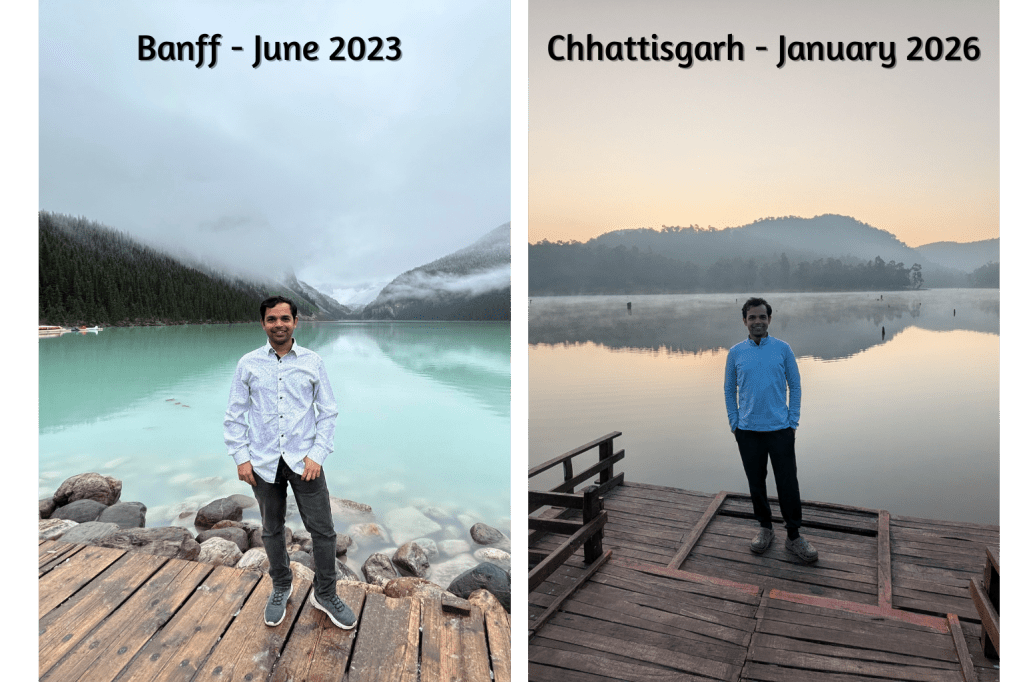
It was a quiet reminder that awe isn’t exclusive to expensive destinations. Sometimes, it’s a function of attention and proximity—a pattern explored in The Return on Travel and Slow Travel.
Solo Doesn’t Mean Lonely
I didn’t feel lonely on this trek.
I felt undistracted.
Without constant conversation or connectivity, the mind initially tried to fill the space. Then it stopped trying.
Awareness widened:
- breathing adjusted naturally
- pace stabilized
- thoughts softened
This is the same mental settling that happens during deep reading or long walks—decluttering rather than withdrawal. A state familiar from The Literature Gym and long-form focus practices.
Carrying Less Creates Slack
Physically, I carried less than expected.
Mentally, I carried even less.
Limited gear. Limited options. Limited contingency planning.
Instead of creating anxiety, this created slack. Decisions were simpler. Expectations were lower. Attention expanded.
Slack isn’t waste. It’s resilience—whether in finances, health, or travel. The same logic appears in Why FIRE Isn’t Sustainable Without Financial Slack and The Psychology of Enough.
What Self-Reliance Actually Means
The biggest outcome wasn’t confidence. It was trust.
For four days, I trusted:
- my judgment
- my pacing
- my ability to respond to discomfort
Self-reliance wasn’t about toughness. It was about regulation.
This is the same skill required in long-term FIRE (Financial Independence, Retire Early) journeys, sustainable training, or building learning systems. You don’t force your way through decades. You calibrate.
This Was a Prototype, Not a Peak
I didn’t come back wanting harder treks.
I came back wanting more environments that remove noise and reward attention.
This trek wasn’t an escape. It was a prototype—a small experiment in how little structure is needed to feel grounded, capable, and energized.
That’s a skill worth training:
- on the trail
- in finances
- in health
- in daily life
And like all skills that compound quietly, it starts with paying attention.
 VD
VD 
Leave a comment