Most people read more books than ever—and remember less from them than they expect.
The problem isn’t intelligence or effort. It’s not even distraction. It’s that most reading creates too little resistance.
Some books slide through your mind smoothly, feel pleasant, and vanish weeks later. Others slow you down, irritate you slightly, force you to stop and rethink—and stay with you for years.
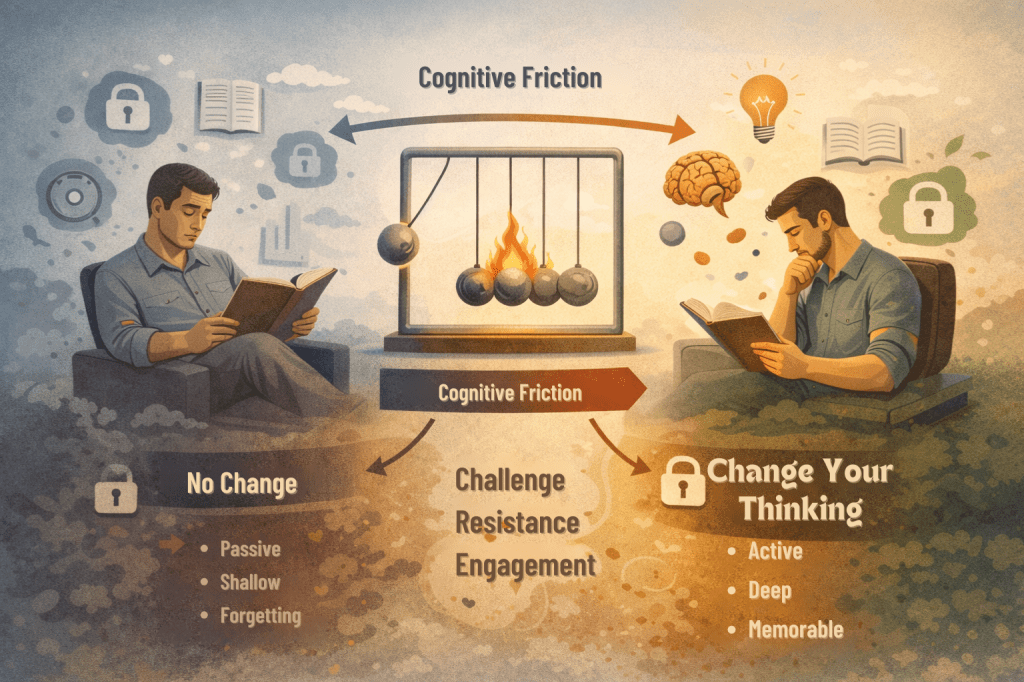
The difference is cognitive friction.
This post explains why friction is the missing ingredient in transformative reading, how to recognize it, and how to deliberately create it—without turning reading into work.
The Illusion of Progress in Reading
Modern reading culture optimizes for volume:
- More books per year
- Faster reading speeds
- Longer lists
This mirrors what I described in Idea Carrying Capacity: accumulating information faster than you can integrate it creates the feeling of learning without the substance.
Reading feels productive because it’s easy to measure. Finishing books is visible. Understanding is not.
Just as FIRE (Financial Independence, retire Early) progress can feel slow when you focus on the wrong metrics (as explored in Why Your FIRE Progress Feels Slow), reading progress feels satisfying even when little changes internally.
Transformation requires something else.
What Is Cognitive Friction?
Cognitive friction is the mental resistance you experience when new ideas collide with existing beliefs, habits, or mental models.
It shows up as:
- Discomfort
- Confusion
- Slower reading
- The urge to reread a paragraph
- The impulse to argue with the author
This friction is not a flaw. It’s the signal that learning is happening.
Books that change you don’t just inform you—they interfere with how you already think.
Why Most Books Don’t Create Friction
Many books are designed to reduce friction:
- They repeat familiar ideas
- They confirm existing beliefs
- They explain concepts smoothly
- They avoid ambiguity
This makes them enjoyable—and forgettable.
It’s similar to the distinction I made in The Learning Bottleneck: growth stalls not because of lack of input, but because the input no longer challenges your existing framework.
Frictionless reading is consumption, not construction.
The Types of Books That Create Cognitive Friction
Not all friction feels the same. Books that change your thinking often generate one (or more) of these forms:
1. Framework Friction
These books introduce a way of thinking that reorganizes familiar facts.
You recognize the information—but the structure is new.
This is why books like those discussed in Books That Changed How I Think About Money and Independence linger. They don’t add facts; they rearrange meaning.
2. Value Friction
Some books challenge what you optimize for:
- Time vs money
- Comfort vs growth
- Efficiency vs meaning
This kind of friction often produces defensiveness first—and clarity later. I’ve seen this pattern repeatedly in reader responses to The Psychology of Enough.
3. Identity Friction
The strongest books quietly question who you think you are.
They suggest:
- You might be wrong
- You might be optimizing the wrong thing
- You might be capable of more—or less—than you assumed
This is why these books are often reread, not skimmed. As explored in Learning in Layers, meaning unfolds over time.
Why Friction Improves Memory
Cognitive friction strengthens memory by forcing active engagement.
When reading is effortless:
- Attention drifts
- Comprehension stays shallow
- Recall decays quickly
This aligns with the forgetting dynamics discussed in How to remember more of what you learn and How to Retain More From What You Read.
Friction slows reading—but deepens encoding.
The goal isn’t to struggle constantly. It’s to struggle selectively.
How to Tell If a Book is Worth Your Friction
A simple diagnostic question:
Does this book force me to pause and think differently?
Other signals:
- You reread passages without trying
- You feel the urge to explain the idea to someone else
- You notice contradictions with your current beliefs
- You feel mild irritation or resistance
If none of these appear after 50–100 pages, the book may still be enjoyable—but it’s unlikely to be transformative.
This is why owning fewer, better books often makes readers smarter, as argued in How to Learn More From Books: Why Owning Fewer Books Can Make You Smarter.
How to Increase Cognitive Friction (Deliberately)
You don’t need harder books. You need better interaction.
Read Slower at the Right Moments
Speed is useful for scanning. Slowness is essential for insight.
Pause when:
- An idea feels unfamiliar
- A claim feels wrong
- A sentence reframes something you thought you understood
This selective slowing mirrors the approach in The 3-Pass Reading System.
Argue With the Author
Don’t highlight—interrogate.
Ask:
- What assumptions does this rely on?
- Where would this fail?
- What evidence would change my mind?
This practice transforms passive reading into dialogue, similar to the habits described in Marginalia Magic.
Revisit Instead of Replacing
Rereading compounds insight.
The second pass often reveals implications you missed. The third reveals yourself. This layering effect is central to The Reading Flywheel.
Friction vs Fatigue
More friction isn’t always better.
Too much cognitive strain leads to fatigue, not learning. This is the same dynamic I explored in Idea Carrying Capacity: overload reduces effectiveness.
The goal is optimal friction:
- Enough resistance to force engagement
- Enough clarity to maintain momentum
This balance shifts over time—and improves with practice.
Reading as a Long-Term Skill
Reading well is not about technique alone. It’s about judgment.
Judgment in:
- What to read
- When to read it
- When to stop
- When to return
This mirrors Financial independence is a skill, not a number — a theme I’ve explored repeatedly. Good readers, like good investors, allocate attention where it compounds.
A Simple Cognitive Friction Checklist
When choosing or continuing a book, ask:
- Does this challenge how I think—or just confirm it?
- Am I slowing down naturally?
- Do I feel mild resistance?
- Can I articulate one idea that changed my perspective?
If the answer is yes, keep going.
If not, move on—without guilt.
Final Thought
Books don’t change people.
Friction does.
The books that shape your thinking are rarely the smoothest or most entertaining. They’re the ones that interrupt your mental autopilot.
Read for comfort when you need rest.
Read for friction when you want to grow.
Knowing the difference is the real reading skill.
 VD
VD 
Leave a comment