Most people return from a trip with photos, souvenirs, and a faint sense that something meaningful happened—but they’re not quite sure what it was.
The memories fade. The routines reassert themselves. A few weeks later, the trip becomes a highlight reel rather than a lived experience that changed how you think.
Travel can be transformative, but it isn’t automatically so. Like reading books or pursuing financial independence, the value of travel depends on what you carry forward, not just what you consume.
This post is about building a mental carry-on—a lightweight system for traveling with ideas, insights, and perspective, not just luggage.
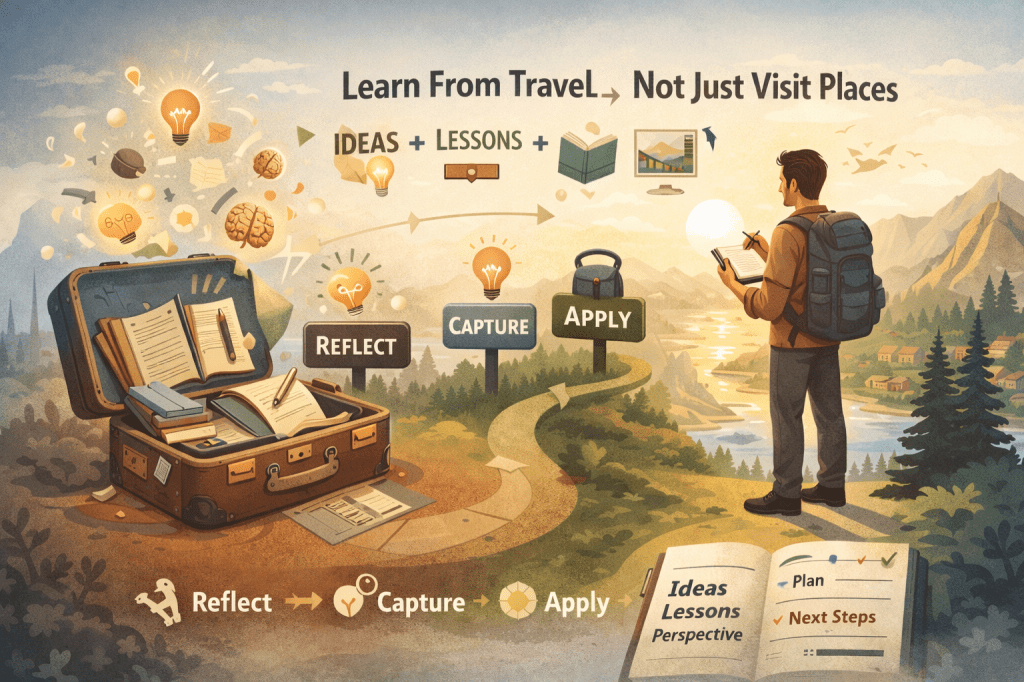
Travel Has a Return—If You Know Where to Look
I’ve written before about The Return on Travel and Travel That Pays You Back. The core idea is simple: travel is not just an expense or indulgence. Done well, it produces long-term returns in judgment, adaptability, and self-knowledge.
But like investing, returns aren’t guaranteed.
You can visit dozens of countries and learn very little—or you can revisit the same place and extract deeper understanding each time. This is why Why Repeating Destinations Beats Chasing New Ones resonates with so many travelers. Depth beats novelty.
The difference isn’t itinerary quality. It’s attention.
The Problem With “Consumption-Style” Travel
Most modern travel is optimized for consumption:
- See as much as possible
- Capture everything
- Move fast
- Optimize for highlights
This creates stimulation, but not necessarily learning.
Just as binge-reading without reflection leads to shallow understanding (a theme I explored in Idea Carrying Capacity), rapid travel without integration overwhelms the mind. Experiences pile up, but insights don’t consolidate.
Learning requires friction, contrast, and pauses.
Travel removes you from your normal environment—but unless you add reflection, your brain treats it as entertainment rather than education.
The Mental Carry-On Concept
A mental carry-on is the set of ideas, questions, and perspectives you deliberately bring home from a trip.
It’s small by design.
Instead of trying to remember everything, you focus on:
- A few observations
- One or two reframed beliefs
- Specific contrasts with your normal life
This mirrors the philosophy behind Minimalist Packing. Just as lighter luggage reduces friction, lighter mental baggage increases clarity.
The goal is not to document the trip—it’s to distill it.
Before You Go: Pack Questions, Not Expectations
Most people travel with expectations:
- This place will relax me
- This trip will inspire me
- This culture will feel different
Expectations narrow perception.
A better approach is to travel with questions. Questions keep the mind open and attentive.
Examples:
- What do people here optimize for that I don’t?
- What feels easier here—and what feels harder?
- How does daily life shape behavior?
This approach aligns with Learning Like an Investor, where attention is allocated deliberately rather than reactively.
You’re not trying to judge the place. You’re trying to understand it.
During the Trip: Slow the Experience Down
Learning from travel requires slowing down—not necessarily the itinerary, but your interaction with it.
Repeat, Don’t Rush
Revisiting the same café, walking the same route, or returning to a familiar neighborhood reveals patterns you’d miss otherwise. This is one reason Slow Travel produces richer insights than checklist tourism.
Patterns are where learning lives.
Notice Friction
Pay attention to what feels uncomfortable or inefficient:
- Communication gaps
- Social norms
- Bureaucracy
- Daily logistics
Friction reveals assumptions you didn’t know you had. This ties closely to the ideas in Why Getting Lost Improves Memory, Creativity, and Thinking—disorientation forces awareness.
Capture, Don’t Chronicle
Avoid detailed journaling or constant note-taking.
Instead, capture:
- One sentence observations
- Short contrasts
- Questions worth revisiting
Think of this as just-in-time learning, similar to the approach in Just-in-Time Learning: Why Timing Matters More Than Volume.
The Most Valuable Souvenirs Are Comparisons
The deepest learning from travel comes from comparison.
Not “this is better” or “this is worse,” but:
- Why does this work here?
- What trade-offs are being made?
For example:
- Cities that prioritize walkability often trade speed for social density
- Cultures with long lunches may sacrifice efficiency for connection
These observations sharpen judgment. They also influence life design choices—where to live, how to work, what to optimize for. I’ve explored this in Designing a Life That Travels Well and Geographic Flexibility as Wealth.
After You Return: Integration Is Where Value Compounds
The real work begins after you get home.
Without integration, travel insights decay quickly—just like unread book highlights or forgotten notes.
Create a Short Debrief
Within a week of returning, write a one-page debrief:
- Three observations
- One belief that changed
- One habit you want to test
This mirrors the reflection loops described in The Reading Afterlife.
Test One Change
Travel insights become real only when tested.
Examples:
- Adjust your daily schedule
- Change how you move through your city
- Modify how you work or rest
This is lifestyle prototyping—using small experiments to explore alternatives, as discussed in Lifestyle Prototyping.
Let Go of the Rest
You don’t need to preserve every insight.
Keeping too much creates cognitive clutter, a problem I addressed in Idea Carrying Capacity. Retain what’s useful. Release the rest.
Travel as a Learning System, Not an Escape
When treated intentionally, travel becomes part of a broader learning system.
It complements:
- Reading
- Experimentation
- Reflection
This is why some of the most enduring benefits of travel show up months later—in changed preferences, refined standards, and better decisions.
Travel doesn’t have to be constant or extreme. Even short trips can produce insights if approached deliberately. This aligns with the philosophy behind Micro-Adventures and Travel That Pays You Back.
The Goal Is Perspective, Not Permanence
Travel won’t turn you into someone else.
Its value lies in showing you options—different ways of structuring days, relationships, and priorities. This optionality is a recurring theme in my writing, from The Optionality Playbook to Future-Proofing Your Lifestyle.
You don’t need to adopt everything you observe. You just need to know alternatives exist.
A Lightweight Mental Carry-On Checklist
If you want a simple system:
Before:
- Pack 2–3 guiding questions
During:
- Repeat places
- Notice friction
- Capture short observations
After:
- Write a one-page debrief
- Test one small change
That’s enough.
Final Thought
Most trips are remembered. Fewer are integrated.
The difference isn’t distance, budget, or novelty. It’s intention.
Travel well, and you don’t just return home—you return with better questions, clearer preferences, and a wider map of how life can be lived.
That mental carry-on is lighter than souvenirs—and far more valuable.
 VD
VD 
Leave a comment