Modern work looks physically effortless.
You sit. You type. You think.
No heavy lifting. No visible strain. No sweat.
And yet many desk workers end the day feeling depleted in a way that’s hard to explain—tight neck, shallow breathing, wired-but-tired, mentally sharp but physically dull. Not injured. Not sick. Just… taxed.
This isn’t a motivation problem.
It isn’t just a posture problem.
And it isn’t simply “stress.”
It’s a nervous system problem.
Focused desk work places a real, cumulative load on your nervous system—one that most people never account for, because it doesn’t announce itself loudly. Over time, this invisible cost shapes your energy, recovery, sleep, and long-term health in ways that are easy to miss until something breaks.
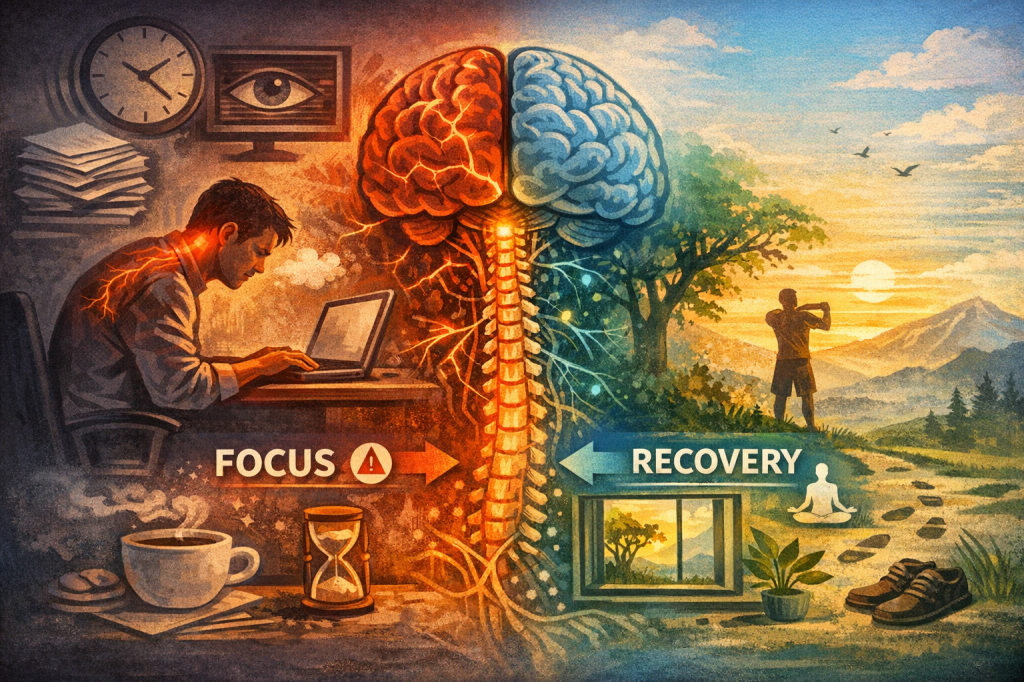
Focus is a Full-Body State, Not a Mental One
We usually think of focus as something that happens in the brain.
In reality, deep focus is a whole-body configuration.
When you concentrate—on code, writing, spreadsheets, or problem-solving—your body subtly shifts:
- Muscle tone increases, especially in the neck, shoulders, jaw, and hips
- Breathing becomes shallower and more restricted
- Eye muscles lock into near-field vision
- Movement drops toward zero
Neurologically, this corresponds to sympathetic nervous system dominance—the same system involved in vigilance, threat detection, and action.
This is not a flaw. It’s how humans evolved to concentrate.
The issue is duration.
Your nervous system evolved for bursts of focus, followed by movement, scanning, and recovery. Desk work demands hours of sustained activation without physical resolution. The system turns on—but never fully turns off.
Desk Work is low-grade Fight-or-Flight
You’re not being chased by a predator.
But from your nervous system’s perspective, prolonged desk work looks like:
- Sustained vigilance
- Narrow sensory input
- Minimal movement
- Continuous cognitive demand
This keeps the system subtly “on.” Not enough to trigger panic—but enough to prevent true downregulation.
The result is a familiar modern state:
- productive but drained
- mentally alert but physically tense
- exhausted without having “done anything physical”
This is why desk fatigue feels different from physical fatigue. After a long hike or strength session, the body is tired but calm. After a long day of focus, the body is tense and restless.
It’s neural load, not muscular exhaustion.
This same mismatch—between what a system evolved for and how we now use it—shows up repeatedly in modern health. I’ve explored this elsewhere in The Science of Movement: Why Sitting Is the New Smoking and Digital Posture: How Screens Reshape Your Body (and How to Fix It Fast). Desk work compresses movement, posture, vision, and breath into a narrow band—and the nervous system pays the price.
The Hidden Physical Costs of Cognitive Work
Because desk work doesn’t look demanding, its costs accumulate quietly.
1. Static Muscle Tension Without Release
Prolonged sitting creates continuous low-level muscle activation, especially in the neck, upper back, hip flexors, forearms, and jaw.
Unlike dynamic movement, static tension:
- restricts blood flow
- reduces sensory feedback
- prevents muscles from fully relaxing
The nervous system stays alert, but the body never gets a clear signal of completion. Over time, this contributes to the “background tightness” many desk workers accept as normal.
This pattern mirrors what I described in The Hidden Injuries of Sitting All Day (and How to Fix Them Early)—damage doesn’t come from dramatic strain, but from unresolved load.
2. Breathing that Never Fully Resets
Focused work narrows breathing almost automatically:
- shorter inhales
- incomplete exhales
- reduced diaphragm movement
This reinforces sympathetic dominance. You are, in effect, telling your nervous system: Stay ready.
Over hours and days, this becomes baseline.
This is why techniques discussed in Posture, Breath, and Walking: Three Simple Habits That Improve Health and Longevity are so effective—not because they’re magical, but because they restore signals of safety the nervous system understands.
3. Sensory Deprivation in a Sensory-Rich World
Screens compress experience:
- fixed-distance vision
- limited peripheral awareness
- repetitive sound and tactile input
The nervous system evolved in environments rich with variation. When input narrows, internal noise increases. Restlessness, irritability, and mental fatigue aren’t signs of weakness—they’re signs the system is under-stimulated and overworked at the same time.
This paradox shows up frequently in knowledge work: high cognitive demand layered on low sensory diversity.
4. Recovery Debt that goes Unnoticed
Because desk work doesn’t feel physical, most people don’t actively recover from it.
Work ends, but the body doesn’t:
- more sitting
- more screens
- more near-field focus
The nervous system never gets a clear “threat resolved” signal.
I’ve written about this pattern in Recovery is a skill: Why it doesn’t happen automatically—rest isn’t just absence of work. It’s an active biological process that requires specific inputs.
Why this accumulates as burnout (not injury)
Desk work rarely causes dramatic breakdowns.
Instead, it produces low-grade dysregulation:
- sleep that’s long enough but not restorative
- workouts that feel harder than they should
- reduced stress tolerance
- minor aches that never fully resolve
This is why burnout feels confusing. There’s no single failure point—just many small costs left unaccounted for.
It’s similar to financial stress. In Why FIRE Isn’t Sustainable Without Financial Slack, I argued that systems fail when there’s no buffer. The nervous system is no different. When every day runs at near-capacity, resilience disappears.
Focus isn’t the Problem – Lack of Resolution is
The solution isn’t less focus.
Focus is valuable. Deep work matters.
The issue is that every activation state requires an off-ramp.
Your nervous system needs clear signals that effort has ended and safety has returned. Without those signals, it stays semi-activated long after work is done.
This is where most productivity advice fails. Optimizing focus without designing recovery simply shifts the cost downstream—often into sleep, health, or mood.
A better framing:
Desk work has an energy cost.
Just like travel, training, or learning.
In Energy Management vs Time Management, I argued that productivity breaks when energy is treated as infinite. Desk work is a prime example.
What the Nervous System actually responds to
Recovery doesn’t require extreme interventions. It requires biologically meaningful signals.
The nervous system responds to:
- movement with variability (not just stretching)
- expanded vision (looking far away, peripheral awareness)
- breathing that fully exhales
- postural change, not perfect posture
- clear transitions between work and non-work
This aligns closely with principles I’ve written about in Daily Mobility for Joint Health and Movement Snacks: How to Stay Active Without “Working Out”. Small, frequent inputs outperform occasional heroic efforts.
Think less about fixing posture and more about interrupting static load.
A Practical Reframe: Desk Work has a Carrying Capacity
Every system has limits.
If you treat focused desk work as “free,” you overspend.
If you acknowledge its cost, you design your days differently.
That might mean:
- short movement resets every 30–60 minutes
- visual breaks that actually change focal distance
- walking after work instead of collapsing into another chair
- sensory-rich activities in the evening
None of this is about optimization. It’s about sustainability.
Focus is powerful – but it’s not free
Modern knowledge work asks your nervous system to do something it was never designed to do:
Stay intensely focused, physically still, and alert for most of the day.
Understanding the physical cost of focus changes how you work, train, and recover—not because you’re fragile, but because you’re biological.
And biology always keeps a ledger.
Ignoring that ledger doesn’t make the costs disappear. It just delays when—and where—they show up.
 VD
VD 
Leave a comment