When most people hear FIRE — Financial Independence, Retire Early — they immediately picture quitting their jobs and spending their days traveling, reading, or pursuing hobbies. Social media feeds overflow with images of early retirees hiking in Bali, sipping coffee in Lisbon, or working remotely from a beachside villa.
But these images miss the deeper truth. The real value of FIRE isn’t simply leaving your job early – it’s creating slack in your life: flexibility, freedom, and margin in the systems that govern your money, time, energy, and attention. Slack is what makes financial independence sustainable, resilient, and truly liberating. Without it, early retirement can feel more like pressure than freedom.
In this post, we’ll explore why slack – not a target number or an early retirement date – is the true goal of FIRE, how to build it, and why it transforms both your financial and personal life.
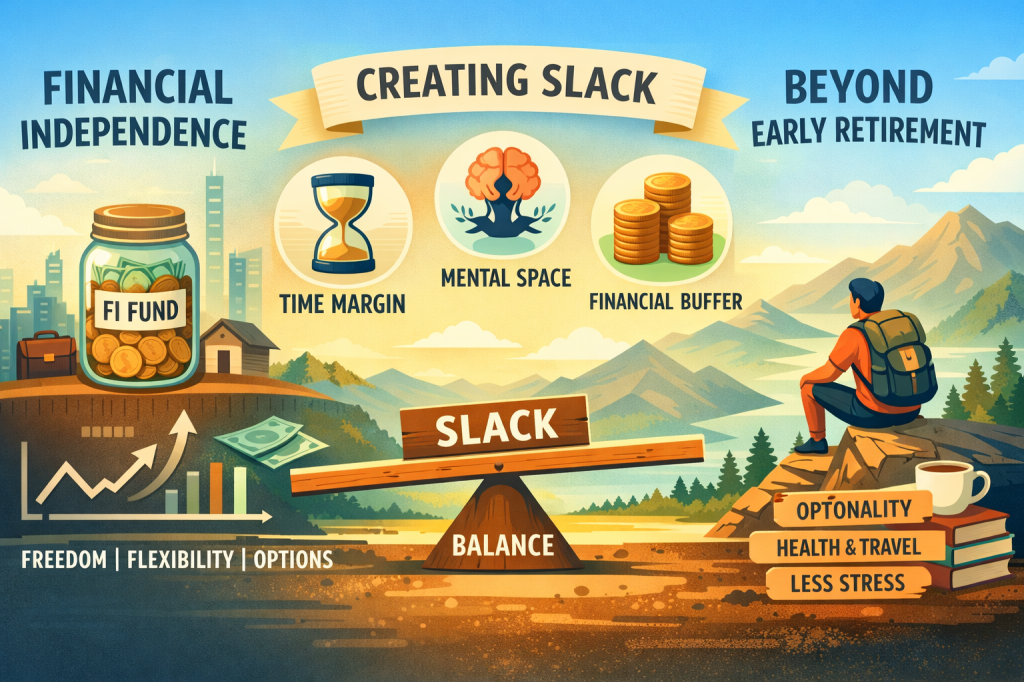
What “Slack” Really Means
Slack isn’t laziness. It’s not idle time or wasted resources. Instead, slack is built-in room for uncertainty, choice, and recovery. It’s the margin that allows you to make intentional decisions rather than react to stress or scarcity.
In the context of financial independence, slack manifests as:
- Time slack: Not being forced to work 60+ hours a week to cover bills or obligations. This frees you to focus on what actually matters: learning, health, relationships, and personal projects.
- Financial slack: Savings and investments that let you make choices without anxiety. It’s the difference between living paycheck to paycheck and having breathing room to respond to unexpected life events.
- Cognitive slack: The mental space to reflect, plan, and innovate without constantly being on the edge of deadlines or obligations.
Think of slack as the difference between surviving and thriving. Two people may both technically have $1 million saved, but the one with financial slack can handle emergencies, experiment with new career opportunities, or travel long-term without stress. The other might meet the “FI” number but is constantly anxious about spending a dime.
Slack is about buffer, flexibility, and resilience. In life and finance, these three qualities are far more valuable than any target retirement date.
Why Early Retirement Is Misleading
“Early retirement” has become synonymous with FIRE in mainstream media. It’s the headline everyone remembers: “Retire at 35!” or “Escape the 9–5 forever!”
But focusing too heavily on early retirement can backfire in several ways:
- Extreme frugality reduces quality of life. Many aspiring early retirees scrutinize every purchase to hit a target number. While this may accelerate reaching FI, it often comes at the cost of mental health, joy, and energy. You might technically be financially independent but feel drained, frustrated, or socially deprived.
- Financial milestones are unpredictable. Investments fluctuate, market conditions change, and life events—like health crises or family needs—can shift your plans. A rigid focus on a specific retirement date often creates unnecessary stress.
- Slack gets sacrificed. People obsessed with retiring at 35 frequently cut everything that doesn’t directly contribute to their FI number—social experiences, learning opportunities, physical health, and sometimes even mental well-being. Ironically, they may achieve “financial freedom” but live a life more constrained than before.
The truth is simple: early retirement is a byproduct, not the purpose of financial independence. The core goal is slack—the margin that allows you to live intentionally and sustainably.
Slack as a Lifestyle Multiplier
Slack doesn’t just prevent stress—it amplifies everything else in life. When you build slack, you gain freedom to invest energy in what matters most, and it compounds across multiple domains:
| Type of Slack | Benefit |
|---|---|
| Financial | Reduced stress, freedom to negotiate salary, ability to invest in growth opportunities |
| Time | Space to exercise, travel slowly, or pursue side projects without burnout |
| Cognitive / Mental | Room to read, reflect, and learn; reduced decision fatigue |
| Physical / Health | Freedom to prioritize rest, recovery, and longevity habits |
Imagine two scenarios:
- Person A retires early but scrimps every penny. They have freedom in theory but live in constant worry over expenses, social obligations, and unforeseen bills.
- Person B achieves FI with built-in slack. They continue working part-time or pursuing a passion project, travel occasionally, and invest in health and learning without anxiety.
Both are financially independent, but Person B experiences the real benefits of FIRE. Slack allows you to say yes to opportunity, invest in yourself, and absorb life’s unpredictability gracefully.
How to Build Financial Slack
Slack doesn’t magically appear when you hit a number on a spreadsheet. It’s a systemic outcome, cultivated intentionally over time. Here’s how to do it sustainably:
1. Focus on income optionality, not just frugality
Extreme saving accelerates FIRE, but only when paired with income flexibility. Skills, side projects, or multiple income streams increase your options without requiring an ever-tightening belt. Optionality is the financial equivalent of slack: it gives you choices when life throws curveballs.
2. Prioritize emergency and opportunity funds
An emergency fund is standard advice—but slack goes beyond that. Your financial buffer should be large enough to cover both predictable disruptions (medical bills, taxes, home repairs) and opportunity costs, like starting a new business, taking a sabbatical, or exploring relocation.
3. Think in terms of margin, not targets
Don’t obsess over an exact FI number. The stock market is unpredictable, and life doesn’t follow a plan. Even a small extra cushion—10–20% beyond your “goal”—creates meaningful slack, reducing stress and increasing freedom.
4. Invest in assets that earn while you sleep
Stocks, index funds, dividend-generating investments, and even rental properties create passive income streams that compound slack over time. Financial independence isn’t just about having money—it’s about having money working for you, freeing your attention and energy.
5. Design systems, not just goals
Slack is preserved by smart habits and systems:
- Automatic savings and investments
- Streamlined budgeting to reduce friction
- Routines that protect physical and cognitive energy
- Minimizing unnecessary financial and lifestyle complexity
Systems create margin automatically, so you don’t rely on willpower alone.
Slack as a Health and Life Strategy
Financial slack spills over into other forms of life margin:
- Time slack lets you exercise consistently, prioritize sleep, and maintain mobility—critical for long-term health.
- Cognitive slack allows reflection, learning, and creative thinking. Without it, even the smartest FIRE strategies fail because decision fatigue clouds judgment.
- Lifestyle slack enables slow travel, exploration, and personal growth without burnout.
In other words, slack is the ultimate life multiplier, converting financial independence into holistic freedom.
Common Misconceptions About FIRE and Slack
Misconception 1: FIRE is only about money
Money is a tool, not the goal. True FIRE focuses on control over your life, which means energy, time, and cognitive space. Without slack, even a “perfect” FI number won’t feel freeing.
Misconception 2: Early retirement equals freedom
As we’ve discussed, quitting work is optional. Some people find freedom in scaling back rather than stopping entirely—taking a reduced schedule, pursuing passion projects, or working selectively. Slack ensures that this choice is real and stress-free.
Misconception 3: Extreme frugality maximizes slack
Paradoxically, extreme frugality often reduces slack. When every dollar and every minute is micromanaged, your freedom is constrained. The goal is efficient use of resources, not maximum austerity.
The Psychology of Slack
Slack also matters psychologically. Humans are wired to notice scarcity more than abundance. Even small financial or time buffers reduce stress dramatically, improve cognitive function, and allow for better decision-making. Slack is psychological capital: the ability to approach life proactively instead of reactively.
Studies in productivity, behavioral economics, and stress science consistently show that buffers — financial, time, or cognitive — improve resilience and long-term outcomes. FIRE, when designed around slack, harnesses this principle intentionally.
A Simple Mental Check
Before obsessing over a target FI number or retirement age, ask yourself:
“Do I have enough slack to live without constant stress?”
If the answer is yes, congratulations—you’re already experiencing the true value of financial independence. If no, focus on building margin in money, time, and energy first. Early retirement will follow naturally as a byproduct, not a requirement.
Key Takeaways
- Slack, not early retirement, is the real goal of FIRE. It’s the margin that makes financial independence meaningful.
- Slack compounds across life domains: financial, time, cognitive, and health.
- Extreme frugality or rigid target dates often reduce slack, limiting the true benefits of FIRE.
- Focus on systems, optionality, and margins to create sustainable freedom.
- When life has slack, every decision becomes optional, not obligatory, and freedom becomes a lived reality.
Financial independence isn’t about hitting a magic number or leaving work early. It’s about building enough slack to live intentionally, respond to life’s challenges, and pursue the things that truly matter. That, more than any spreadsheet or retirement date, is the real reward of FIRE.
 VD
VD 
Leave a comment