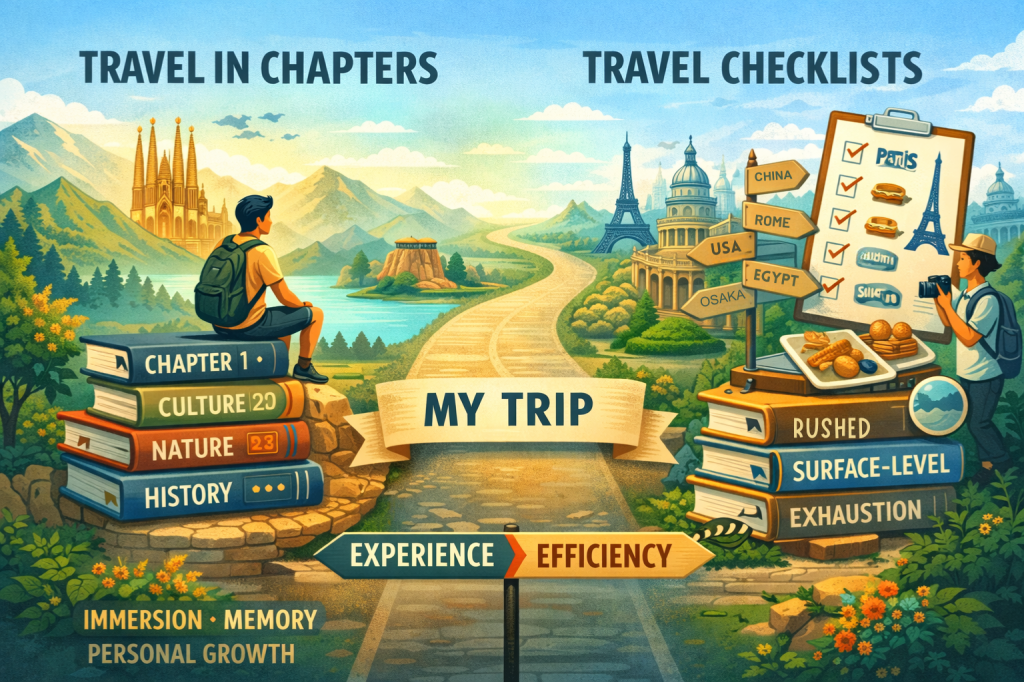
Most travel advice focuses on checklists: see these 10 landmarks, eat at these 5 restaurants, take these photos, pack these items. At first glance, checklists feel efficient—they promise maximum coverage in minimal time. But as anyone who’s traveled extensively knows, rigid checklists can turn exploration into a chore. You may see all the “highlights,” but rarely experience anything meaningful.
There’s a better way: travel in chapters. Think of a trip not as a series of boxes to tick off but as a narrative, divided into sections, each with its own rhythm, theme, and purpose. Traveling in chapters transforms your experience from a superficial sightseeing sprint into a series of immersive, memorable episodes.
In this post, we’ll explore what chapter-based travel looks like, why it works better than checklists, and how you can design trips that are both enriching and sustainable.
The Checklist Trap
Checklists work well for logistics—they ensure you don’t forget your passport, tickets, or hiking shoes—but they can inadvertently rob a trip of depth. Here’s why:
- Quantity over quality: Checking off all the famous spots often means rushing, snapping photos, and moving on without reflection. You arrive, you tick, you leave. The memory of the place becomes shallow.
- Mental overload: A checklist creates constant pressure. Instead of experiencing the moment, your mind is already thinking about the next item, the next meal, or the next attraction.
- Lost spontaneity: Life’s best travel moments often come from unscheduled detours, chance encounters, and slow observation. Checklists leave little room for these experiences.
- Short-term gratification: Ticking boxes gives a sense of accomplishment, but rarely leads to lasting insight or personal growth.
In short, checklists optimize efficiency, not experience.
Travel in Chapters: A Narrative Approach
Chapter-based travel treats a trip like a story, with each segment or “chapter” designed for a particular experience, pace, or focus. Instead of trying to see everything, you curate a sequence of meaningful experiences.
What a Chapter Looks Like
A chapter can be defined by:
- Place: Spend a week exploring a single city or region.
- Theme: Dedicate a chapter to culture, food, hiking, or learning a skill (like cooking or photography).
- Pace: Alternate slow chapters with more active ones, e.g., three days of hiking followed by three days in a quiet village.
- People: Center a chapter around social interaction—joining a local festival or staying in community-oriented accommodations.
By structuring your trip this way, each chapter has intent, focus, and rhythm. Chapters are flexible, but they prevent trips from feeling like a chaotic scramble from one tourist spot to another.
Why Chapters Work Better Than Checklists
1. Deep Immersion
When you travel in chapters, you can stay in a place long enough to notice subtleties: the rhythm of streets at different times, the way locals interact, or the changing seasons of a market.
Example: In Kyoto, a checklist traveler might see Kinkaku-ji, Fushimi Inari, and Gion all in one day. A chapter-based traveler might spend two days in Gion alone—wandering quiet streets, sitting in a teahouse, observing daily life. The latter leaves you with lasting memories and insights.
2. Reduced Travel Fatigue
Rushing through checklists is exhausting. Constantly moving from one destination to another, juggling bookings, and sticking to a rigid schedule drains your mental and physical energy.
Chapters allow you to settle into a place, reducing decision fatigue. You unpack once, explore deliberately, and create a rhythm that matches your energy levels. Over longer trips, this approach prevents burnout and keeps travel enjoyable.
3. Encourages Serendipity
The best moments in travel are often unplanned: a conversation with a local, a hidden alleyway, or a festival you didn’t know existed. Checklists leave little room for these experiences. Chapters provide natural space for spontaneity, because not every hour is accounted for, and the goal isn’t to tick boxes—it’s to experience.
4. Storytelling and Reflection
Chapter-based travel encourages reflection. Each chapter can be seen as a self-contained story with its own beginning, middle, and end. When you return home, it’s easier to remember and integrate experiences.
Compare:
- Checklist memory: “I saw the Eiffel Tower, Louvre, and Sacré-Cœur.”
- Chapter memory: “My week in Paris felt like a slow unfolding story—I spent mornings wandering Montmartre cafes, afternoons sketching at the Seine, and evenings meeting local artists. Each day built on the last.”
Chapter-based memories are richer, more personal, and often transformative.
5. Flexible Logistics
Chapters naturally align with practical travel systems:
- Packing: You can pack for a few days or one theme at a time, reducing luggage stress.
- Accommodation: Staying longer in fewer places is often cheaper and more comfortable.
- Budgeting: You can allocate spending per chapter, making costs predictable.
- Health: Less transit and more consistent routines improve sleep, reduce fatigue, and protect energy for experiences.
In essence, chapters optimize both experience and logistics, unlike rigid checklists that favor speed and quantity.
How to Plan Chapter-Based Travel
- Start with the narrative, not the map:
Ask yourself: What story do I want to tell through this trip? This could be a personal theme (culinary exploration), a place-based theme (Northern Italy), or a mixture. - Break the trip into 3–5 chapters:
Each chapter should have a focus, pace, and purpose. Even a week-long trip can be split into chapters—a city, a countryside retreat, a cultural immersion. - Assign time flexibly:
Avoid rigid schedules. Chapters provide structure, but leave gaps for exploration, rest, and spontaneity. - Design experiences around senses and rhythm:
Include chapters that vary your sensory and cognitive load: busy markets, quiet nature hikes, social immersion, or reflective solo walks. - End each chapter with reflection:
Journaling, sketching, photography, or simply sitting and observing helps consolidate memories and integrate lessons before moving to the next chapter.
Examples of Chapter-Based Travel
Example 1: Japan in Chapters
- Chapter 1 – Tokyo: Fast-paced city life, culture, and tech.
- Chapter 2 – Kyoto: Slow exploration, temples, tea ceremonies.
- Chapter 3 – Hokkaido: Nature immersion, hiking, rural life.
Example 2: Europe on a Month-Long Trip
- Chapter 1 – Barcelona: Art, tapas, and architecture.
- Chapter 2 – Provence: Countryside, markets, local cooking.
- Chapter 3 – Rome: History, slow mornings, evening gelato rituals.
In each case, the chapters create natural narrative arcs, blending movement, immersion, and reflection.
Lessons from Chapter-Based Travel
- Quality beats quantity: Seeing fewer places more deeply is more memorable than checking off dozens of landmarks.
- Pace yourself: Energy is finite. Chapters allow you to align your pace with your physical and mental capacity.
- Structure without rigidity: Chapters provide a framework but preserve the flexibility that makes travel meaningful.
- Memory is narrative-based: Your mind recalls stories, not lists. Chapters create stories you can relive.
- Integration is natural: Each chapter allows reflection, turning travel into a source of personal growth, not just entertainment.
Applying Chapters Beyond Travel
This philosophy isn’t limited to trips. You can apply the chapter approach to life, learning, and work:
- Learning: Focus on one skill at a time instead of hopping between dozens.
- Projects: Divide complex goals into thematic chapters.
- Life experiences: Instead of chasing experiences randomly, design “life chapters” that create depth and meaning.
Chapter-based thinking transforms scattered effort into coherent, memorable experiences, whether in travel or life.
Final Thoughts
Travel is more than visiting famous landmarks; it’s a practice of presence, curiosity, and reflection. Checklists optimize for efficiency, but they rarely leave space for meaningful experiences.
Traveling in chapters turns each trip into a narrative you live, not a list you complete. It reduces fatigue, encourages spontaneity, fosters deeper memories, and allows your experiences to ripple beyond the trip itself.
Next time you plan a trip, ask yourself:
“What story do I want this journey to tell?”
Break the journey into chapters, immerse yourself fully in each, and let the narrative unfold. You’ll return home not just having visited places, but having lived stories worth remembering.
Key Takeaways
- Checklists prioritize efficiency; chapters prioritize depth.
- Chapters structure travel into rhythms, themes, and stories, creating more meaningful experiences.
- Travel fatigue decreases when you stay longer and explore deliberately.
- Reflection after each chapter enhances memory and personal growth.
- Chapter-based travel is a mindset—one that can extend beyond trips to learning and life design.
Travel in chapters. Leave the checklists behind. Experience, reflect, and remember.
 VD
VD 
Leave a comment