Most people try to improve their thinking by consuming more information.
More books.
More podcasts.
More newsletters.
More saved threads.
But better thinking doesn’t primarily come from input.
It comes from processing.
Daily reflection is the missing multiplier in personal growth. It is how experience turns into insight. It is how reading turns into judgment. It is how mistakes turn into wisdom.
And when practiced consistently, reflection compounds.
Not dramatically in a week.
Not visibly in a month.
But meaningfully over years.
Input Is Not the Same as Intelligence
In The Compound Effect of Reading, I argued that 20 minutes of daily reading can transform a life.
But reading alone doesn’t guarantee growth.
Without reflection:
- Ideas blur together
- Lessons fade quickly
- Experiences remain unexamined
- Mistakes repeat
You’ve probably felt this.
You finish a great book. You feel sharper. Inspired. Motivated.
Two weeks later?
The concepts dissolve.
Reflection is what prevents cognitive evaporation.
It forces you to:
- Articulate what mattered
- Connect new ideas to old frameworks
- Decide what changes behavior
Thinking improves when you examine your thinking.
Why Daily Reflection Improves Mental Clarity
Mental clutter isn’t caused by lack of intelligence.
It’s caused by:
- Unprocessed experiences
- Unresolved decisions
- Accumulated micro-stress
- Fragmented attention
In Idea Carrying Capacity: How Many Concepts Can You Actually Use at Once?, I discussed the limits of cognitive load.
Reflection increases usable capacity.
When you reflect, you:
- Close open loops
- Extract lessons
- Reduce rumination
- Create structure from chaos
Instead of carrying 50 half-formed thoughts, you distill them into 3 usable insights.
Clarity is compression.
And reflection is the compression algorithm.
The Compounding Effect (Explained Simply)
Compounding in finance works because gains generate more gains.
Reflection works the same way.
Day 1:
You notice you were distracted in the afternoon.
Day 3:
You identify it’s tied to poor sleep.
Day 7:
You adjust your wind-down routine.
Day 30:
Your sleep improves.
Day 90:
Your focus baseline improves.
One small observation leads to a system change.
That system change improves performance.
That improved performance gives you better data.
Better data leads to better decisions.
This is the compounding IQ effect.
Not a literal IQ increase.
But a steady improvement in:
- Judgment
- Pattern recognition
- Decision quality
- Emotional regulation
Over years, that gap becomes enormous.
Reflection as Cognitive Recovery
In Recovery Is a Skill, I wrote that recovery doesn’t happen automatically.
The same applies mentally.
Modern life is high input:
- News
- Slack
- Code
- Meetings
- Social feeds
But we rarely schedule mental digestion.
Daily reflection functions as cognitive recovery.
It signals:
The day is complete.
The experience has been processed.
Nothing is pending mentally.
That reduces background stress.
It also improves sleep.
Your brain rests better when it feels complete.
Why Smart People Plateau
In The Learning Bottleneck: Why Smart People Plateau (And How to Break Through), I argued that plateauing often happens when learning becomes passive.
High performers consume a lot.
But they don’t always synthesize.
Reflection is synthesis.
Without it:
- Knowledge stays theoretical
- Patterns go unnoticed
- Feedback loops stay weak
With it:
- You detect repeated mistakes faster
- You refine mental models
- You sharpen intuition
Over time, this feels like “better instincts.”
But instincts are just compressed reflection.
What Daily Reflection Actually Looks Like
Reflection is not writing three pages of poetic journaling.
It can be simple.
Five to ten minutes.
Three prompts.
That’s enough.
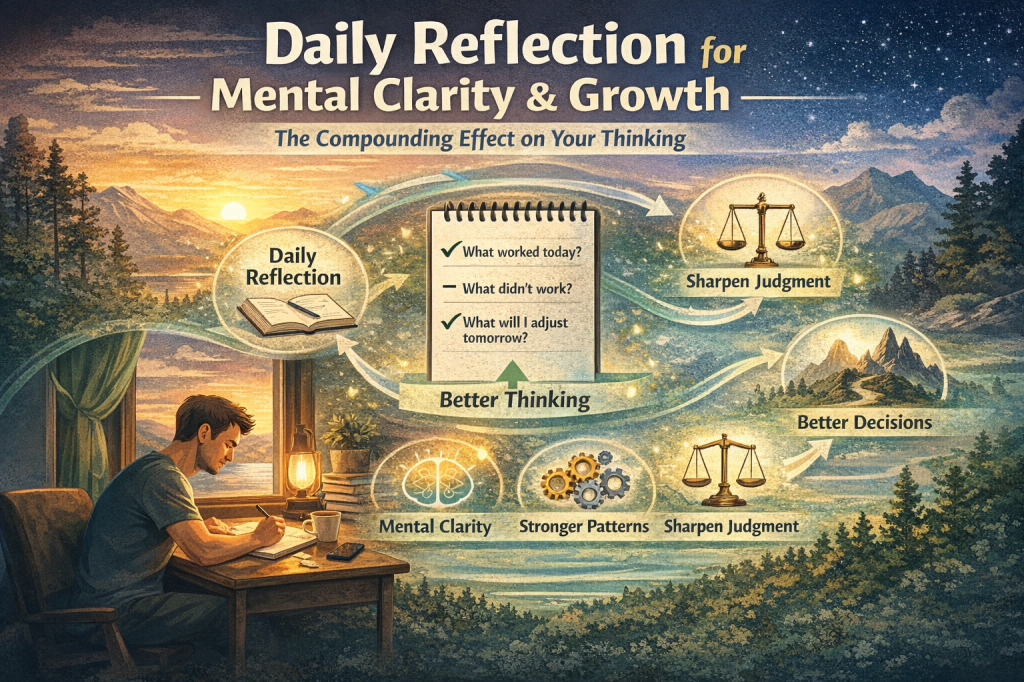
Here’s a minimalist framework aligned with your systems-based approach:
1. What worked today?
This reinforces effective behavior.
You train your brain to recognize leverage.
Maybe:
- Deep work before email improved output.
- A short walk restored energy.
- A breathing session reduced tension (as discussed in Breathing Exercises for Stress, Focus, and Performance).
Success leaves clues.
Reflection captures them.
2. What didn’t work?
No drama.
Just data.
Maybe:
- Afternoon caffeine hurt sleep.
- You overcommitted socially.
- You underestimated a task.
The goal is pattern detection, not self-criticism.
Over weeks, you’ll see recurring themes.
Those themes are leverage points.
3. What will I adjust tomorrow?
Tiny change.
Not reinvention.
Maybe:
- Protect 90 minutes for deep work.
- Stop coffee after 1 p.m.
- Add a 10-minute walk post-lunch.
Reflection without adjustment is intellectual entertainment.
Reflection with small adjustments creates compounding.
The Link Between Reflection and Decision-Making
Most poor decisions aren’t caused by ignorance.
They’re caused by:
- Emotional reactivity
- Recency bias
- Social pressure
- Fatigue
Daily reflection improves decision-making because it:
- Surfaces emotional patterns
- Separates facts from feelings
- Strengthens long-term thinking
In Learning Like an Investor: How to Allocate Attention for Long-Term Growth, I described attention as capital allocation.
Reflection is performance reporting.
It shows:
Where attention paid off.
Where it didn’t.
Without reflection, you’re investing blindly.
With reflection, you’re reviewing the portfolio daily.
Reflection as Identity Design
In Why Systems Beat Motivation, I argued that identity grows from repeated systems.
Reflection reinforces identity.
When you write:
“I kept my word today.”
“I trained even when tired.”
“I chose depth over distraction.”
You strengthen that identity.
You become someone who notices.
Someone who adjusts.
Someone who improves.
Over time, this changes self-perception.
And identity shifts drive durable behavior change.
The Long-Term Cognitive Dividend
What happens after one year of daily reflection?
You develop:
- Sharper self-awareness
- Faster error correction
- Reduced emotional volatility
- Stronger pattern recognition
- More intentional living
After five years?
Your thinking becomes structured.
You naturally:
- Pause before reacting
- Analyze tradeoffs
- Consider second-order effects
Reflection trains that muscle daily.
You begin seeing beyond the immediate.
That’s cognitive maturity.
Why Most People Don’t Do It
Because it’s quiet.
It doesn’t feel productive.
It doesn’t create visible output.
But neither does sleep — and yet sleep determines everything.
Reflection feels optional.
But over decades, it’s decisive.
Just like:
- Daily mobility work (Daily Mobility for Joint Health)
- Strength training for longevity
- Small financial optimizations in FIRE
Tiny inputs.
Massive downstream effects.
A 7-Day Reflection Experiment
If you prefer experiments over philosophy, try this:
For 7 days:
- Reflect for 5 minutes each evening.
- Use the 3 prompts.
- No phone during reflection.
- Keep it short.
Track:
- Mental clarity
- Emotional stability
- Decision confidence
- Sleep ease
At the end of the week, reflect on the reflection.
Meta-awareness accelerates growth.
Reflection vs Rumination
Important distinction:
Reflection is structured and forward-moving.
Rumination is repetitive and unresolved.
Reflection asks:
“What happened? What does it mean? What changes?”
Rumination asks:
“Why am I like this?”
Reflection produces insight.
Rumination produces anxiety.
Structure prevents spiraling.
That’s why prompts matter.
The Simplest Way to Start Tonight
Before bed, ask:
- What was the most important moment today?
- What did it teach me?
- What will I do differently tomorrow?
Five minutes.
No perfection required.
Just consistency.
Because thinking improves when examined daily.
Clarity improves when chaos is compressed.
Growth accelerates when feedback loops shorten.
You don’t need more information.
You need more integration.
Daily reflection is not dramatic.
It is subtle.
But over years, it quietly upgrades the quality of your thinking.
And better thinking changes everything.
 VD
VD 
Leave a comment