“The first $100,000 is a b*tch.”
— Charlie Munger
It’s blunt advice. And it’s true.
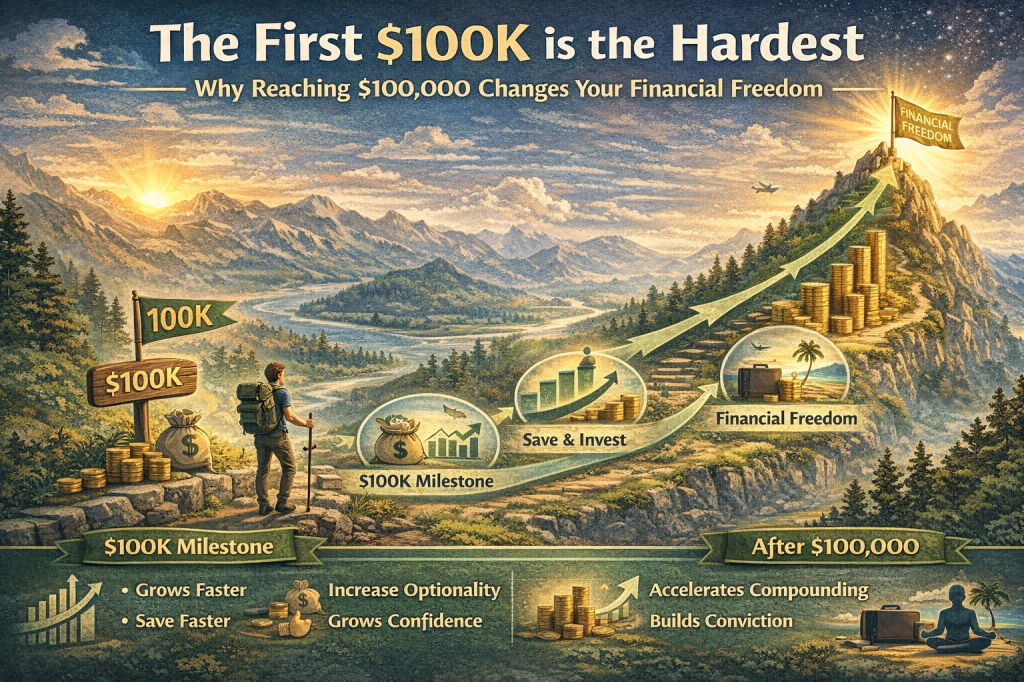
The first $100K is the hardest milestone in wealth building — not because of market complexity, but because of math, behavior, and identity.
After $100K, momentum begins to shift. Compounding starts to matter. Your habits stabilize. Optionality increases.
Before $100K, you are pushing a financial boulder uphill.
After $100K, gravity starts helping your FIRE (Financial Independence, Retire Early) journey.
Let’s unpack why.
1. The Math Is Brutal in the Beginning
Compounding is unimpressive at small numbers.
Assume a 7% annual return.
- $10,000 earns $700 per year.
- $25,000 earns $1,750.
- $50,000 earns $3,500.
That’s not life-changing.
But $100,000?
Now you’re earning $7,000 per year without additional effort.
At $200,000, that becomes $14,000.
At $500,000, $35,000.
The early phase feels slow because your contributions matter far more than returns.
In fact, before $100K, your savings rate matters more than your investment strategy.
That’s why in The 80/20 of FIRE, I emphasized optimizing savings and fixed costs first. The portfolio comes later.
Early wealth building is labor-driven.
Later wealth building becomes capital-driven.
That shift changes everything.
2. The Psychological Breakthrough
The first $100K is not just a financial milestone.
It’s a psychological one.
Before $100K:
- Money feels fragile.
- Progress feels slow.
- Setbacks feel large.
- Markets feel scary.
After $100K:
- You see compounding in action.
- Market swings feel less catastrophic.
- Your system feels validated.
You stop asking:
“Is this working?”
You start asking:
“How can I accelerate this?”
In Why Your FIRE Progress Feels Slow (And What to Do About It), I wrote about the motivational dip that occurs when results lag effort.
The $100K mark often marks the end of that dip.
It’s the point where effort becomes visible.
3. You’ve Built the Real Asset: Behavior
The first $100K requires:
- Budget discipline
- Automated investing
- Lifestyle restraint
- Emotional regulation during volatility
- Long-term thinking
Those are the real assets.
The money is just the scorecard.
In Financial Independence Is a Skill, Not a Number, I argued that FIRE is built on behaviors, not balances.
If you can accumulate $100K from scratch, you have proven:
- You can live below your means.
- You can delay gratification.
- You can ignore social comparison.
- You can stick with a system.
That identity compounds faster than capital.
4. Lifestyle Inflation Is Still Contained
The early accumulation phase forces constraint.
You likely:
- Question purchases more carefully.
- Optimize recurring expenses.
- Resist lifestyle creep.
In Lifestyle Inflation Detox, I explained how rising income silently expands fixed costs.
If you reach $100K without dramatically inflating lifestyle, you’ve created margin.
Margin is freedom.
And freedom compounds.
If your lifestyle is lean relative to income, every raise accelerates wealth disproportionately.
That’s the hidden advantage of the first $100K.
5. Your Money Starts Buying Optionality
Before $100K, your investments don’t meaningfully change your life.
After $100K, they start buying flexibility.
At a conservative 4% withdrawal rate, $100K generates $4,000 annually.
That’s not retirement money.
But it might be:
- Three months of living expenses.
- A sabbatical buffer.
- Runway to change jobs.
- A geographic arbitrage experiment.
In The Optionality Playbook, I described financial independence as expanding choices.
$100K is often the first time those choices feel real.
You’re no longer starting from zero.
6. The Compounding Inflection Point
Wealth growth follows a curve.
Early phase:
Slow. Effort-heavy. Contribution-driven.
Middle phase:
Faster. Momentum-driven. Return-assisted.
Late phase:
Accelerating. Capital-dominated.
The first $100K sits near the bottom bend of the curve.
After this point, annual returns begin rivaling annual contributions.
That’s the inflection.
If you invest $20,000 per year:
Before $100K:
You are the engine.
After $100K:
Your portfolio becomes a second engine.
Two engines accelerate faster than one.
That’s why the first $100K changes the emotional experience of investing.
7. Risk Tolerance Stabilizes
Small portfolios feel fragile.
A 20% market drop on $15,000 wipes out $3,000 — which might represent months of savings.
A 20% drop on $100K is $20,000 — larger in absolute terms, but psychologically different.
Why?
Because by $100K:
- You’ve likely lived through volatility.
- You’ve seen recoveries.
- You trust the system more.
Experience builds conviction.
Conviction reduces panic selling.
Reduced panic preserves compounding.
And compounding is everything.
8. The Skill Stack Solidifies
Reaching $100K requires stacking key financial skills:
- Income optimization
- Expense control
- Tax efficiency
- Basic investing literacy
- Emotional discipline
In The FIRE Skill Stack: 7 Essential Skills to Reach Financial Independence Faster, I argued that wealth building is multi-dimensional.
The first $100K proves you’ve assembled the foundation.
After that, optimization becomes easier.
You’re no longer learning from scratch.
You’re refining.
9. You Stop Obsessing Over Micro-Optimization
When your portfolio is small, every percentage point feels critical.
You debate:
- Which ETF?
- Which broker?
- Which rebalancing frequency?
But at small balances, these tweaks barely move the needle.
The biggest variable is income minus expenses.
After $100K, your energy shifts.
You think more about:
- Asset allocation.
- Tax efficiency.
- Career leverage.
- Geographic flexibility.
In Geographic Flexibility as Wealth, I discussed how location independence multiplies income potential.
Once your base is established, strategic moves matter more than tactical tweaks.
10. Identity Shift: From Saver to Investor
Before $100K, you feel like a disciplined saver.
After $100K, you begin to feel like an investor.
That shift matters.
Savers protect money.
Investors deploy money.
Savers focus on accumulation.
Investors focus on growth and allocation.
This identity shift often increases long-term risk tolerance in a healthy way — enabling higher equity exposure and sustained compounding.
Why It Still Feels Slow
Reaching $100K can take years.
Especially if:
- You start from debt.
- Your income is moderate.
- You’re supporting family.
- You’re building career capital simultaneously.
In FIRE Mistakes That Delay Financial Independence, I highlighted common errors like inconsistent investing or lifestyle creep.
The early stage requires patience.
But remember:
The hardest part is not mathematical.
It’s behavioral.
Consistency wins.
What to Prioritize Before $100K
If you’re below the milestone, focus on:
1. Savings Rate Over Returns
An extra 5% savings rate beats chasing 1% higher returns.
2. Income Growth
Upskilling, negotiating, and career leverage often outperform investment tweaks.
3. Fixed Cost Control
Housing, transportation, and subscriptions matter more than coffee.
4. Automation
Remove willpower from the equation.
Systems beat motivation.
After $100K: What Changes Strategically?
Once you cross the milestone:
- Reassess asset allocation.
- Improve tax efficiency.
- Consider broader diversification.
- Think about optionality plays (career shifts, travel experiments, sabbaticals).
This is where Financial Independence Without Extremes becomes relevant.
You don’t need austerity forever.
You need discipline early so flexibility can exist later.
The Deeper Reason It Changes Everything
The first $100K changes your relationship with money.
Before:
Money feels scarce.
Progress feels slow.
Freedom feels distant.
After:
Money feels productive.
Progress feels visible.
Freedom feels plausible.
It’s not about the number.
It’s about proof.
Proof that:
- You can build capital.
- You can resist lifestyle inflation.
- You can delay gratification.
- You can stay consistent.
That proof builds confidence.
Confidence sustains compounding.
The Freedom Curve
Imagine plotting wealth over time.
The curve starts flat.
Then slightly upward.
Then steeper.
The first $100K sits at the base of that slope.
Push through it.
After that, the system starts working harder than you do.
And that’s when financial freedom stops being theoretical — and starts becoming mathematical.
Not because you’re rich.
But because you’ve crossed the hardest threshold.
And from there, compounding does what it has always done:
Reward patience.
 VD
VD 
Leave a comment