Some cities give you energy.
You wake up clear-headed. Walking feels effortless. Ordinary days feel lighter, even when nothing special is happening. You’re more patient, more curious, and strangely more productive—without trying harder.
Other cities drain you.
You sleep enough but never feel fully rested. Simple tasks feel heavier than they should. Noise, crowds, logistics, and constant motion quietly tax your attention. Nothing is “wrong,” yet everything feels slightly uphill.
This difference isn’t about taste, prestige, or even opportunity.
It’s about energy.
Cities don’t just shape your career, expenses, or social life. They shape your nervous system. Over time, that shapes your health, focus, financial decisions, and long-term freedom.
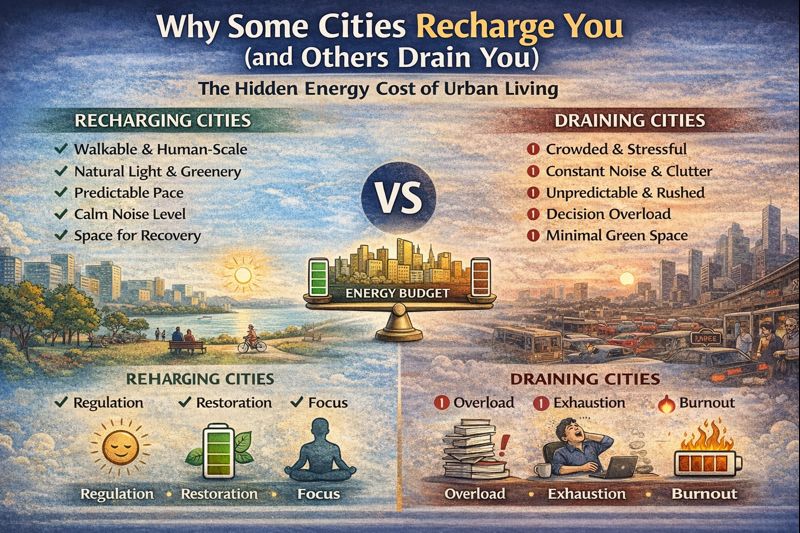
The Missing Lens: Energy, Not Lifestyle
When people evaluate cities, they usually compare:
- cost of living
- salaries and job markets
- weather
- food, culture, and entertainment
- safety and infrastructure
These matter. But they miss a quieter variable that often matters more:
How much energy does this city demand from you every single day?
Two cities with similar costs and amenities can feel radically different because their energy tax is different.
Urban living is not neutral. Every environment either:
- leaks your energy, or
- quietly restores it
And the effect compounds.
Cities Are Energy Systems, Not Just Places
Think of a city as a system that continuously interacts with your body and mind.
Some systems increase friction:
- noise
- visual clutter
- unpredictable traffic
- crowding without refuge
- constant decision-making
- time pressure baked into daily life
Each factor is small on its own. Together, they create a persistent background load.
Other cities reduce friction:
- walkable layouts
- predictable rhythms
- legible neighborhoods
- access to nature
- natural pauses built into the day
A draining city isn’t necessarily “bad.” It’s often just high-frequency—too many inputs, too little recovery.
A recharging city does less to you—and that’s precisely why it feels better.
The Nervous System Perspective
Your nervous system runs one continuous calculation:
Am I safe enough to relax?
Cities that drain you keep that answer uncertain.
Common triggers include:
- unpredictable noise
- aggressive traffic
- overcrowding
- constant vigilance
- blurred boundaries between work and rest
- lack of quiet or darkness
None of these are emergencies. But they keep your system in low-grade alert mode.
Cities that recharge you send clearer signals of safety:
- slower pace
- human-scale streets
- greenery in daily sightlines
- reliable routines
- social warmth without overload
Over time, this shifts how your body allocates energy. Less goes to defense. More becomes available for thinking, creativity, and recovery.
Why Productivity Feels Effortless in Some Cities
People often say, “I’m more productive in this city,” as if productivity were a personal trait.
It isn’t.
In recharging cities:
- sleep quality improves
- decision fatigue decreases
- attention fragments less
- recovery happens faster
You’re not more disciplined.
You’re leaking less energy.
This explains why some people appear to “get ahead” after relocating. They didn’t unlock motivation. They removed friction.
The Hidden Cost of Modern Convenience
Many modern cities optimize aggressively for convenience:
- food delivery
- ride-hailing
- dense amenities
- constant connectivity
Paradoxically, this often increases cognitive load.
Convenience removes macro friction (distance, effort) but adds micro friction:
- more notifications
- more choices
- more noise
- more social exposure
- more context switching
Life becomes compressed. Compression taxes the nervous system.
Cities that recharge you may look “less efficient” on paper—but feel more humane in practice.
Pace Matters More Than Speed
Fast cities reward responsiveness.
Slow cities reward presence.
Neither is inherently better—but mismatch is costly.
If your internal pace doesn’t match the city’s pace, you’ll feel perpetually behind or overstimulated. That mismatch quietly drains energy even when everything else is working.
This is why:
- some people thrive in New York and burn out elsewhere
- others feel relieved the moment they leave
It’s not about intensity.
It’s about alignment.
Density Isn’t the Enemy—Design Is
Density alone doesn’t drain people.
Well-designed dense cities can feel energizing:
- short distances
- mixed-use neighborhoods
- human-scale streets
- vibrant public spaces
Poorly designed density feels oppressive:
- traffic-dominated streets
- noise without refuge
- crowding without community
What matters is whether density creates connection or friction.
Nature as Energy Infrastructure
Access to nature isn’t a luxury. It’s regulation infrastructure.
Cities that recharge you usually offer:
- trees in everyday sightlines
- water nearby
- parks woven into neighborhoods
- walking paths, not just gyms
Nature reduces cognitive load automatically. No optimization required.
This isn’t about weekend hikes. It’s about ambient restoration—the quiet replenishment that happens without effort.
The Energy Budget of Urban Living
Every city imposes an energy budget:
- how much it demands
- how much it restores
If demand consistently exceeds restoration, you compensate with:
- caffeine
- discipline
- money
- willpower
This works—until it doesn’t.
Burnout in cities is rarely about work alone. It’s about environmental overdraft.
Why Travel Makes This Obvious
Travel reveals energy differences quickly.
Within weeks, you notice:
- how your sleep changes
- how much you walk without effort
- how often you feel rushed
- how quickly you recover
This is why people “feel better” in certain places even when their habits stay the same. The environment is doing part of the work.
Designing Your Personal City Stack
The goal isn’t to find the “best” city.
It’s to find cities that support your energy profile.
Useful questions:
- How much stimulation can I tolerate before fatigue?
- Do I recover faster with solitude or social energy?
- How important is walkability to my daily mood?
- How sensitive am I to noise and crowds?
- Does this city support my default routines—or fight them?
Cities aren’t identities.
They’re tools.
Final Thought: Energy Is the Real Cost of Living
Cost of living is measurable.
Energy cost is experiential.
Over years, energy compounds faster than money—positively or negatively.
A city that quietly restores you improves:
- health
- focus
- creativity
- relationships
- financial decision-making
Not because it’s magical—but because it reduces friction.
The cities that recharge you aren’t indulgences.
They’re infrastructure for a sustainable life.
Related Reading
If this post resonated, you may also enjoy these related posts:
Energy, Nervous System, and Burnout
- The Cost of Being “On” All Day: How Modern Work Overloads Your Nervous System
- Energy Management vs Time Management: How to Increase Focus, Productivity, and Avoid Burnout
- Recovery Is a Skill: Why It Doesn’t Happen Automatically (and How to Improve It)
- Your Body’s Dashboard: Early Physical Signs of Burnout You Shouldn’t Ignore
Travel, Place, and Lifestyle Design
- How to Test Living in a New City: The 30-Day City Experiment Framework
- Designing a Life That Travels Well: A Framework for Sustainable, Location-Flexible Living
- Why Repeating Destinations Beats Chasing New Ones: The Case for Slow Travel
- The Energy Budget of Travel: How to Avoid Travel Fatigue and Explore Without Exhaustion
- Lifestyle Prototyping: How to Test-Drive a New Life Before You Commit
Comfort, Optionality, and Long-Term Freedom
- Why Comfort Is a Force Multiplier for Long-Term Travel (and Prevents Burnout)
- Financial Independence Is a Skill, Not a Number
- The Optionality Playbook: Why Financial Independence Is About Better Choices, Not Early Retirement
- Future-Proofing Your Lifestyle: How to Spend Less Every Year (While Improving Your Quality of Life)
 VD
VD 
Leave a comment