In today’s fast-paced world, our minds are often overwhelmed with an endless stream of information, tasks, and decisions. Whether it’s personal, professional, or even digital clutter, the sheer volume of thoughts we try to juggle can lead to mental overload. This clutter not only drains our energy but also clouds our judgment and makes decision-making more difficult. When your mind is cluttered, it’s harder to think clearly, prioritize effectively, and make sound decisions.
So, how do you cut through the noise? How can you declutter your mind to improve mental clarity and make decisions with confidence and ease? In this blog, we’ll explore effective strategies for simplifying your mind, clearing mental fog, and creating the space needed for better decision-making.
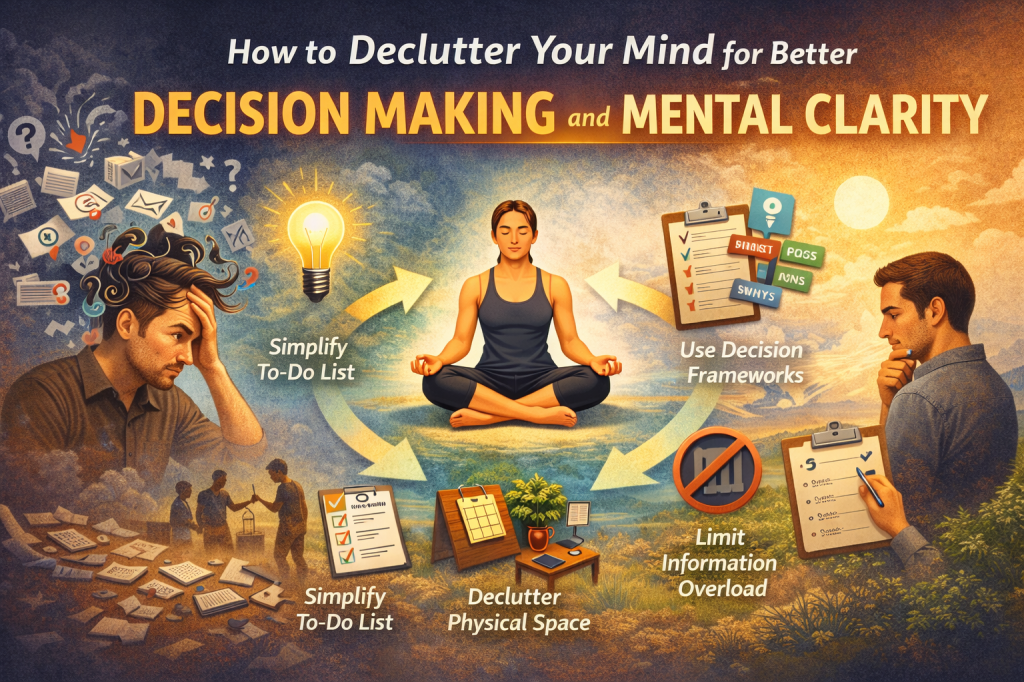
Why Mental Clutter Affects Your Decision Making
Before diving into solutions, it’s important to understand why mental clutter has such a significant impact on decision-making. When your mind is cluttered, several cognitive functions suffer:
- Decreased Focus: Mental clutter creates distractions, making it difficult to focus on one task or decision at a time.
- Analysis Paralysis: With too many thoughts racing through your mind, it’s easy to become paralyzed by options and uncertainty.
- Poor Prioritization: When your mind is full, it’s hard to assess what truly matters, leading to poor decision-making based on immediate reactions rather than thoughtful reflection.
- Stress and Anxiety: Constantly feeling overwhelmed by the weight of numerous tasks and decisions can increase stress, which further clouds your ability to think clearly.
In short, mental clutter blocks your ability to think critically, act with intention, and make decisions that align with your values and long-term goals. Now, let’s look at practical steps to help you declutter your mind and reclaim your cognitive clarity.
1. Practice Mindfulness and Meditation
Mindfulness and meditation are powerful tools for decluttering the mind. These practices help quiet the internal noise and bring you back to the present moment, allowing for clearer thinking and better decision-making.
- Start small: Begin with just 5-10 minutes of mindfulness each day. Focus on your breath, sensations in your body, or simply observe your thoughts without judgment.
- Use guided meditation: Apps like Headspace or Calm can guide you through meditation sessions that help reduce stress and improve mental clarity.
- Mindful breathing: Take a few minutes throughout the day to focus on deep, slow breaths. This simple technique can clear your mind and calm your nervous system, helping you approach decisions with a fresh perspective.
Pro Tip: Practice body scans—a mindfulness technique where you mentally check in with each part of your body. This helps release physical tension and refocus your mind.
2. Simplify Your To-Do List
When you have too many things to do and too little time, your mind becomes overloaded with all the tasks, deadlines, and responsibilities. Simplifying your to-do list is a critical step in decluttering your mind and regaining mental clarity.
- Prioritize your tasks: Identify what truly matters and tackle those tasks first. Use a simple method like the Eisenhower Matrix to separate urgent tasks from important ones.
- Break down big tasks: Large tasks can feel overwhelming. Break them down into smaller, more manageable steps to avoid feeling swamped by everything you need to do.
- Delegate: If possible, delegate tasks that others can handle. Freeing up your mental space allows you to focus on what only you can do.
Pro Tip: Implement time blocking in your schedule, which involves dedicating specific chunks of time to specific tasks. This helps reduce mental clutter by giving structure to your day.
3. Limit Information Overload
In the digital age, information is constantly at our fingertips. From news to social media to emails, the influx of information can overwhelm the mind and make it hard to think clearly. Limiting information intake is crucial for mental clarity.
- Set boundaries for technology use: Avoid mindlessly scrolling through social media or checking emails first thing in the morning or right before bed. This reduces mental clutter and helps you start and end the day with a clear mind.
- Curate your information sources: Choose a few trusted sources for news and updates, and stick to them. Avoid drowning in a sea of conflicting information from too many platforms.
- Unsubscribe: Take time to unsubscribe from unnecessary email lists or notifications. This can help reduce distractions and make it easier to focus on important decisions.
Pro Tip: Consider doing a digital detox—disconnect from all non-essential technology for a set period each day or week to give your mind the space it needs to relax and recharge.
4. Practice Decision-Making Frameworks
When faced with difficult decisions, having a structured decision-making process can help you clear mental clutter and approach the situation with confidence. Decision-making frameworks guide you through the process in an organized way, reducing the mental fog that comes with uncertainty.
- The 5-Whys: This technique involves asking “why” five times to get to the root cause of an issue, helping you clarify the real problem and make better decisions.
- Pro and Con Lists: Write down the advantages and disadvantages of each option. This simple exercise can help you see things more clearly and weigh your options objectively.
- The Two-Minute Rule: For minor decisions, use the Two-Minute Rule. If it can be decided in less than two minutes, make the decision immediately and move on.
Pro Tip: Use decision journals to track your decision-making process. Writing down the steps you take and reflecting on past decisions can improve future judgment and clarity.
5. Declutter Your Physical Space
A cluttered physical environment often leads to a cluttered mind. When your surroundings are disorganized, it can feel as though everything in your life is chaotic, contributing to mental overload.
- Tidy up your workspace: Keep your desk, home, and digital devices organized. A clean space allows for a clearer mind, making it easier to focus on the task at hand.
- Minimize distractions: Remove unnecessary objects from your work environment. If you work from home, designate a specific area for work to mentally separate it from relaxation spaces.
- Declutter your digital space: Organize your files, folders, and emails to avoid the stress of a disorganized digital life.
Pro Tip: Try the two-minute declutter: If you can tidy something up in two minutes or less, do it immediately. Regular small efforts will keep your environment in check and reduce mental clutter.
6. Simplify Your Mental Habits
Many of us have mental habits that contribute to cognitive overload. Simplifying these habits can make it easier to focus on the things that matter most.
- Let go of perfectionism: Striving for perfection can paralyze decision-making. Accept that it’s okay to make mistakes and that progress is often more important than perfection.
- Cultivate a growth mindset: Embrace challenges as opportunities for growth, rather than sources of stress. A growth mindset helps you approach decisions with an open, adaptable mindset.
- Reduce multitasking: Focusing on one task at a time improves mental clarity and helps you make better decisions. Multitasking can actually lower efficiency and increase cognitive load.
Pro Tip: Use affirmations to help reframe your thinking. Remind yourself that you are capable of making good decisions and that clarity comes from simplifying your thought processes.
Conclusion: Embrace Mental Clarity for Better Decision Making
Mental clutter isn’t just a nuisance—it’s a barrier to effective decision-making. When your mind is overwhelmed by excess information, tasks, and distractions, it’s difficult to make clear, confident decisions. By incorporating these strategies—mindfulness, simplifying tasks, limiting information overload, using decision-making frameworks, and decluttering your physical and mental space—you can clear the mental fog and start making better, more intentional decisions.
With a decluttered mind, you’ll experience improved focus, better decision-making, and a greater sense of mental clarity, leading to a more fulfilling and productive life.
Related Reading:
If you found this post helpful, you might also enjoy these related articles on mental clarity and productivity:
- Energy Management vs Time Management: How to Increase Focus, Productivity, and Avoid Burnout
- How to Improve Your Thinking: Why Reading Alone Isn’t Enough
- The Cost of Being “On” All Day: How Modern Work Overloads Your Nervous System
- How to Test Living in a New City: The 30-Day City Experiment Framework
 VD
VD 
Leave a comment