Travel changes you long before you understand how it’s changing you. It shifts the way you see the world—and yourself—but that shift doesn’t unfold gradually. It happens fast. Surprisingly fast.
Most travelers assume wisdom comes from long-term wandering or visiting dozens of countries. But that’s not how the travel learning curve works.
The truth is simple:
Your first three trips teach you more about travel—and about yourself—than the next thirty.
Not because later trips are unimportant. But because early experiences carry disproportionate weight. They’re formative. They’re foundational. They reshape how you plan, move, think, adapt, and experience the world. Everything after that is refinement, not reinvention.
This is why the beginning matters far more than most people realize.
Let’s explore what actually happens during these early trips—and why the lessons stick for life.
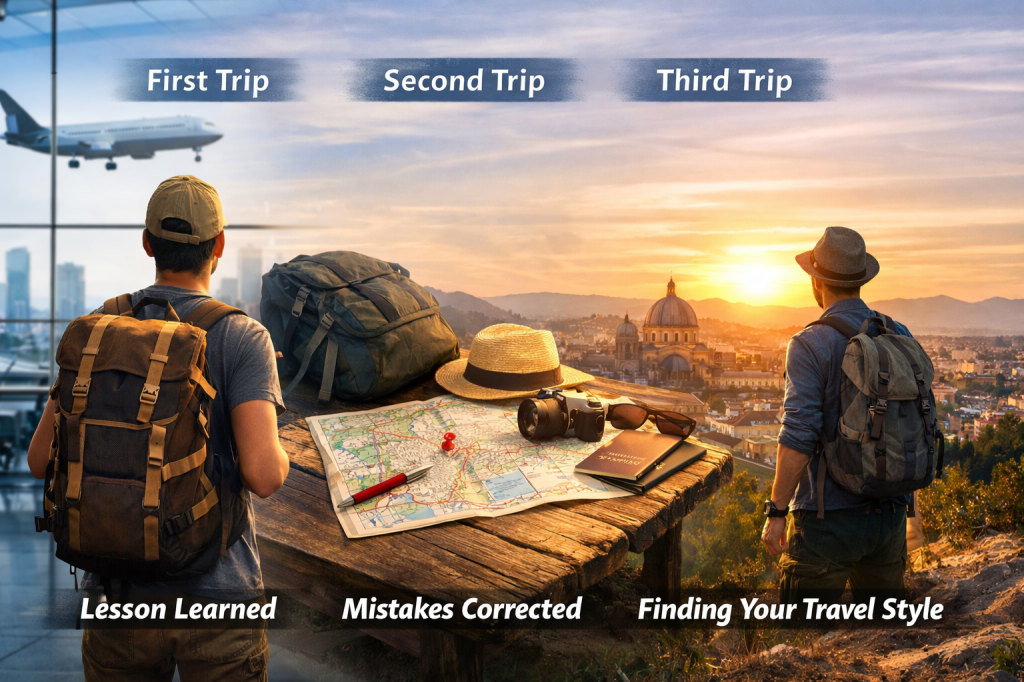
1. Trip #1: The Shock of Real Travel
Nothing prepares you for your first trip—not guidebooks, not travel vlogs, not blogs, not stories from friends. You cannot understand travel intellectually. You must feel it.
Trip #1 is that initiation. It’s the shattering of theory into reality.
Up until this moment, travel is mostly:
- a collage of Instagram expectations
- an idealized fantasy about “finding yourself”
- someone else’s curated version of exploration
Then your plane lands, and everything changes.
You suddenly experience:
- jet lag hitting harder than expected
- the chaos of navigating a new city
- the thrill of hearing unfamiliar languages
- the confusion of figuring out local norms
- the small victories of finding your way
More importantly, you confront what travel actually does to you psychologically and physically. You discover what energizes you—and what drains you. You experience stimulation, fatigue, curiosity, anxiety, excitement, and overwhelm all at once.
Most people are surprised by how intense travel can be.
But there’s a hidden gift inside that intensity:
You realize travel isn’t an escape. It’s a skill.
And now that you’ve tasted it, you can never see the world—or yourself—the same way again.
2. Trip #2: Fixing Every Mistake You Just Made
Your second trip is where the learning curve spikes.
The emotional overwhelm of the first trip fades, replaced by sharp awareness: “Okay… I can definitely do this better.”
The second trip is strategic. You begin correcting everything that didn’t work the first time around:
- You pack way lighter.
- You structure your days with more realism.
- You understand travel days require energy buffering.
- You stop chasing “top 10 things to do” lists.
- You don’t expect efficiency in foreign transit.
- You accept that schedules slip, trains run late, and things go wrong—and that’s okay.
You start treating travel like a system instead of an improvisation.
More importantly, you begin developing travel instincts:
- noticing the difference between safe and unsafe areas
- detecting tourist traps
- recognizing local cues
- managing your stress response
- pacing yourself instead of rushing
- giving yourself permission to rest
The shift from Trip #1 to Trip #2 is enormous. You go from reacting to adapting.
Trip #2 is where you evolve from “tourist” to “competent traveler.”
This alone changes the trajectory of every journey that follows.
3. Trip #3: Meeting Your True Travel Self
By the third trip, something profound happens:
You stop copying how other people travel and begin discovering your personal travel blueprint.
On Trip #1, you imitate.
On Trip #2, you correct.
On Trip #3, you customize.
Suddenly, patterns appear:
- Do bustling cities drain you or energize you?
- Do you feel more alive in nature, villages, or urban neighborhoods?
- Do you prefer structured days or open wandering?
- Do you enjoy social hostels, or does a quiet Airbnb feel right?
- Does fast travel feel exciting—or exhausting?
- Does slow travel bring clarity, calm, and depth?
This is also the trip where you tune into your energy rhythm:
- when you hit decision fatigue
- how many days you can explore before needing downtime
- what foods help you feel grounded
- how your body handles long walks, heat, altitude, or humidity
This self-awareness is gold.
Trip #3 is where travel becomes sustainable, not stressful.
You stop trying to travel well—and start traveling authentically.
From here forward, every trip feels more natural because you’re no longer building your travel identity. You’re simply expressing it.
4. Why Travel Learning Is Front-Loaded
Travel has one of the steepest early learning curves of any skill.
The essential competencies develop early:
- navigation literacy
- packing systems
- airport flow awareness
- recognizing scams
- regulating stress and uncertainty
- understanding your travel energy limits
- sensing how quickly (or slowly) you prefer to move
- choosing experiences based on meaning, not marketing
- adjusting expectations to match reality
Once you learn these fundamentals, additional trips offer diminishing returns in terms of skills—but richer returns in terms of depth.
You go from learning how to travel to learning from travel.
The difference is subtle but life-changing.
5. Early Trips Shape Your Travel Identity
Identity formation happens early in any skill—music, sports, reading, work, fitness—and travel is no exception.
Your first few trips silently shape who you become as a traveler.
Maybe you’re…
- the slow traveler
- the early riser
- the culture-first explorer
- the nature seeker
- the food-driven adventurer
- the comfort optimizer
- the minimalist packer
- the city wanderer
- the off-the-beaten-path type
Most people don’t choose these roles consciously.
Their early experiences assign them.
After Trip #3, you may still refine your preferences, but the core personality is set. You’ve built your inner travel compass.
And that compass guides every trip afterward.
6. Why Early Travel Improves the Rest of Your Life
The skills earned on your first few trips transcend geography.
Travel forces you to develop:
- resilience
- adaptability
- improvisation
- patience
- communication
- emotional regulation
- situational awareness
- curiosity
- problem solving
- confidence
These are not “travel skills.” They’re life assets.
You learn to trust yourself.
You learn to handle the unknown.
You learn to stay calm when things go sideways.
You learn to move through the world with awareness instead of fear.
You learn to let go.
Travel accelerates maturity not because it’s glamorous but because it compresses life into dense, meaningful moments.
And the lessons from your first few trips stay with you forever.
7. Why Later Trips Are Better ONLY Because of the First Ones
Everything wonderful about later travel—the deeper cultural understanding, the smoother days, the confidence, the comfort, the emotional richness—depends on the foundation built by your first trips.
Trip #30 is richer because of Trip #3.
Trip #10 feels effortless because of Trip #2.
And Trip #1 reshaped your worldview so profoundly that nothing afterward could compare.
The beginning creates the base layer.
The rest is expansion.
This is why the first three trips carry asymmetric weight.
They don’t just teach you how to travel—they change your relationship with the world.
8. How to Make Your First 3 Trips Count
To maximize the travel learning curve, use these principles:
1. Travel slower than you think you need to.
Rushing erases insights. Pace reveals them.
2. Keep itineraries simple.
You need space for discovery, not obligation.
3. Build rest days intentionally.
Energy, not time, determines how much you enjoy a place.
4. Choose locations that match your curiosity.
Not what’s popular—what feels personally meaningful.
5. Allow yourself to make mistakes.
They are the curriculum.
6. Treat travel as a skill to practice, not a checklist to complete.
Skills compound. Checklists don’t.
7. Reflect on what each trip taught you.
Travel becomes wisdom only when processed.
If you follow these principles, your first three trips will set you up for decades of meaningful, healthy, sustainable exploration.
Final Thought: The First Trips Change You. The Next Ones Deepen You.
Your first three trips aren’t just vacations. They are formative experiences that shape your identity, sharpen your instincts, and expand your internal world. They teach you how to move through unfamiliar spaces, how to adapt when plans fail, and how to travel as the best version of yourself.
After that, the world opens.
Not because travel becomes easier—but because you do.
If you’re early in your travel journey, embrace the steep learning curve.
If you’re further along, you’ll recognize the invisible scaffolding those early trips gave you.
Travel teaches fast.
Pay attention, and the lessons last a lifetime.
Here’s an improved, reader-focused version of your Related Reading section — written directly for your audience instead of for you.
Related Reading
If you enjoyed this article, you may also like these pieces that explore deeper layers of travel, personal growth, and location-independent living:
Travel & Location Independence
- Travel Optionality: How to Stay Location-Independent Without Feeling Rootless
- Why Some Cities Recharge You (and Others Drain You)
- The Energy Budget of Travel: How to Avoid Travel Fatigue and Explore Without Exhaustion
- Why Travel in Chapters Works Better Than Checklists
- Why Repeating Destinations Beats Chasing New Ones: The Case for Slow Travel
- How to Travel More Efficiently: Systems Frequent Travelers Use
- Travel Warm-Ups: Simple Routines to Arrive Energized and Avoid Fatigue
- How to Make Friends While Traveling Solo: A Guide to Finding Community
- Slow Travel: Why Staying Longer Saves Money and Creates Richer Experiences
- Geoarbitrage 101: Living Well for Less Around the World
- Travel as Therapy: How Exploring New Places Boosts Mental Health
Learning & Personal Growth
- Mental Carry-On: How to Learn From Travel (Not Just Visit Places)
- Micro-Adventures: How to Find Wonder and Adventure Without Leaving Your City
- The Return on Travel: How Travel Builds Skills, Perspective, and Long-Term Value
- The Art of Coming Home: How Travel Redefines Your Routine
- Why Getting Lost Improves Memory, Creativity, and Thinking
Lifestyle Design & Independence
- Designing a Life That Travels Well: A Framework for Sustainable, Location-Flexible Living
- Lifestyle Prototyping: How to Test-Drive a New Life Before You Commit
- Geographic Flexibility as Wealth: How Location Independence Multiplies Your Income
- The Optionality Playbook: Why Financial Independence Is About Better Choices, Not Early Retirement
- Freedom Forecasting: How to Predict Your FIRE Date With a Simple Framework
 VD
VD 
Leave a comment