Introduction
Picture this.
You’ve been looking forward to this trip for months. You’ve saved up, booked flights, researched everything, pinned dozens of spots on Google Maps.
Day one: you’re electric. Everything is new. The streets feel alive. You’re walking 20,000 steps without even noticing. Every meal is an adventure. Every corner is a photo opportunity.
Day three: your feet hurt. Your back aches from the backpack. You’re tired but pushing through because — you only have seven days and there’s so much to see.
Day five: you’re dragging. The museum you waited an hour to enter? You walked through it in 20 minutes because you couldn’t focus. That famous restaurant? You were too exhausted to enjoy it. The sunset viewpoint? You sat down, checked your phone, and barely looked up.
Day seven: you fly home more tired than when you left.
Sound familiar?
This is what I call the traveler’s paradox: the more you try to experience, the less you actually absorb.
And the solution is embarrassingly simple.
Schedule days where you do absolutely nothing.
No sightseeing. No itinerary. No alarms. No “must-see” lists.
Just… rest.
It sounds counterintuitive. You flew thousands of miles, spent good money, and took time off work — why would you “waste” a day doing nothing?
Because rest days don’t subtract from your trip. They multiply it.
In this post, I’ll explain why rest days are the most underrated travel strategy, how they prevent travel burnout, and how to build them into any trip — whether you’re gone for a week or a year.
Let’s slow down.
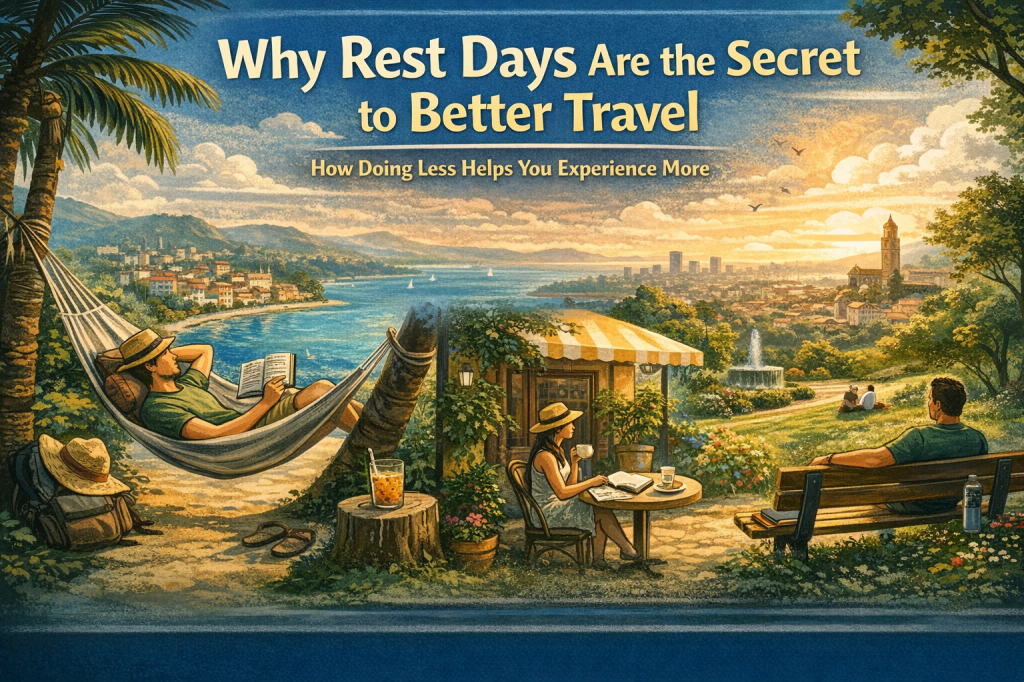
The Problem: Why Most Travelers Burn Out
Before we talk about the solution, let’s understand why travel exhaustion is so universal.
The “Maximize Every Moment” Trap
Most travelers operate under an unspoken rule:
“I’m here for a limited time, so I need to see and do as much as possible.”
This sounds logical. But it leads to a specific pattern:
- Wake up early to “beat the crowds”
- Pack the day with back-to-back activities
- Walk 15-25K steps daily (often in heat, altitude, or humidity)
- Eat at odd times or skip meals to fit more in
- Stay out late to “experience the nightlife”
- Sleep poorly in an unfamiliar bed
- Repeat for 7-14 days straight
No human being can sustain this. Not even professional athletes train every day without rest.
Yet we expect ourselves to perform at peak capacity — physically, mentally, and emotionally — every single day of a trip.
The Hidden Costs of Non-Stop Travel
When you travel without rest, you pay costs that don’t show up on any receipt:
| Hidden Cost | What It Looks Like |
|---|---|
| Decision fatigue | You stop caring about choices — “whatever, let’s just go here” |
| Sensory overload | New sights stop feeling special — everything blurs together |
| Physical exhaustion | Sore feet, back pain, headaches, poor sleep |
| Emotional flatness | You’re “there” but not really present |
| Memory loss | Days blend together — you can’t remember what you did on Tuesday |
| Irritability | Small inconveniences become major frustrations |
| Reduced immunity | Exhaustion + new environments = getting sick on vacation |
The Cruel Irony
Here’s what’s heartbreaking: you worked hard to earn this trip. You saved money. You took time off. You planned carefully.
And then you spent the entire trip too exhausted to actually enjoy it.
You came home with photos of places you barely remember being at.
This is not a travel problem. It’s a pacing problem.
And rest days fix it completely.
What Exactly Is a “Rest Day” While Traveling?
Let me be clear about what I mean — because “rest day” gets misunderstood.
What a Rest Day IS NOT
- ❌ A wasted day
- ❌ A “lazy” day you should feel guilty about
- ❌ Staying in your hotel room staring at the ceiling
- ❌ A sign that you’re not adventurous enough
- ❌ Something only “old” or “unfit” travelers need
What a Rest Day IS
- ✅ A day with no fixed plans and no obligations
- ✅ A day where you follow your energy, not an itinerary
- ✅ A day to sleep in, walk slowly, sit in cafés, and just exist in a new place
- ✅ A day that lets your body recover and your mind process
- ✅ A day that makes every other day of your trip dramatically better
What a Rest Day Might Look Like
Here’s an actual rest day from one of my trips:
- 9:30 AM — Woke up naturally (no alarm)
- 10:00 AM — Slow breakfast at a nearby café, reading a book
- 11:30 AM — Walked to a park, sat on a bench, watched people
- 1:00 PM — Lunch at a small local place I stumbled upon
- 2:00 PM — Back to the apartment, napped for an hour
- 3:30 PM — Journaled about the trip so far
- 5:00 PM — Walked through the neighborhood with no destination
- 7:00 PM — Found a quiet restaurant, had a long dinner
- 9:00 PM — Read, stretched, early sleep
No museum. No landmark. No “must-see.” No rushing.
And yet — this was one of the most memorable days of the entire trip.
Why? Because I was actually present for it.
The Science Behind Why Rest Days Work
This isn’t just a feel-good philosophy. There’s real science behind why doing less helps you experience more.
1. Memory Consolidation Requires Downtime
Your brain doesn’t form long-term memories in real-time. It forms them during rest — particularly during sleep and periods of low stimulation.
When you’re constantly bombarding your brain with new inputs (new streets, new foods, new languages, new navigation challenges), it doesn’t have time to process and store what you’ve experienced.
Research on memory consolidation shows that:
- Wakeful rest (sitting quietly, daydreaming) significantly improves recall of recent experiences
- Sleep is when your brain transfers short-term experiences into long-term memories
- Overstimulation actively impairs memory formation
This is why you can spend two weeks in Europe and barely remember the middle days. Your brain was too overloaded to record them.
A rest day isn’t a gap in your trip. It’s when your brain actually saves the trip to permanent storage.
2. The Hedonic Adaptation Problem
Hedonic adaptation is the psychological phenomenon where new experiences stop feeling exciting when they become constant.
On Day 1 of your trip, a simple street market feels magical. By Day 5, you’re walking past ancient cathedrals without looking up.
It’s not that you’ve become ungrateful. It’s that your brain has adapted to novelty as the new normal.
Rest days reset your hedonic baseline. After a day of low stimulation, the next day’s experiences feel fresh and exciting again.
It’s the same principle as palate cleansing between courses at a fine restaurant. The pause makes the next bite better.
3. Your Nervous System Needs Recovery
Travel puts your nervous system in a constant state of low-level alertness:
- Navigating unfamiliar environments
- Processing a foreign language
- Staying vigilant about safety
- Adapting to new foods, weather, and time zones
- Making hundreds of micro-decisions daily
This keeps your sympathetic nervous system (fight-or-flight) chronically activated.
A rest day allows your parasympathetic nervous system (rest-and-digest) to take over:
- Heart rate decreases
- Cortisol drops
- Digestion improves
- Immune function recovers
- Emotional regulation improves
You don’t just feel better after a rest day. You physiologically are better.
4. Creativity and Insight Come From Boredom
Some of your best travel insights — the moments where you suddenly understand something about a culture, about yourself, about life — don’t come during busy days.
They come during quiet moments.
Sitting in a park. Staring out a café window. Walking without a destination.
Research on creativity shows that boredom and mind-wandering activate the brain’s default mode network — the same network responsible for:
- Self-reflection
- Creative insight
- Making connections between ideas
- Long-term planning
When you’re constantly “doing,” this network never activates. You stay in execution mode and never enter reflection mode.
Rest days are when travel transforms from “seeing places” to “understanding places.”
The Practical Benefits of Rest Days
Beyond the science, rest days solve a dozen practical travel problems:
1. You Get Sick Less Often
Travel illness is rampant — and exhaustion is the primary cause.
When you’re sleep-deprived and physically depleted, your immune system drops. Add in new bacteria, different water, unfamiliar food, and crowded tourist sites — and you’re a sitting duck.
One rest day can prevent three sick days. That’s a trade any rational traveler should make.
2. You Spend Less Money
Rest days are naturally cheap:
- No admission tickets
- No tours or excursions
- No transportation costs
- Simple, local meals
- No impulse purchases from “tourist mode”
A typical sightseeing day might cost $50-150. A rest day? Often under $20.
Rest days are budget-friendly by default — which makes them doubly valuable for long-term travelers.
3. You Make Better Decisions
Decision fatigue is real, and travel amplifies it. By Day 4 of a packed trip, you’re making worse choices about:
- Where to eat (defaulting to the nearest option)
- What to see (saying “yes” to everything or “no” to everything)
- How much to spend (impulse buying out of exhaustion)
- How to navigate (taking expensive taxis instead of figuring out transit)
A rest day resets your decision-making capacity. The day after a rest day, you’ll notice sharper thinking, better choices, and more intentional spending.
4. You Enjoy Your Travel Partners More
If you’ve ever traveled with someone and found yourself getting irrationally annoyed by Day 4 — you weren’t annoyed at them. You were exhausted.
Travel puts relationships under pressure:
- Constant togetherness
- Shared decision-making
- Different energy levels
- Different interests
- No personal space
Rest days relieve this pressure. You can split up, do your own thing, recharge independently, and come back together refreshed.
Many travelers report that rest days save their relationships — and make shared experiences more enjoyable.
5. You Actually Remember the Trip
Here’s a question: can you describe, in detail, what you did on Day 4 of your last trip?
Most people can’t. Days 1-2 are vivid. The last day is memorable. Everything in the middle is a blur.
Rest days create mental bookmarks. They break the trip into distinct chapters, making each segment more memorable.
A 10-day trip with two rest days becomes three distinct “mini-trips” in your memory — each with its own beginning, middle, and end. You remember three times as much.
How Many Rest Days Do You Actually Need?
The right number depends on your trip length, travel style, and personal energy levels. But here’s a framework that works for most people:
The Rest Day Ratio
| Trip Length | Recommended Rest Days | Ratio |
|---|---|---|
| 3-4 days | 0-1 (half-day rest) | Light pacing throughout |
| 5-7 days | 1 full rest day | 1:6 |
| 8-14 days | 2-3 rest days | 1:4 |
| 2-4 weeks | 4-7 rest days | 1:3 to 1:4 |
| 1-3 months | 1-2 per week | 1:3 |
| 3+ months (long-term) | 2 per week | 1:2.5 |
Adjustments Based on Travel Style
Add more rest days if:
- You’re in a drastically different climate or altitude
- You’re dealing with significant jet lag
- You’re traveling through multiple cities (transit days are NOT rest days)
- You’re an introvert recharging from constant social stimulation
- You’re traveling with children
- You’re over 40 (recovery takes longer — no shame in that)
You might need fewer rest days if:
- You’re traveling slowly (one base, no transit)
- Your “activities” are naturally relaxed (beach, nature, reading)
- You’re in a familiar culture and climate
- You’re young, fit, and well-adapted to travel
The One Rule That Matters Most
Schedule rest days BEFORE you need them — not after you’ve already crashed.
If you wait until you’re exhausted to take a rest day, you’ve already lost 1-2 good days to diminished experiences. Prevention beats recovery.
When to Schedule Your Rest Days
Timing matters. A poorly timed rest day feels wasteful. A well-timed one feels like a superpower.
Best Times for Rest Days
1. After Arrival (Day 2)
Don’t hit the ground running. Especially after a long flight or significant time zone change.
Day 1: arrive, settle in, light walk, early dinner
Day 2: rest day — sleep in, explore the neighborhood slowly, adjust
This prevents the “Day 3 crash” that ruins so many trips.
2. Mid-Trip (The Halfway Point)
This is when most travelers hit the wall. Energy drops. Enthusiasm fades. Everything starts to feel like “another church” or “another market.”
A mid-trip rest day resets your enthusiasm and splits the trip into two fresh halves.
3. After a Big Experience
Did you just:
- Hike a mountain?
- Do a full-day tour?
- Navigate a chaotic city?
- Attend a festival or event?
- Have an emotionally intense experience?
The next day should be a rest day. Let your body and mind process what just happened.
4. Before a Big Experience
If tomorrow is your most anticipated activity — a major hike, a special dinner, a once-in-a-lifetime experience — rest today.
You want to show up with full energy, full attention, and full emotional capacity. Not dragging yourself through it at 60%.
5. After Transit Days
Travel days (flights, long buses, train transfers) are exhausting even though you’re “just sitting.” The stress, dehydration, disrupted routine, and poor sleep all take a toll.
The day after a transit day should always be gentle. Ideally a full rest day, or at minimum, a half-day rest.
How to Take a Rest Day Without Guilt
This is the hardest part. Not the logistics — the psychology.
The Guilt Problem
Most travelers feel guilty about rest days because of three beliefs:
Belief 1: “I’m wasting money”
- You already paid for the flight and accommodation
- Whether you “do something” or not, that cost is sunk
- A rest day often costs less than a sightseeing day
- And it makes your remaining days worth more
Belief 2: “I might never come back”
- Statistically, you probably will — or you’ll go somewhere equally interesting
- Seeing 80% of a city with full energy beats seeing 100% while exhausted
- The places you miss become reasons to return
Belief 3: “Other travelers do more than me”
- Other travelers are also exhausted — they just don’t post about it
- Instagram shows Day 1 energy, not Day 6 exhaustion
- Comparison is the thief of enjoyment
Reframe: Rest Days Are Active Investments
Instead of thinking of rest days as “doing nothing,” reframe them:
| Old Frame | New Frame |
|---|---|
| “I’m wasting a day” | “I’m investing in the quality of every remaining day” |
| “I should be out exploring” | “I’m exploring at a sustainable pace” |
| “I’m being lazy” | “I’m being strategic” |
| “I’m missing out” | “I’m making sure I can actually enjoy what I don’t miss” |
| “Real travelers don’t need rest” | “Experienced travelers always rest” |
The Permission Slip
If you need explicit permission, here it is:
You are allowed to travel thousands of miles and spend an entire day reading in a café. That is not a waste. That is the whole point.
You didn’t travel to check boxes. You traveled to experience something. And experience requires presence. And presence requires energy. And energy requires rest.
The chain is unbreakable: Rest → Energy → Presence → Experience → Memory.
Remove rest, and the whole chain collapses.
The Rest Day Toolkit: What to Pack and Prepare
Having the right setup makes rest days more enjoyable and less “boring.”
Physical Items
- A good book — physical, not your phone (less temptation to plan activities)
- A journal — for processing the trip so far
- Comfortable walking shoes — for aimless wandering (different from hiking shoes)
- A reusable water bottle — hydration is recovery
- Headphones — for music, podcasts, or silence in noisy environments
- A small daypack — lighter than your regular bag, just essentials
Digital Preparation
- Download offline maps — so you can wander without stress
- Save 2-3 casual café/restaurant options near your accommodation
- Turn off travel app notifications — no “top 10 things you’re missing!” alerts
- Queue up a playlist or podcast — something relaxing, not productivity-focused
Mental Preparation
- Tell your travel partner (if applicable) — “Tomorrow is a rest day”
- Set zero expectations — the only goal is no goal
- Delete tomorrow’s itinerary — if you have one, remove it from sight
- Remind yourself: this is part of the trip, not a break from it
Rest Day Activities That Don’t Feel Like “Doing Nothing”
If the idea of a completely unstructured day stresses you out, here are gentle activities that provide rest while still feeling engaging:
Low-Energy, High-Reward Activities
1. The Long Café Session
- Find a local café (not Starbucks)
- Order something you wouldn’t normally try
- Sit for 2-3 hours with a book or journal
- Watch people, listen to conversations, absorb the atmosphere
2. The Neighborhood Walk
- No destination, no map, no step count goal
- Walk slowly through the streets near your accommodation
- Notice details: architecture, plants, shop signs, sounds
- Stop whenever something catches your eye
3. The Food Market Wander
- Visit a local market with no shopping list
- Try small bites, ask vendors questions
- Buy ingredients and cook a simple meal at your accommodation
- This is cultural immersion without the exhaustion of a food tour
4. The Park Sit
- Find the nearest park or public garden
- Sit on a bench for at least 30 minutes
- Bring nothing — or bring a book
- Watch how locals use the space
5. The Journal Session
- Write about your trip so far
- What surprised you? What moved you? What annoyed you?
- What do you want to remember?
- This is where travel insights actually crystallize
6. The Body Recovery Session
- Stretch for 20 minutes
- Take a long hot shower or bath
- Do gentle mobility work
- Give your feet a proper rest (elevate them!)
- Hydrate intentionally (you’re probably dehydrated)
7. The Slow Meal
- Go to a restaurant alone or with your partner
- Order without rushing
- Don’t check your phone during the meal
- Eat slowly, taste everything, enjoy the ritual
8. The Reorientation Walk
- Revisit a place you went on Day 1 or 2
- Notice how your perception has changed
- See details you missed the first time
- This is surprisingly satisfying
Rest Days for Different Types of Travelers
Solo Travelers
Rest days are essential for solo travelers because:
- You’re making every decision alone (massive cognitive load)
- You’re constantly in “alert mode” for safety and navigation
- You have no one to share the mental burden with
- Social energy depletion is real — even for extroverts
Solo rest day tip: Use part of the day for a video call with someone from home. It grounds you and prevents the isolation that sometimes builds during solo trips.
Couple Travelers
Rest days can save your relationship on a trip:
- Split up for part of the day — genuine personal space
- Reconvene for dinner and share what you each discovered
- Reduces the friction of constant joint decision-making
- Allows each person to rest in their own way
Couple rest day tip: Agree in advance that “I want a rest day” is never a criticism of the other person’s plans. It’s self-care, not rejection.
Family Travelers
With kids, rest days aren’t optional — they’re survival:
- Children burn out faster and recover slower
- Overstimulated kids = meltdowns that ruin the day for everyone
- A morning at the hotel pool or a park beats a forced museum visit
- Parents need rest too — tired parents make poor decisions
Family rest day tip: Let kids lead the day. Their instinct is usually to play, explore slowly, and rest when needed — which is exactly the right pace.
Long-Term Travelers / Digital Nomads
When travel is your lifestyle, rest days become structural:
- Build them into your weekly rhythm (not just when you crash)
- Treat them like weekends — non-negotiable, recurring
- Use them to maintain health habits (cooking, exercise, sleep)
- Without regular rest days, long-term travel becomes long-term exhaustion
Digital nomad rest day tip: A rest day means rest from both work and tourism. Don’t use your “day off from sightseeing” to catch up on emails. True rest means true rest.
The Compound Effect of Rest Days
Here’s something beautiful that happens when you consistently take rest days:
Short-Term Compounds
- Day after a rest day: sharper senses, better mood, more curiosity
- You notice things you would have walked past
- You engage more deeply with people and places
- Your photos are better because you’re actually seeing what you’re photographing
Medium-Term Compounds
- Over a 2-week trip: more vivid memories, fewer regrets, better stories
- You return home with genuine insights, not just a checklist of visited places
- Your relationship with your travel partner is stronger, not strained
- You don’t need a “vacation from your vacation”
Long-Term Compounds
- Over years of travel: sustainable travel practice that doesn’t burn you out
- You develop a reputation as someone who travels well, not just often
- Your travel journal becomes a rich record of real experiences, not a blur
- You actually look forward to your next trip instead of dreading the exhaustion
Rest days compound like interest. Each one makes every future travel day more valuable.
A Real-World Example: Two Versions of the Same Trip
Let me show you exactly how rest days transform a trip.
The Same City. The Same Budget. Two Different Approaches.
Scenario: 7 days in Lisbon
Version A: No Rest Days
| Day | Plan | Energy Level |
|---|---|---|
| Day 1 | Alfama, São Jorge Castle, sunset viewpoint | ⚡⚡⚡⚡⚡ (100%) |
| Day 2 | Belém Tower, Jerónimos, pastéis de nata tour | ⚡⚡⚡⚡ (80%) |
| Day 3 | Sintra day trip (palaces, hiking, crowds) | ⚡⚡⚡ (60%) |
| Day 4 | LX Factory, Time Out Market, Bairro Alto nightlife | ⚡⚡ (40%) |
| Day 5 | Cascais day trip, beach, seafood | ⚡⚡ (35%) |
| Day 6 | National Tile Museum, shopping, fado show | ⚡ (20%) |
| Day 7 | Last-minute sightseeing, packing, stress | 💀 (5%) |
Result: Saw everything. Enjoyed maybe 60% of it. Can’t clearly remember Days 4-6. Flew home exhausted. Needed two days to recover.
Version B: With Strategic Rest Days
| Day | Plan | Energy Level |
|---|---|---|
| Day 1 | Arrive, light walk through Alfama, early dinner | ⚡⚡⚡⚡ (85%) |
| Day 2 | REST DAY — café, reading, neighborhood walk | ⚡⚡⚡⚡⚡ (recharge to 100%) |
| Day 3 | Belém district, Jerónimos, sunset at viewpoint | ⚡⚡⚡⚡⚡ (95%) |
| Day 4 | Sintra day trip (full energy, fully present) | ⚡⚡⚡⚡ (80%) |
| Day 5 | REST DAY — market visit, journaling, long lunch | ⚡⚡⚡⚡⚡ (recharge to 100%) |
| Day 6 | LX Factory, fado show (fully present, emotional) | ⚡⚡⚡⚡⚡ (95%) |
| Day 7 | Slow morning, favorite café revisit, peaceful departure | ⚡⚡⚡⚡ (80%) |
Result: Saw slightly less. Enjoyed nearly 100% of it. Vivid memories of every day. Flew home feeling fulfilled, not depleted. Didn’t need recovery time.
The Math
- Version A: 7 active days × average 50% enjoyment = 3.5 “good” days
- Version B: 5 active days × average 95% enjoyment = 4.75 “good” days
Doing less produced 35% more enjoyment.
And Version B cost less money, created better memories, and didn’t require a recovery period after returning home.
How to Convince Your Travel Partner to Take Rest Days
If you’re sold on rest days but your travel partner isn’t, here’s how to bridge the gap:
Common Objections (and Responses)
“We’re wasting money if we don’t do something every day”
“Actually, rest days cost almost nothing. And they make the expensive days — the tours, the restaurants, the experiences — worth more because we’re actually present for them.”
“We can rest when we get home”
“That’s what we said last trip, and we spent the first three days home in recovery mode. What if we came home already rested?”
“I don’t want to miss anything”
“We’ll see fewer things, but we’ll actually experience them. Right now we’re speed-running through everything and barely remembering half of it.”
“That’s boring”
“It’s only boring if we think of it as ‘not sightseeing.’ Think of it as a slow day — café, wandering, local food, reading. Some of our best travel memories are unplanned moments.”
The Compromise Approach
If your partner really resists full rest days, try these compromises:
- Half-rest days: Mornings off, gentle afternoon activity
- Split days: One person rests, the other explores, reconvene for dinner
- “Soft” activity days: A light activity that doesn’t drain energy (cooking class, gentle walk, market visit)
- One rest day per trip minimum: Start small, prove the concept
Once your partner experiences how much better the day after a rest day feels, they’ll be converted.
Building Rest Days Into Your Travel System
To make rest days automatic rather than something you have to argue for each time, build them into your travel planning system.
The Pre-Trip Planning Rule
When mapping out any trip, follow this process:
- Count your total days
- Apply the rest day ratio (see framework above)
- Block rest days FIRST — before planning any activities
- Plan activities around rest days — not the other way around
- Protect rest days fiercely — don’t let them get “eaten” by spillover plans
The Calendar Method
When I plan a trip, I open a calendar and:
- Mark arrival and departure days (these are already low-energy)
- Mark rest days in a different color — they’re non-negotiable
- Fill in high-energy activities on the remaining days
- Ensure no two high-energy days are back-to-back if possible
- Leave at least one day completely unplanned as a “flex day”
The Flex Day Concept
A flex day is different from a rest day:
- Rest day = intentionally doing nothing (recovery)
- Flex day = no plans, but open to spontaneity (could become a rest day or an adventure)
Having one flex day per week gives you freedom to respond to your energy instead of being locked into a schedule.
Some flex days become rest days. Others become your favorite day of the trip — the day you stumbled upon something amazing because you had the time and energy to say yes.
The Meta-Lesson: Rest as a Life Skill
Here’s what I’ve learned after years of traveling with intentional rest days:
The ability to rest — truly rest — is a skill most people have lost.
We’ve been trained to:
- Fill every hour with productivity
- Feel guilty about “doing nothing”
- Equate busyness with worthiness
- Measure trips by how much we “accomplished”
But rest is where the real value lives.
It’s where memories consolidate. Where insights emerge. Where energy rebuilds. Where gratitude surfaces.
And this doesn’t just apply to travel.
The same principle works in:
- Work — rest days between intense projects improve output
- Fitness — rest days between workouts improve strength
- Learning — rest days between study sessions improve retention
- Relationships — time apart improves time together
- Life — unscheduled days are where you discover what you actually want
Travel just makes the lesson visceral because the stakes feel higher. You paid for this trip. You only have 7 days. The pressure to maximize is intense.
But maximizing isn’t about doing more. It’s about experiencing more.
And you can’t experience deeply when you’re running on empty.
Final Thoughts: The Traveler Who Does Less, Sees More
The best travelers I’ve met — the ones with the most vivid stories, the deepest cultural understanding, the richest memories — all share one trait.
They’re not afraid to do nothing.
They sit in cafés for hours. They wander without maps. They sleep in. They skip the famous museum because they’d rather watch the sunset from a quiet bench.
They don’t travel to check boxes. They travel to feel something.
And they’ve learned the most counterintuitive truth in travel:
The less you rush, the more you absorb. The more you rest, the better you travel. The fewer things you see, the more you actually experience.
So on your next trip — whether it’s a weekend getaway or a three-month adventure — do something radical.
Block out a day to do absolutely nothing.
No itinerary. No alarms. No guilt.
Just you, a new city, and the space to actually be there.
It won’t feel productive. It won’t make a great Instagram story. It won’t check any boxes on any list.
But it might be the best day of your entire trip.
And when you get home and someone asks, “What was the highlight?” — don’t be surprised if your answer is:
“Honestly? The day I did nothing.”
Your Rest Day Cheat Sheet
| Element | Guideline |
|---|---|
| Frequency | 1 rest day per 4-6 active days (minimum) |
| Timing | After arrival, mid-trip, after big days, after transit |
| Activities | Cafés, reading, journaling, wandering, napping, stretching |
| Mindset | Investment, not waste |
| Cost | Usually the cheapest day of your trip |
| Impact | Multiplies enjoyment of every other day |
| Non-negotiable rule | Schedule them BEFORE planning activities |
Recommended Reading
- The Art of Travel — Alain de Botton
- Vagabonding — Rolf Potts
- How to Travel the World on $50 a Day — Matt Kepnes
- Rest: Why You Get More Done When You Work Less — Alex Soojung-Kim Pang
- Stolen Focus — Johann Hari
Related Posts From This Blog
- The Energy Budget of Travel: How to Avoid Travel Fatigue and Explore Without Exhaustion
- Why Comfort is a Force Multiplier for Long-Term Travel (and Prevents Burnout)
- Slow Travel: Why Staying Longer Saves Money and Creates Richer Experiences
- Recovery is a Skill: Why It Doesn’t Happen Automatically (And How to Improve It)
- Why Repeating Destinations Beats Chasing New Ones: The Case for Slow Travel
- Travel Warm-Ups: Simple Routines to Help You Arrive Energized and Avoid Travel Fatigue
- Energy Management vs Time Management: How to Increase Focus, Productivity, and Avoid Burnout
Do you schedule rest days when you travel? Or do you pack every day full? I’d love to hear how you balance exploration and recovery — especially if you’ve had a trip where a rest day changed everything.
 VD
VD 
Leave a comment