We live in an age of unprecedented specialization. Doctors train for decades in narrow fields. Programmers master specific languages and frameworks. Academics publish papers that only a handful of peers can fully understand. While this depth of knowledge has driven remarkable progress, it has come with an unintended cost: the fragmentation of human understanding.
What happens when we deliberately step outside our intellectual silos? When a biologist reads philosophy, a programmer studies architecture, or an economist explores poetry? The result isn’t confusion—it’s creative ignition. Interdisciplinary reading creates cognitive cross-pollination, where ideas from unrelated fields combine to form something entirely new and unexpectedly powerful.
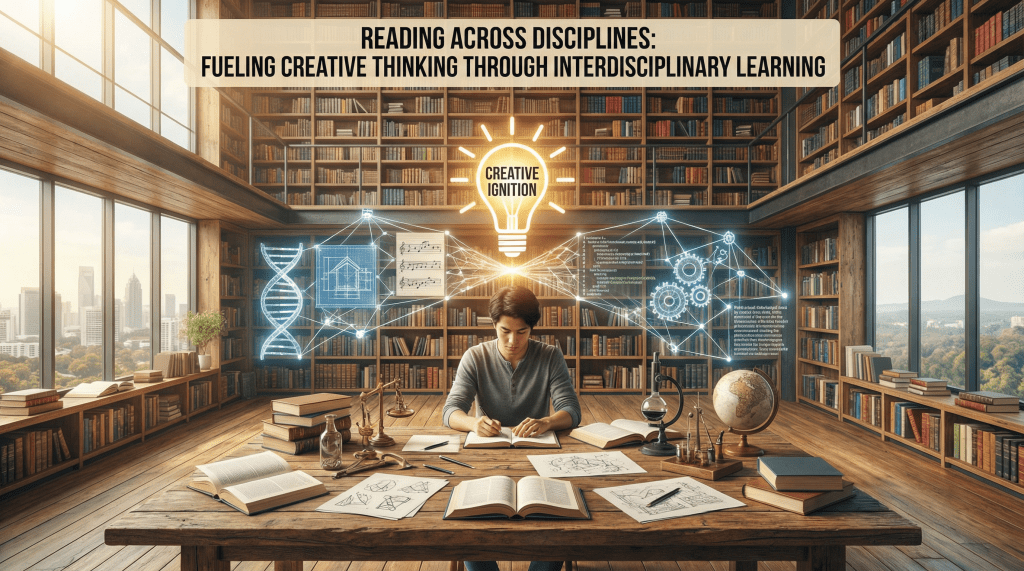
The Cognitive Architecture of Original Thought
Our brains don’t store information in neatly labeled boxes. Instead, they form vast, interconnected networks of concepts, experiences, and patterns. When you read within a single discipline, you’re strengthening existing pathways—deepening grooves that already exist. This creates expertise but can also create intellectual ruts.
Reading across disciplines, however, builds bridges between previously isolated neural networks. A study in the Journal of Creative Behavior found that individuals who regularly consumed content from diverse fields scored 34% higher on tests of creative problem-solving. Their brains had developed what researchers called “conceptual mobility”—the ability to transfer insights from one domain to another.
Consider how the structure of a tree (biology) inspired branching database architectures (computer science). Or how ant colony behavior (entomology) revolutionized logistics algorithms (operations research). These breakthroughs didn’t come from deeper specialization but from looking sideways—from connecting what others had kept separate.
The Three Mechanisms of Interdisciplinary Insight
1. Pattern Recognition Across Domains
When you read widely, you begin to notice recurring patterns that transcend individual fields. The concept of “feedback loops” appears in biology (hormonal regulation), engineering (control systems), economics (market cycles), and psychology (behavioral reinforcement). Recognizing these meta-patterns gives you a more fundamental understanding of how systems work—and how to influence them.
2. Metaphorical Thinking
Metaphors aren’t just literary devices; they’re cognitive tools that allow us to understand unfamiliar concepts through familiar ones. When physicist Richard Feynman struggled with quantum mechanics, he turned to probability theory from gambling—a seemingly unrelated field that provided the conceptual framework he needed. Reading across disciplines gives you a richer metaphorical toolkit.
3. Problem-Solving Toolkits
Every discipline develops specialized tools for solving problems. Mathematics offers precision and proof. Literature offers narrative and empathy. History offers perspective and pattern recognition. When you face a challenge in your primary field, having access to these diverse toolkits dramatically expands your solution space.
Practical Framework: The T-Shaped Mindset
The most effective thinkers today aren’t just deep specialists (I-shaped) or broad generalists (dash-shaped). They’re T-shaped: with deep expertise in one area complemented by broad understanding across many.
Building Your Horizontal Bar:
- Map Your Intellectual Ecosystem: Identify 3-4 fields adjacent to yours, then 2-3 seemingly distant ones. For a software developer, this might mean: adjacent (UI/UX design, product management), distant (architecture, cognitive psychology, poetry).
- The 70/20/10 Reading Rule: Allocate 70% of your reading to your core field (staying current), 20% to adjacent fields (expanding your toolkit), and 10% to seemingly unrelated fields (sparking creativity).
- Create Connection Rituals: After finishing a book outside your field, spend 15 minutes answering: “What does this remind me of in my work?” and “What assumption in my field does this challenge?”
Case Studies in Cross-Pollination
Steve Jobs and Calligraphy: Perhaps the most famous example. Jobs’ seemingly impractical interest in calligraphy at Reed College directly informed Apple’s focus on beautiful typography and design—a competitive advantage that shaped personal computing.
Marie Curie’s Interdisciplinary Approach: Curie didn’t just excel in chemistry or physics separately; her ability to think across both fields enabled her discovery of radioactivity and two new elements—achievements that earned her Nobel Prizes in both physics and chemistry.
James Watson and Francis Crick: Their discovery of DNA’s structure came not from deeper specialization in biology, but from incorporating insights from chemistry, physics, and—crucially—X-ray crystallography from Rosalind Franklin.
Overcoming the Barriers to Interdisciplinary Reading
The Efficiency Trap: “I should focus on what’s directly relevant to my work.” This mindset optimizes for short-term productivity at the expense of long-term breakthrough thinking. The most “relevant” reading for future breakthroughs is often what seems least relevant today.
The Imposter Syndrome: Reading outside your field means being a beginner again. Embrace the discomfort. Remember that you’re not aiming for expertise in these new fields, but for conceptual borrowing.
The Time Constraint: Start small. One interdisciplinary article per week, or 10 pages of an unrelated book each morning. These small investments compound into significant cognitive diversity.
Building Your Interdisciplinary Reading System
- Curate a Diverse “Antilibrary”: Actively maintain a collection of unread books from fields outside your expertise. Nassim Taleb’s concept of the antilibrary—valuing unread books for their potential—is particularly powerful for interdisciplinary exploration.
- Practice “Forced Connection” Exercises: Regularly take a concept from your latest interdisciplinary read and deliberately apply it to a challenge in your primary field. Write these connections down.
- Join Unusual Conversations: Participate in reading groups or forums focused on fields outside your own. Listen more than you speak. Notice the different assumptions, values, and methods.
- Create an “Insights Journal”: Maintain a dedicated notebook or digital document for connections between fields. Review it monthly to spot emerging patterns in your own thinking.
The Long Game: Compound Interest for Your Mind
The benefits of interdisciplinary reading follow a J-curve. Initially, you may feel scattered or less productive as you allocate time to seemingly unrelated material. But over months and years, the connections multiply exponentially. You develop what economist David Galenson calls “experimental innovation”—the ability to make creative leaps by combining disparate elements in novel ways.
This approach transforms your mind from a well-organized library into a living ecosystem, where ideas cross-pollinate naturally. You begin to see solutions where others see only specialization. You ask questions that don’t occur to those who stay within disciplinary boundaries.
In a world facing increasingly complex, interconnected challenges—from climate change to artificial intelligence to public health—the ability to think across disciplines isn’t just an intellectual luxury. It’s becoming an essential skill. The most pressing problems don’t respect academic boundaries; neither should our thinking.
The next breakthrough in your field might be waiting in a book from a field you’ve never considered. The connection between neuroscience and architecture might reveal how to design better workspaces. The principles of ecology might transform how you approach organizational culture. The structure of a sonnet might inspire a more elegant algorithm.
Your reading habits create the boundaries—or the bridges—of your thinking. Choose bridges.
Related Reading
If you enjoyed this exploration of how diverse inputs create better thinking, you might find value in these related pieces:
On Learning & Cognitive Systems
- How to Build a Second Brain with What You Read (No Apps Needed)
- Why Smart Readers Still Don’t Change: How to Apply What You Read
- The Reading Flywheel: How to Remember, Apply, and Learn More From Books
- Cognitive Nutrition: Why Information Quality Matters More Than Quantity
- Learning Like an Investor: How to Allocate Attention for Long-Term Growth
On Building Effective Habits & Systems
- Why Systems Beat Motivation: A Practical Framework for Health, Wealth, and Learning
- How to Build a Consistent Reading Habit That Lasts for Personal Growth
- The Compound Effect of Reading: How 20 Minutes a Day Changes a Life
- Just-in-Time Learning: Why Timing Matters More Than Volume
On Mental Clarity & Cognitive Performance
- How to Improve Mental Clarity and Make Better Decisions: Simplify Your Mind
- How to Declutter Your Mind for Better Decision Making and Mental Clarity
- Daily Reflection for Mental Clarity and Growth: The Compounding Effect on Your Thinking
- The Learning Bottleneck: Why Smart People Plateau (And How to Break Through)
 VD
VD 
Leave a comment