Most trips leave you entertained. The best ones leave you transformed. Here’s how to design travel that improves your body, sharpens your mind, and deepens your self-awareness — without turning your trip into a productivity project.
There’s a version of travel where you come home with hundreds of photos, a few restaurant recommendations, and a vague sense that it was “really great.” And then there’s a version where you return genuinely changed — fitter, sharper, calmer, more self-aware.
The difference isn’t the destination. It’s the design.
Most people treat travel as a break from their life. But what if travel could be an accelerator for the things that matter most — your health, your learning, your clarity of thought? Not by turning every trip into a bootcamp or a masterclass, but by layering small, intentional habits into the natural rhythm of exploration.
That’s the idea behind Travel Stacking — a simple framework for combining fitness, learning, and reflection into any trip, without sacrificing the joy of discovery or the freedom of being somewhere new.
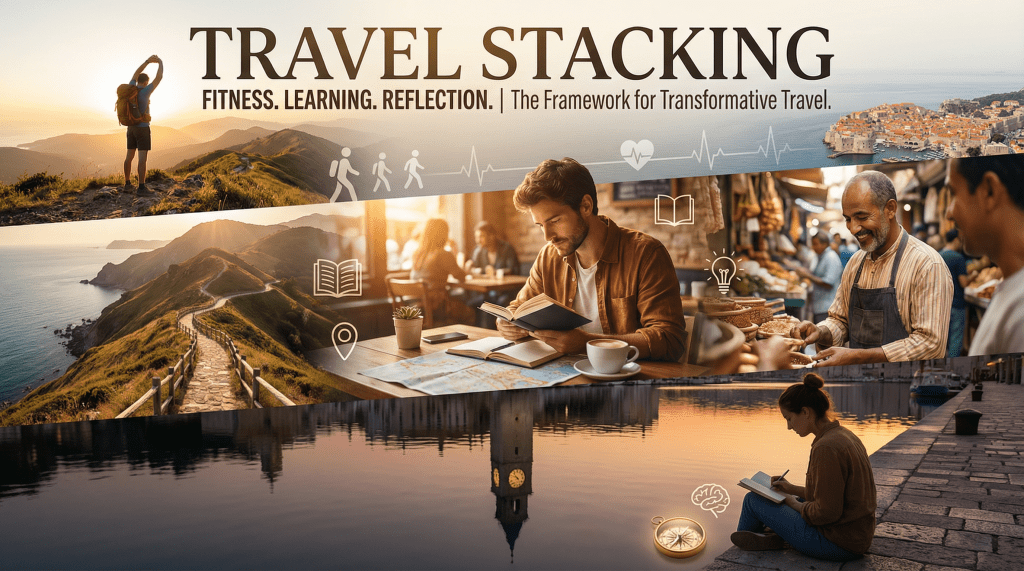
What Is Travel Stacking?
Travel Stacking is the practice of intentionally layering multiple dimensions of personal growth into a single trip. Instead of isolating travel as “leisure” and personal development as “work,” you integrate them — so that every trip becomes a compound experience.
Think of it like habit stacking, but for travel. You’re not adding a rigid schedule to your itinerary. You’re embedding small, flexible practices into the natural flow of your trip that make you healthier, smarter, and more reflective — almost without noticing.
The three layers of a stacked trip are:
- Fitness — movement, physical challenge, body awareness
- Learning — curiosity, new knowledge, mental stimulation
- Reflection — journaling, thinking, integrating experiences
When all three are present, even a short trip can leave you feeling more energized and aligned than a two-week vacation spent passively consuming experiences.
Layer 1: Fitness — Moving With the Place
The easiest way to stay physically active while traveling is to stop thinking of fitness as something separate from your trip. The trip itself is the workout — if you design it that way.
Walk as your default mode of transport. Most travelers underestimate how much walking reshapes a trip. When you walk through a city instead of taking cabs or metros, you don’t just burn calories — you notice more, stumble into unexpected places, and develop a physical memory of the place that sticks longer than any photograph.
Use the terrain. Every destination offers unique movement opportunities. A beach town gives you swimming and sand runs. A mountain town gives you hikes and elevation training. A dense city gives you stairs, bridges, and urban exploration on foot. Instead of searching for a gym, ask yourself: what does this place naturally invite my body to do?
Anchor one physical ritual. Choose one non-negotiable movement practice that travels with you — something that doesn’t require equipment or planning. It could be a 15-minute morning stretch, a bodyweight circuit on your hotel room floor, or a sunrise walk before the city wakes up. This anchor keeps your body calibrated regardless of time zone, jet lag, or schedule changes.
Explore actively, not passively. Rent a bike instead of booking a bus tour. Take the stairs to the viewpoint instead of the cable car. Kayak to the island instead of taking the ferry. These aren’t extreme choices — they’re small upgrades that turn passive sightseeing into active engagement with the place.
The goal isn’t to maintain your regular training program while traveling. It’s to move in ways that the destination makes possible — and to come home feeling physically better than when you left.
Layer 2: Learning — Feeding Your Curiosity
Travel is inherently educational, but most travelers absorb information passively — a plaque at a museum, a caption on an audio guide, a Wikipedia article skimmed the night before. Travel Stacking means making learning intentional, so that your trip becomes a real-time classroom.
Read one book connected to your destination. This is the highest-leverage learning habit you can build into any trip. Read a novel set in the city you’re visiting, a history of the region, or a memoir by someone who lived there. When you walk through a neighborhood you’ve read about, the experience transforms from surface-level tourism into something layered and meaningful. The place comes alive in a way that no guided tour can replicate.
Talk to locals with genuine curiosity. Every conversation with a local is a primary source. Ask the café owner why they chose this neighborhood. Ask the bookshop keeper what’s changed about the city. Ask your taxi driver what visitors always get wrong. These conversations won’t show up in your itinerary, but they’ll be the moments you remember most vividly.
Learn one new skill tied to the place. Take a cooking class in Oaxaca. Learn three phrases in Japanese before your trip to Kyoto. Try a local martial art in Thailand. Join a pottery workshop in Portugal. You don’t need to master anything — you just need to engage with the place through a skill, not just through observation. Skills create muscle memory, and muscle memory anchors learning far deeper than sightseeing ever could.
Carry a “curiosity list.” Before your trip, write down five questions you’re genuinely curious about — not things to see, but things to understand. Why does this city feel different from others? How do people here think about time, food, or community? What can this place teach me about how I want to live? These questions give your trip a quiet intellectual structure that turns wandering into inquiry.
The shift here is subtle but powerful. You’re not adding homework to your vacation. You’re giving your natural curiosity a framework — so that learning happens through the trip, not despite it.
Layer 3: Reflection — Processing What You Experience
This is the layer most travelers skip entirely — and it’s the one that makes the biggest difference.
Without reflection, experiences accumulate but don’t integrate. You visit ten countries but can’t articulate what any of them taught you. You see extraordinary things but forget how they made you feel. Reflection is what turns raw experience into lasting personal growth.
Journal for 10 minutes a day. It doesn’t need to be literary. It doesn’t need to be profound. Just write what you noticed today — what surprised you, what challenged you, what felt different from home. This practice alone will triple your retention of the trip and reveal patterns in your thinking that you’d never notice otherwise.
Build in deliberate solitude. Not loneliness — solitude. Find one hour per day where you sit alone with your thoughts. A café without your phone. A park bench at sunset. A quiet courtyard in the morning. Travel bombards your senses with new stimuli, and without space to process that input, it becomes noise. Solitude is where signal emerges from the noise.
Ask yourself one question each evening. Make it the same question every night. Some powerful options:
- What did I learn about myself today?
- What assumption did this place challenge?
- What would I do differently if I lived here?
- What am I carrying that I don’t need — physically or mentally?
The repetition matters. Asking the same question in different contexts across different days reveals how your thinking evolves throughout the trip. By the end, your answers form a narrative — one that tells you more about yourself than any personality test ever could.
Capture one takeaway before you leave. On your last day, before the packing frenzy begins, write down one sentence: the single most important thing this trip taught you. Not the best meal. Not the most beautiful view. The one insight, shift, or realization you want to carry home. This is the return on your travel investment — the thing that makes the trip matter long after the tan fades.
How to Stack Without Over-Planning
The biggest objection to Travel Stacking is usually: “I don’t want my trip to feel like a schedule.”
It shouldn’t. The entire point is that these layers are lightweight and flexible. Here’s a sample day that integrates all three without any rigid planning:
- Morning: Wake up, stretch for 10 minutes in your room. Walk to a local café (fitness). Read 20 pages of a book about the city (learning). Write in your journal while sipping coffee (reflection).
- Midday: Explore a neighborhood on foot (fitness). Visit a local market or workshop. Ask three questions to someone you meet (learning).
- Evening: Sit alone at a rooftop or park for 30 minutes (reflection). Reflect on your daily question. Enjoy dinner — no agenda, no optimization, just presence.
That’s it. No gym. No classroom. No meditation retreat. Just a day of travel with three thin layers of intention woven through it.
Why Stacked Trips Compound
The real power of Travel Stacking reveals itself over multiple trips. Each stacked trip builds on the last. Your fitness improves because you stop losing momentum between trips. Your learning deepens because you start connecting ideas across destinations. Your self-awareness grows because you have a growing journal of reflections that maps your evolution as a person.
Over time, you stop asking “Where should I go next?” and start asking “Who do I want to become next — and which trip will get me closer?”
That’s the shift from travel as consumption to travel as compounding. And once it starts, every trip becomes more valuable than the last.
Start Small, Stack Gradually
You don’t need to implement all three layers on your next trip. Start with one. If you already walk a lot when you travel, add the learning layer — bring a book connected to your destination. If you already read while traveling, add reflection — journal for 10 minutes each morning.
The magic isn’t in doing everything at once. It’s in recognizing that travel is one of the richest environments for personal growth — if you bring even a small amount of intention to it.
Your next trip doesn’t have to be longer, more expensive, or more exotic. It just has to be a little more stacked.
Related Reading
If this post resonated with you, here are some related posts from the blog that explore these ideas further:
- How to Use Travel for Personal Growth and Self-Discovery: Unlock Your True Potential
- Mental Carry-On: How to Learn From Travel (Not Just Visit Places)
- Why Rest Days Are the Secret to Better Travel: How Doing Less Helps You Experience More
- How to Create a Meaningful Travel Itinerary for Personal Growth and Self-Discovery
- The Energy Budget of Travel: How to Avoid Travel Fatigue and Explore Without Exhaustion
- The Return on Travel: How Travel Builds Skills, Perspective, and Long-Term Value
- Travel That Pays You Back: How Travel Builds Skills and Expands Your Perspective
- Why Getting Lost Improves Memory, Creativity, and Thinking
- Slow Travel: Why Staying Longer Saves Money and Creates Richer Experiences
- Why Repeating Destinations Beats Chasing New Ones: The Case for Slow Travel
- How to Build a Portfolio of Meaningful Experiences for Long-Term Personal Growth
- Travel as Therapy: How Exploring New Places Boosts Mental Health
- Why Travel in Chapters Works Better Than Checklists
- Comfort-Optimized Travel: Simple Systems That Reduce Stress and Save Time
- How to Travel Like a Local — Even If You Only Have One Day
- Digital Sabbaticals: How to Travel to Disconnect (Not Just Work Remotely)
- The Art of Coming Home: How Travel Redefines Your Routine
 VD
VD 
Leave a comment