Most people treat books like lectures. The author speaks, the reader listens, and the words flow in one direction—from the page into a mind that rarely pushes back. We highlight passages that sound profound, nod along with arguments that feel intuitive, and close the cover believing we’ve learned something simply because we consumed something.
But consumption isn’t comprehension. And agreement isn’t understanding.
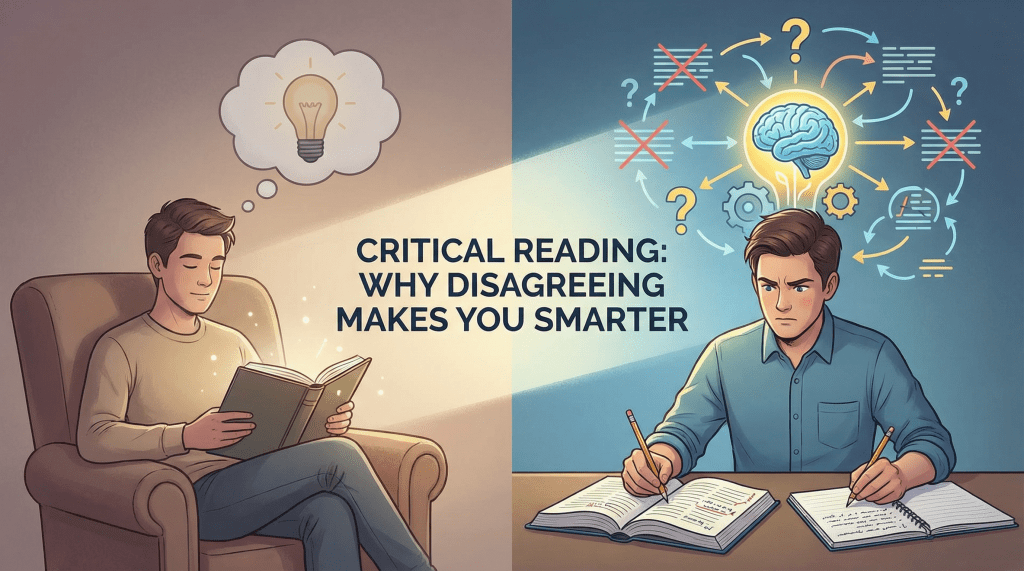
The readers who grow the fastest, think the sharpest, and retain the most aren’t the ones who read passively. They’re the ones who argue with what they read. They question assumptions, challenge conclusions, and test the author’s logic against their own experience. They treat reading not as reception but as conversation—one where they have just as much right to speak as the person who wrote the book.
This isn’t about being contrarian for the sake of it. It’s about developing the intellectual muscle that separates someone who reads a lot from someone who thinks well. And that distinction matters more than most readers realize.
The Problem With Passive Reading
There’s a quiet assumption baked into how most of us learn to read: the author knows more, so your job is to absorb. This works well enough in school, where textbooks carry institutional authority and exams reward recall over reasoning. But it creates a dangerous habit that follows us into adulthood—the habit of intellectual submission.
When you read passively, you outsource your thinking. You let someone else’s framework become your framework without ever stress-testing it. You adopt conclusions without examining the premises they rest on. And because the author’s argument is polished, edited, and persuasive, it feels true—even when it’s incomplete, biased, or built on shaky evidence.
The result is a strange paradox: the more you read, the less original your thinking becomes. You accumulate other people’s ideas without developing the capacity to evaluate them. Your mental library grows, but your intellectual independence shrinks.
Passive reading also cripples retention. Neuroscience consistently shows that the brain encodes information more deeply when it’s actively processed—when you wrestle with it, connect it to prior knowledge, or generate your own response. Simply running your eyes over words and agreeing doesn’t create durable memory. It creates the illusion of learning.
What Critical Reading Actually Means
Critical reading is not cynicism. It’s not approaching every book with suspicion, looking for reasons to dismiss what the author says. That’s just a different kind of intellectual laziness—one that protects you from changing your mind by refusing to engage honestly.
True critical reading means engaging with a text on equal footing. It means reading generously enough to understand what the author is actually arguing—their strongest case, not a strawman version of it—and then evaluating whether that argument holds up under scrutiny.
Mortimer Adler, in his classic How to Read a Book, described this as the difference between being an “informed” reader and an “enlightened” one. An informed reader can tell you what a book says. An enlightened reader can tell you whether it’s right, and why.
This requires a specific set of mental moves: identifying the author’s key claims, understanding the evidence supporting those claims, recognizing unstated assumptions, considering alternative explanations, and determining whether the conclusions actually follow from the premises. It’s rigorous work. It’s also deeply rewarding, because it transforms reading from passive absorption into active thinking.
The goal isn’t to disagree with everything. The goal is to earn your agreement. When you’ve genuinely interrogated an argument and still find it compelling, your understanding of it is orders of magnitude deeper than if you’d simply nodded along.
Why Disagreement Makes You Smarter
Disagreeing with a book forces cognitive engagement in ways that agreement never can. When you agree with something, there’s nothing for your brain to resolve. The information slides neatly into your existing mental models, and your mind moves on. But when something strikes you as wrong, incomplete, or questionable, your brain activates. It searches for counterexamples, retrieves competing frameworks, and generates its own arguments. This is where real thinking happens.
It exposes your own assumptions. When you push back against an author’s claim, you’re forced to articulate why you disagree. That process often reveals assumptions you didn’t know you held. Maybe you reject a behavioral economist’s argument about irrationality because you’re unconsciously committed to a model of human agency you’ve never examined. The disagreement doesn’t just tell you about the book—it tells you about yourself.
It strengthens your reasoning. Constructing a counterargument requires the same skills as building an original argument: marshaling evidence, identifying logical connections, anticipating objections. Every time you disagree thoughtfully with a book, you’re practicing the architecture of clear thinking. Over time, this makes you better not just at reading, but at writing, speaking, and making decisions.
It deepens comprehension. To disagree intelligently, you must first understand the argument you’re disagreeing with. You can’t critique a position you haven’t fully grasped. This forces you to read more carefully, to slow down at the points where the author’s reasoning is most intricate, and to distinguish between central claims and peripheral observations. Paradoxically, the effort to disagree often produces a better understanding of the book than if you’d simply agreed.
It builds intellectual independence. Every act of thoughtful disagreement is an act of intellectual autonomy. It’s a declaration that you’re not just a receptacle for other people’s ideas—you’re a thinker in your own right, capable of evaluating claims on their merits. Over months and years of practice, this compounds into something invaluable: a mind that thinks for itself.
How to Practice Critical Reading
Critical reading is a skill, and like any skill, it improves with deliberate practice. Here are concrete techniques you can start using immediately.
1. Read With a Pencil, Not a Highlighter
Highlighting feels productive, but it’s largely passive. You’re marking someone else’s words without generating your own. Instead, write in the margins. Record your reactions in real time: “Is this actually true?” “What’s the evidence for this?” “This contradicts what I read in [other book].” “I disagree because…” These marginal notes create a dialogue between you and the author. They also serve as anchors for memory—when you revisit the book later, your own thinking comes back to you alongside the author’s.
2. Identify the Author’s Core Argument
Before you can evaluate a book, you need to know what it’s actually claiming. Many readers get lost in the details and miss the central thesis. After finishing a chapter or section, pause and ask: What is the author’s main point? What evidence supports it? What would have to be true for this argument to hold? This disciplined summarizing prevents you from engaging with surface-level details while missing the structural argument underneath.
3. Steel-Man Before You Critique
Before you disagree, make sure you can state the author’s position in its strongest possible form—strong enough that the author would say, “Yes, that’s exactly what I mean.” This is called steel-manning, and it’s the opposite of the straw man fallacy. It forces intellectual honesty. If you can’t articulate the strongest version of an argument, you haven’t understood it well enough to disagree with it.
4. Ask “What’s Missing?”
Every book is a selection. The author chose to include certain evidence, perspectives, and examples while excluding others. Sometimes those exclusions are innocent—no book can cover everything. But sometimes they’re strategic, designed to make the argument look more airtight than it is. Ask yourself: What perspectives are absent? What evidence would weaken this claim? What does the author not address?
5. Cross-Reference With Other Sources
No book exists in isolation. The richest critical reading happens when you bring multiple sources into conversation with each other. If you’re reading a book on productivity, compare its claims with what you’ve read about neuroscience, behavioral psychology, or even philosophy. Where do the sources agree? Where do they conflict? The intersections and contradictions are where the most interesting thinking lives.
6. Separate the Person From the Argument
One of the most common barriers to critical reading is authority bias—the tendency to accept claims because of who made them rather than the strength of the evidence. A Nobel laureate can make a weak argument. A first-time author can make a brilliant one. Evaluate the reasoning, not the résumé. This doesn’t mean ignoring expertise—it means not letting it substitute for your own judgment.
7. Keep a Disagreement Journal
After finishing a book, write down two or three points where you disagreed with the author. For each point, articulate your counterargument. This practice does two powerful things: it forces you to consolidate your critical thinking into clear language, and it creates a record of your intellectual development over time. Reviewing this journal periodically reveals how your thinking has evolved—which disagreements you’ve maintained, which you’ve reversed, and which have led you to entirely new questions.
The Books That Change You Are the Ones That Challenge You
There’s a comfortable reading life available to anyone who wants it. You can read books that confirm what you already believe, that echo your existing worldview, and that leave your mental models undisturbed. It’s pleasant. It’s also stagnant.
The books that genuinely change your thinking are rarely the ones you agree with completely. They’re the ones that create what psychologists call cognitive dissonance—the uncomfortable tension between what you believed before and what the author is proposing. That discomfort is a signal. It means your brain is being stretched, your assumptions are being tested, and your intellectual boundaries are being pushed.
This doesn’t mean you should seek out books you’ll hate. It means you should seek out books that make you work. Books that present unfamiliar arguments with enough rigor that you can’t dismiss them easily. Books that force you to either update your thinking or articulate clearly why you won’t.
The philosopher John Stuart Mill put it well: “He who knows only his own side of the case knows little of that.” Understanding opposing arguments doesn’t weaken your position—it fortifies it. If your ideas can survive contact with the strongest counterarguments, they’re robust. If they can’t, it’s better to know now.
From Reader to Thinker
The shift from passive reading to critical reading is really a shift in identity. You stop being a consumer of ideas and become a participant in them. You stop asking “What does this book say?” and start asking “What do I think about what this book says?” It’s a small grammatical change that represents a profound intellectual one.
This doesn’t happen overnight. The first few times you try to argue with a book, it might feel awkward or even disrespectful—as if you’re being ungrateful for the author’s work. Push through that feeling. The best authors don’t want uncritical devotion. They want engaged readers who take their ideas seriously enough to challenge them.
Start small. Pick one book you’re currently reading and commit to writing three marginal notes per chapter—not highlights, but responses. Questions, objections, connections, counterexamples. Do this for a month and notice what happens. Your reading will slow down. Your comprehension will speed up. And your thinking will sharpen in ways that no amount of passive reading could ever produce.
Because the point of reading was never to agree with books. It was to think better. And thinking better starts the moment you give yourself permission to disagree.
Related Reading
If this post resonated with you, explore these related articles on reading, learning, and sharper thinking:
- Cognitive Friction: Why Some Books Change Your Thinking (and Others Don’t)
- Why Smart Readers Still Don’t Change: How to Apply What You Read
- How to Improve Your Thinking: Why Reading Alone Isn’t Enough
- Marginalia Magic: How Writing in Books Improves Comprehension and Critical Thinking
- The Reading Afterlife: What to Do After You Finish a Book to Remember and Apply It
- Reading Across Disciplines: How Interdisciplinary Learning Fuels Creative Thinking
- Learning in Layers: Why Rereading Books Unlocks Deeper Insights
- How to Understand Any Book Better: The 3-Pass Reading System Explained
- The Learning Bottleneck: Why Smart People Plateau (And How to Break Through)
- How to Read Books That Change You — Not Just Inform You
- Cognitive Nutrition: Why Information Quality Matters More Than Quantity
- The Reading Flywheel: How to Remember, Apply, and Learn More From Books
 VD
VD 
Leave a comment