You spent years optimizing, saving, and sacrificing. You tracked every dollar, ran the spreadsheets, and finally hit the number. You reached financial independence. Congratulations — you’ve won the game most people don’t even know they’re playing.
So why does it feel so… strange?
The Arrival Paradox
There’s a phenomenon that nobody in the FIRE (Financial Independence, Retire Early) community talks about enough. You work relentlessly toward a goal for five, ten, maybe fifteen years. Then you arrive. And instead of the euphoria you expected, you feel something closer to disorientation.
You wake up on a Monday morning with nowhere to be. No Slack messages. No standup meetings. No deadlines. The structure that once suffocated you is gone. And in its absence, you feel not freedom — but emptiness.
This is the arrival paradox. The moment you reach the destination you fantasized about for years, you realize the journey was carrying more meaning than you thought. Not because the job was fulfilling — but because it answered a question you never had to consciously ask yourself:
Who am I?
For most of your adult life, your job answered that for you. You were a developer, a consultant, a manager, a founder. Your title gave you a tribe, a schedule, a social identity, and a purpose — even if that purpose was just “get through the week.”
Financial independence strips that away. And what’s left underneath is often… unclear.
Why Identity and Career Are So Dangerously Intertwined
We live in a culture that equates productivity with value. From the time we’re children, we’re asked, “What do you want to be when you grow up?” Not how do you want to live. Not what kind of person do you want to become. But what do you want to do — implying that your worth is tied to your output.
By the time you reach adulthood, this belief is deeply embedded. Your job becomes the lens through which you see yourself and the shorthand others use to understand you.
Think about what happens at a dinner party. Within the first five minutes, someone asks, “So, what do you do?” Your answer shapes how they perceive you — and, more dangerously, how you perceive yourself.
When you leave that behind through financial independence, you’re not just leaving a paycheck. You’re leaving an identity infrastructure. And most people don’t build a replacement before they exit.
That’s the root of the crisis.
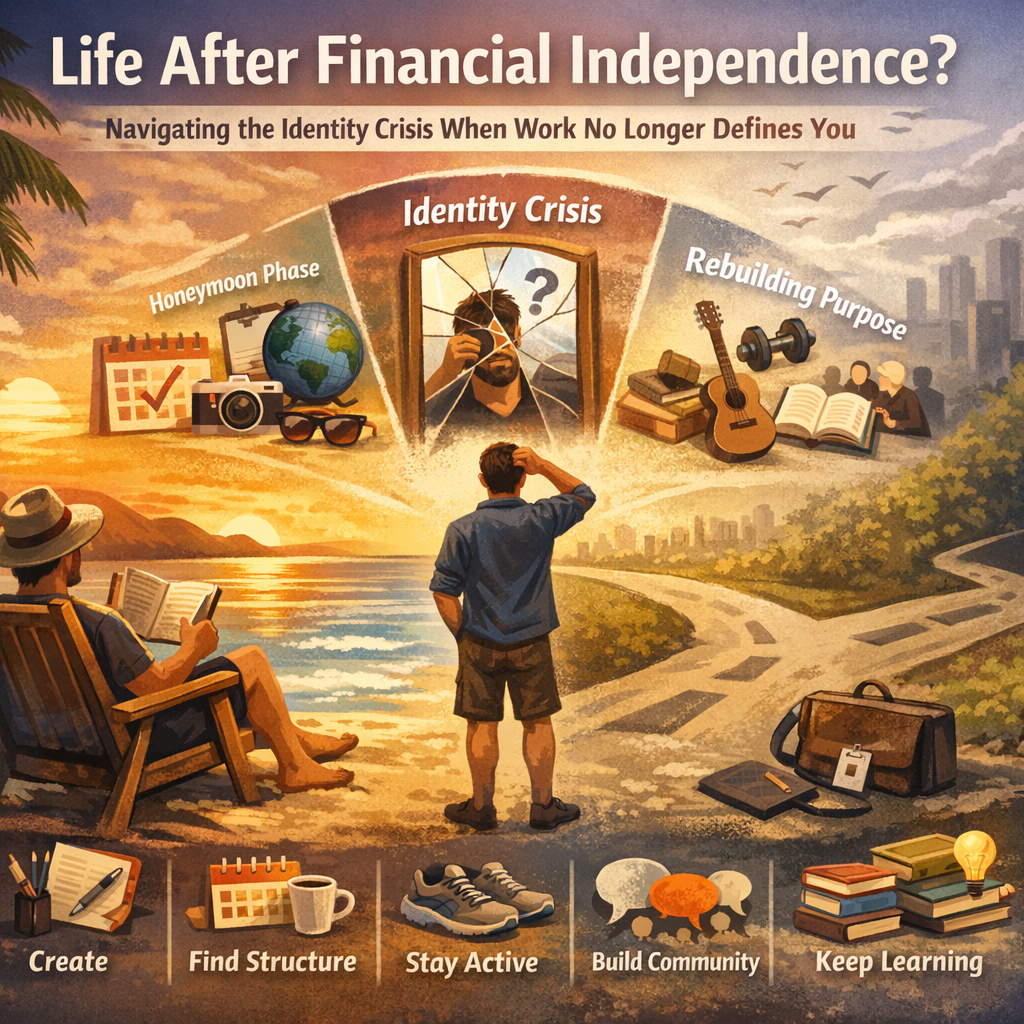
The Three Phases of Post-FIRE Identity
Based on patterns across the FIRE community and my own experience, the identity shift after financial independence tends to unfold in three distinct phases.
Phase 1: The Honeymoon (Weeks 1–8)
Everything feels amazing. You sleep in. You travel. You read books at 2 PM on a Wednesday. You feel smug walking past office buildings. You tell yourself, “I can’t believe people are still doing that.”
This phase is real, and you should enjoy it. But it’s also temporary.
Phase 2: The Drift (Months 2–6)
The novelty fades. You start to feel restless. Days blur together. You catch yourself scrolling your phone for hours, not because you’re lazy, but because you have no structure to anchor your time.
You might feel guilty for not being “productive.” You might start questioning whether FIRE was the right decision. Some people quietly go back to work during this phase — not because they need the money, but because they need the meaning.
This is the dangerous phase. Not because anything is wrong, but because the discomfort can trick you into retreating to old patterns instead of building new ones.
Phase 3: The Reconstruction (Months 6–18+)
This is where the real work begins. You start experimenting. You try new routines, hobbies, projects, and relationships. Some stick. Most don’t. But slowly, you begin to construct an identity that isn’t borrowed from a job title — it’s built from values, curiosity, and intentional living.
This phase doesn’t have a clean ending. It’s an ongoing process. But it’s also where the deepest growth happens.
The Five Pillars of Post-FIRE Identity
If your job was the scaffolding of your identity, you need new pillars to hold up the structure. Here are five that consistently help people navigate the transition.
1. Craft Something — Anything
Humans need to make things. It’s wired into us. Without creative output, we stagnate.
This doesn’t mean you need to start a business or monetize a hobby. It means you need a craft — something you can improve at over time that gives you a sense of progression.
Write. Build furniture. Code open-source tools. Cook elaborate meals. Garden. Paint. The medium doesn’t matter. What matters is the loop: effort → improvement → satisfaction.
Financial independence gives you the rare luxury of pursuing craft without the pressure of profit. Use it.
2. Maintain a Structure (Even a Loose One)
Total freedom sounds appealing in theory. In practice, it’s paralyzing. Without any structure, your days become amorphous, and amorphous days lead to existential drift.
You don’t need a rigid schedule. But you need anchors — a morning routine, a weekly rhythm, recurring commitments that give your week a shape.
The irony of FIRE is that the people who thrive after reaching it are the ones who voluntarily reintroduce structure. Not because they have to, but because structure is the container that makes freedom usable.
3. Stay Physically Engaged
When you lose the external accountability of a workplace, your body is often the first casualty. Without a commute, meetings to walk to, or even the social pressure of being seen, it’s easy to become sedentary.
But physical engagement isn’t just about health. It’s about identity. When you train consistently — whether it’s lifting, walking, swimming, or yoga — you build a self-concept rooted in something tangible.
“I’m someone who moves every day” is a small identity statement, but it’s a powerful one. It gives you something to be, independent of any job.
4. Cultivate Relationships Outside of Work
One of the most underestimated losses of leaving work is the loss of casual social interaction. You don’t realize how much of your social life was subsidized by your job until it’s gone.
After FIRE, you have to be intentional about relationships. Join a community. Volunteer. Take a class. Show up to the same coffee shop every morning. Build the kind of weak-tie social connections that used to happen automatically.
Loneliness after FIRE is more common than people admit. And it’s not solved by having a partner or family. It’s solved by having a community — a group of people who expect to see you regularly.
5. Develop a Learning Practice
Without the forced learning of a career — new tools, new challenges, new problems — your intellectual growth can flatline quickly.
A deliberate learning practice fills this gap. Read across disciplines. Take online courses. Attend lectures. Write about what you’re learning. Teach others.
The goal isn’t to accumulate knowledge for its own sake. It’s to maintain the feeling of growth — the sense that you’re becoming someone slightly different, slightly better, than you were last month.
This is perhaps the most sustainable source of post-FIRE identity: the person who is always learning.
Redefining Success Without a Salary
Here’s the deeper challenge: after FIRE, you need a new definition of success.
For years, success had clear metrics — savings rate, net worth, investment returns, maybe a promotion or a raise. These numbers gave you feedback. They told you whether you were on track.
After FIRE, those metrics become irrelevant. Your net worth still matters, but optimizing it is no longer the game. And without a new scoreboard, you can feel like you’re living without direction.
The shift is this: success moves from external metrics to internal ones.
- Did I spend today doing something meaningful?
- Am I healthier than I was six months ago?
- Did I learn something that changed how I think?
- Did I connect with someone in a real way?
- Am I living in alignment with my values?
These questions don’t produce neat numbers. They produce something better — clarity.
The Identity You Build Is Better Than the One You Borrowed
Here’s what nobody tells you about the post-FIRE identity crisis: it’s a feature, not a bug.
The identity you had before — the one built on your job title, your salary, your role in someone else’s organization — was borrowed. It was convenient, but it wasn’t really yours. It was shaped by external expectations, social norms, and economic necessity.
The identity crisis after FIRE is your chance to build something authentic. It’s uncomfortable because authentic things always are. They require you to sit with uncertainty, to experiment, to fail, and to keep going.
But the identity that emerges on the other side — built from your values, your curiosity, your relationships, and your craft — is more resilient, more fulfilling, and more genuinely yours than anything a job title could ever provide.
The Real FIRE Journey Starts After the Number
The financial part of FIRE is the easy part. It’s math. It’s discipline. It’s patience.
The hard part – the part that truly changes your life – is what comes after. It’s learning to live without the scaffolding of work. It’s building an identity from the inside out. It’s answering the question, “Who am I when nobody’s paying me to be someone?”
That question is terrifying. It’s also the most important question you’ll ever answer.
And the beautiful thing about financial independence is that it gives you the time, the space, and the freedom to answer it honestly.
Don’t waste that gift by going back to the way things were. Sit in the discomfort. Build something new. Become someone you chose to be — not someone you were hired to be.
That’s the real return on FIRE. Not the money. The meaning.
Related Reading
If this post resonated with you, here are some related articles from the blog that explore similar themes:
- Why Financial Independence Is Really About Slack (Not Early Retirement)
- The Boring Middle of FIRE: How to Stay Consistent While Compounding Works
- The Psychology of Enough: How to Redefine Wealth Beyond Money
- FIRE as a Lifestyle Upgrade, Not a Career Downgrade
- Financial Independence is a Skill, Not a Number
- Coast FIRE Explained: The Ultimate Lifestyle Upgrade for People Who Don’t Hate Their Jobs
- How to Recover from Burnout and Rebuild Your Energy After a Long Stint at Work
- The Second-Order Effects of Frugality: When Saving Money Starts to Cost You
- Why Your FIRE Progress Feels Slow (And What to Do About It)
- How to Build a Healthy Morning Routine for Wealth, Focus, and Productivity
- Time vs Money: Which One Compounds Faster for Long-Term Freedom?
- Lifestyle Prototyping: How to Test-Drive a New Life Before You Commit
Have you experienced the identity shift after reaching financial independence — or are you preparing for it? I’d love to hear your story.
 VD
VD 
Leave a comment