Why your growing pile of unread books isn’t a problem to solve — it’s a sign you’re doing something right.
Let me describe a scene you probably know well.
There’s a stack of books on your nightstand. Maybe another pile on your desk. A few more on the shelf that still have that uncracked spine. Your Kindle library has thirty-seven books downloaded, fourteen of which you’ve opened, six of which you’ve read past chapter three, and two of which you’ve actually finished.
You keep buying books. You keep adding titles to your list. Friends recommend something, you order it. A podcast mentions a must-read, you download it. You walk past a bookstore and somehow walk out with three new additions to what is already a small, guilt-inducing library of good intentions.
And somewhere beneath the excitement of each new acquisition, there’s a quiet, nagging voice:
You’re falling behind. You’ll never read all of these. Why do you keep buying books you don’t finish?
That voice has a name. I call it reading debt.
And today, I want to convince you that it’s not the problem you think it is.
What Is Reading Debt?
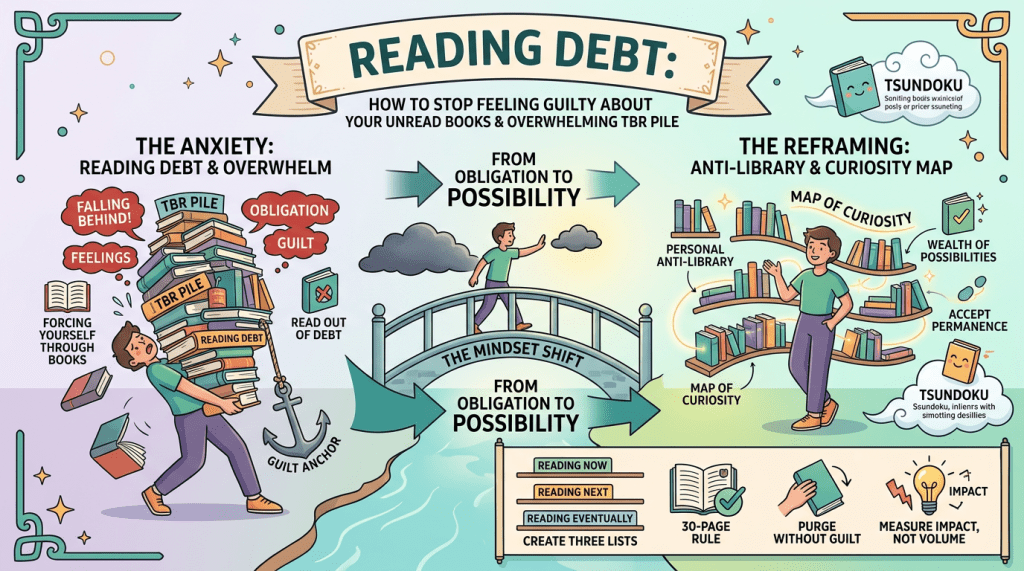
Reading debt is the psychological weight of the gap between the books you own and the books you’ve read. It’s that low-grade anxiety that comes from watching your TBR (To Be Read) pile grow faster than your reading pace could ever match.
It borrows its logic from financial debt — the idea that every unread book is an obligation. A promise you made to yourself that you haven’t kept. A purchase that hasn’t delivered its return.
And just like financial debt, reading debt creates stress, shame, and avoidance. People stop buying books because they feel guilty about the ones they haven’t read. They force themselves through books they don’t enjoy just to “clear the backlog.” They start measuring their reading life not by what they’ve gained, but by what they haven’t gotten to yet.
This is a terrible way to relate to books. And it’s built on a fundamentally flawed assumption.
The assumption is that every book you buy is a book you’re supposed to read.
It’s not.
The Anti-Library: Reframing Your Unread Books
The writer and scholar Nassim Nicholas Taleb has a beautiful concept for this. He calls it the anti-library.
Taleb describes the massive personal library of the Italian writer Umberto Eco — roughly 30,000 books, the vast majority of which Eco had never read. When visitors marveled at the collection and asked, “Have you read all of these?” they were missing the point entirely.
The unread books were the point.
An anti-library is not a trophy case. It’s a research tool. It represents the boundaries of what you don’t yet know. Each unread book is a reminder that there’s more to learn, more to explore, more to understand. The library isn’t there to impress anyone. It’s there to keep you humble and curious.
Your TBR pile is your personal anti-library. It’s not a backlog of failures. It’s a map of your curiosity.
When you reframe it this way, the guilt dissolves. You don’t owe your bookshelf anything. Your bookshelf owes you nothing. It’s a collection of possibilities, not a list of obligations.
Why We Accumulate More Books Than We Can Read
Before we go further, let’s understand why reading debt happens in the first place — because the causes are actually quite healthy.
1. Your Curiosity Grows Faster Than Your Reading Speed
This is a good problem to have. It means you’re intellectually alive. You’re encountering ideas, following threads, and discovering new fields faster than any single human could consume them.
The alternative — having no interest in new books — is far worse than having too many to read.
2. Recommendations Come at the Wrong Time
Someone suggests a book about stoic philosophy when you’re deep in a phase of reading about nutrition. You add it to the list because it genuinely interests you — just not right now.
This is temporal mismatch, not irresponsibility. The book isn’t wrong. The timing is.
3. Your Identity as a Reader Evolves
The books you bought two years ago were bought by a different version of you. Your interests shift. Your questions change. The book that seemed urgent in 2023 may feel irrelevant in 2026 — and that’s perfectly fine.
You are not obligated to honor the reading preferences of your past self.
4. Buying Books Is a Low-Cost Bet on Future Interest
When you buy a book, you’re not committing to read it. You’re placing a small bet that it might be valuable at some point. Some bets pay off immediately. Some pay off years later. Some never do. That doesn’t make them bad bets — it makes them options.
This is exactly how an investor thinks about optionality. You acquire the option. You exercise it if and when it makes sense. There’s no penalty for letting it expire.
The Real Cost of Reading Guilt
Here’s the thing about reading debt — left unchecked, the guilt doesn’t motivate you to read more. It makes you read worse.
You Force-Finish Books You Don’t Enjoy
This is the most common symptom. You’re 80 pages into a book that isn’t working for you, but you keep going because quitting feels like failure. So you drag yourself through 250 more pages of diminishing returns, resenting every chapter.
Life is too short, and books are too numerous, to finish ones that aren’t serving you. Quitting a book isn’t failure. It’s curation.
You Read Out of Obligation, Not Curiosity
When your reading life becomes about clearing a backlog, you stop reading for the right reasons. You read to reduce guilt rather than to feed curiosity. The experience shifts from exploration to obligation — and reading-as-obligation is one of the fastest ways to kill a reading habit entirely.
You Stop Buying Books That Excite You
Some people respond to reading guilt by imposing a moratorium on new purchases. “I’m not buying anything until I finish what I have.”
This sounds disciplined. In practice, it’s stifling. It cuts off the spontaneous discovery that makes reading alive. It turns your bookshelf into a closed system when it should be an open, evolving one.
You Measure Progress by Volume, Not Impact
Reading guilt pushes you toward quantity metrics. How many books did I read this year? This leads to choosing shorter books, easier books, faster books — not necessarily better ones.
A single book that changes how you think is worth more than twenty books you sped through and forgot.
How to Manage Your TBR Without Guilt: A Practical Framework
The goal isn’t to eliminate your TBR pile. It’s to change your relationship with it. Here’s how.
1. Accept the Pile as Permanent
Your TBR will never be at zero. Not because you’re failing, but because you’re curious. Stop treating it as a problem to solve and start treating it as a garden to tend. Some books will bloom now. Some later. Some never. All of them contributed to the landscape.
2. Use the “Right Book, Right Time” Principle
Instead of reading books in the order you bought them, ask yourself a different question:
“What question am I sitting with right now? What season of life am I in? Which book on my shelf speaks to where I am today?”
The best book to read next isn’t the oldest one on your list. It’s the most relevant one.
A book about career transitions hits differently when you’re actually in one. A book about solitude lands deeper when you’ve just come off a crowded, exhausting month. Timing transforms a good book into a life-changing one.
3. Adopt the 30-Page Rule
Give every book 30 pages. If it hasn’t earned your attention by then — if you’re not curious, engaged, or provoked — put it down without guilt.
This isn’t quitting. This is quality control. You’re protecting your most valuable reading resource: attention.
Some books you abandon at page 30 will call you back months or years later. When they do, you’ll be ready. And the ones that don’t call you back? They weren’t your books.
4. Create Three Lists, Not One
A single, massive TBR list is overwhelming by design. Instead, break it into three categories:
- Reading Now — The 1 to 2 books you’re actively engaged with
- Reading Next — The 3 to 5 books you’re most drawn to right now
- Reading Eventually — Everything else, held loosely, without obligation
This turns an infinite backlog into a manageable rotation. You always know what’s current, what’s coming, and what’s waiting — without the pressure of a 97-item master list staring you down.
5. Purge Without Guilt
Here’s a liberating practice: every six months, remove books from your TBR that no longer interest you.
Not because they’re bad books. Because you’ve changed. Your questions have shifted. Your curiosity has moved.
Give them away. Donate them. Sell them. Pass them to someone whose season matches that book’s offering.
Letting go of books you’ll never read isn’t wasteful. It’s honest. And it creates space — physical and mental — for the books that actually matter to you now.
6. Stop Counting, Start Noticing
Drop the annual reading goal. Stop counting books per month. Instead, pay attention to something far more meaningful:
- Which book changed how you think about something?
- Which idea from a book did you actually apply in your life?
- Which passage did you underline, photograph, or share with a friend?
Impact is a better metric than volume. Ten books read deeply and applied will transform your life more than fifty books skimmed and forgotten.
The Japanese Have a Word for This
The Japanese term tsundoku describes the act of acquiring books and letting them pile up without reading them. It’s not a criticism. It’s not a diagnosis. It’s simply a word for something that bookish people do.
And there’s something beautiful about the fact that an entire culture found this behavior common enough to name — without attaching shame to it.
Tsundoku isn’t a disorder. It’s a disposition. It means you’re the kind of person who sees a book and feels possibility. Who walks into a bookstore and imagines who they could become. Who collects ideas the way some people collect stamps or vinyl records — not to consume them all, but to surround themselves with potential.
That’s not guilt-worthy. That’s wonderful.
Your Bookshelf Is Not a To-Do List
Here’s the core mindset shift:
Your unread books are not tasks. They’re invitations.
Some you’ll accept now. Some later. Some never. The invitation doesn’t expire, and declining it doesn’t make you a failure.
The guilt comes from treating your bookshelf like a productivity system — inputs and outputs, backlog and throughput. But reading isn’t manufacturing. It’s exploration. And exploration, by definition, means you’ll discover more paths than you could ever walk.
That’s not a bug. That’s the entire point.
So the next time you look at your TBR pile and feel that familiar pang of guilt, try this instead:
Feel gratitude.
Gratitude that you’re curious enough to want all those books. Gratitude that you live in an era where they’re accessible. Gratitude that your future self has a rich, curated collection of possibilities waiting — whenever the right moment arrives.
Your reading debt isn’t debt at all. It’s wealth.
Related Reading
If this post resonated, you might enjoy these related articles from the blog:
- How to Build a Reading Habit That Lasts for Personal Growth
- How to Build a Lifelong Reading Habit (Even with a Busy Schedule) for Personal Growth
- The Reading Compass: How to Choose the Right Book for Every Season of Life
- How to Read Books That Change You — Not Just Inform You
- Cognitive Friction: Why Some Books Change Your Thinking (and Others Don’t)
- Just-in-Time Learning: Why Timing Matters More Than Volume
- How to Learn More From Books: Why Owning Fewer Books Can Make You Smarter
- The Compound Effect of Reading: How 20 Minutes a Day Changes a Life
- Learning in Layers: Why Rereading Books Unlocks Deeper Insights
- 10 Books That Reshape Your Life (Not Just Your Reading List)
- The Reading Afterlife: What to Do After You Finish a Book to Remember and Apply It
- Why Smart Readers Still Don’t Change: How to Apply What You Read
- Idea Carrying Capacity: How Many Concepts Can You Actually Use at Once?
- Cognitive Nutrition: Why Information Quality Matters More Than Quantity
- The Reading Flywheel: How to Remember, Apply, and Learn More From Books
 VD
VD 
Leave a comment