Why the most effective exercise for a longer, healthier life is the one that feels like you’re barely trying.
Here’s a fitness paradox nobody talks about.
The workout that will probably add the most years to your life is the one you’d never post about on Instagram. No one films it. No one brags about it. There’s no dramatic before-and-after transformation to share.
It’s slow. It’s quiet. It feels almost embarrassingly easy.
It’s Zone 2 cardio.
And if you’re not doing it, you’re missing what might be the single highest-return investment you can make in your long-term health — not just for your heart, but for your brain, your metabolism, your energy, and your ability to be active and independent at 70, 80, and beyond.
Let me explain why the boring workout might be the most important one you’ll ever do.
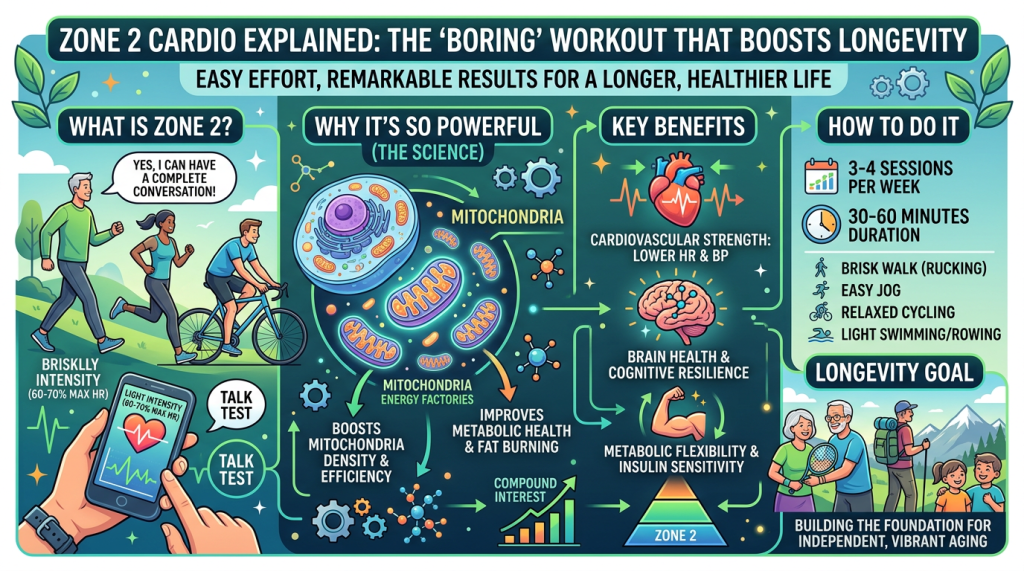
What Exactly Is Zone 2 Cardio?
To understand Zone 2, you first need to understand heart rate zones.
Your heart rate during exercise exists on a spectrum, typically divided into five zones based on your maximum heart rate:
| Zone | Intensity | % of Max Heart Rate | How It Feels |
|---|---|---|---|
| Zone 1 | Very light | 50–60% | Barely moving, casual walk |
| Zone 2 | Light | 60–70% | Comfortable, conversational pace |
| Zone 3 | Moderate | 70–80% | Getting harder, breathing heavier |
| Zone 4 | Hard | 80–90% | Uncomfortable, can’t hold conversation |
| Zone 5 | Maximum | 90–100% | All-out effort, unsustainable |
Zone 2 sits in that sweet spot where you’re working, but it doesn’t feel like work.
The simplest test? The talk test. If you can hold a full conversation without gasping for air — complete sentences, not just one-word answers — you’re probably in Zone 2. If you’re breathing so comfortably that you could sing, you’re too low. If you can only manage a few words between breaths, you’ve gone too high.
For most people, Zone 2 looks like:
- A brisk walk (especially uphill or with a loaded backpack)
- An easy jog where you feel like you should be going faster
- A relaxed bike ride
- A light rowing session
- An easy swim
The key sensation is this: it should feel almost too easy. And that’s exactly why most people skip it — or unconsciously push harder because “easy” feels unproductive.
It’s not. It’s the opposite.
Why Zone 2 Is So Powerful: The Science
Here’s where things get interesting.
Zone 2 cardio doesn’t just improve your fitness. It improves the fundamental machinery of your cells. The science behind it centers on one critical structure: the mitochondria.
Mitochondrial Efficiency
Mitochondria are the energy factories inside your cells. They convert fuel (fat, glucose) into ATP — the energy currency your body runs on. The more mitochondria you have, and the better they function, the more efficiently your body produces energy.
Zone 2 training is the single most effective stimulus for building mitochondrial density and function. At this intensity, your body primarily burns fat for fuel (rather than glucose), which requires robust mitochondrial activity. Over time, your cells build more mitochondria and the existing ones become more efficient.
This matters because mitochondrial dysfunction is now understood to be a root driver of aging, metabolic disease, and chronic fatigue. By training in Zone 2, you’re essentially upgrading your body’s energy operating system at the cellular level.
Metabolic Health
Zone 2 cardio improves your body’s ability to use fat as fuel — a quality called metabolic flexibility. Most modern humans are overly dependent on glucose for energy, which leads to blood sugar spikes, insulin resistance, and eventually metabolic disease.
Regular Zone 2 training teaches your body to tap into fat stores efficiently, improving insulin sensitivity, stabilizing blood sugar, and reducing the risk of type 2 diabetes — one of the leading killers worldwide.
Cardiovascular Strength
Your heart is a muscle, and Zone 2 is its preferred training ground.
At this intensity, your heart’s left ventricle fills completely with blood before each contraction, maximizing stroke volume — the amount of blood pumped per beat. Over time, this makes your heart stronger and more efficient. Your resting heart rate drops. Your blood pressure improves. Your cardiovascular system becomes resilient in a way that high-intensity training alone cannot achieve.
Brain Health
This one surprises most people.
Zone 2 cardio increases blood flow to the brain, promotes the production of BDNF (brain-derived neurotrophic factor — essentially fertilizer for brain cells), and has been shown to reduce the risk of cognitive decline and dementia.
Dr. Peter Attia, one of the most prominent voices in longevity medicine, has called Zone 2 “the most important exercise modality for longevity.” Not strength training. Not HIIT. Not yoga. Zone 2.
That’s a strong claim — and the research increasingly backs it up.
Why Most People Get It Wrong
If Zone 2 is so powerful, why isn’t everyone doing it?
Because it violates everything modern fitness culture has taught us.
The “No Pain, No Gain” Problem
We’ve been conditioned to believe that effective exercise must be hard. If you’re not drenched in sweat, gasping for air, and questioning your life choices, you’re wasting your time. Right?
Wrong.
This mentality is not just inaccurate — it’s counterproductive. Most people who think they’re doing Zone 2 are actually training in Zone 3 or higher. They unconsciously push harder because easy feels lazy. They speed up when someone runs past them. They add resistance on the bike because the current level feels “too light.”
The hardest part of Zone 2 isn’t the exercise. It’s the ego management.
You have to be okay with being slow. You have to resist the urge to push harder. You have to accept that the person walking their dog might be keeping pace with you — and that’s fine.
The Intensity Addiction
High-intensity workouts — HIIT classes, CrossFit sessions, heavy lifting — give you an immediate dopamine hit. You feel accomplished. You feel the burn. The results feel tangible.
Zone 2 gives you almost nothing in the moment. No rush. No pump. No dramatic fatigue. The results are invisible and compounding — they show up in your bloodwork, your resting heart rate, your energy levels, and your health span years from now.
Zone 2 is a long-term investment in a culture addicted to short-term returns.
The Time Objection
Zone 2 sessions should ideally be 30 to 60 minutes long, and most experts recommend 3 to 4 sessions per week. That’s a significant time commitment, especially compared to a 20-minute HIIT session.
But here’s the reframe: Zone 2 doesn’t require dedicated “workout time” the way intense training does. You can do it while walking to work, cycling to the grocery store, taking a phone call on a treadmill, or exploring a new city on foot.
It integrates into life in a way that high-intensity exercise never can.
How to Actually Do Zone 2 Cardio
Step 1: Find Your Zone 2 Heart Rate Range
The simplest formula:
Zone 2 = 60–70% of your maximum heart rate
Estimated max heart rate = 220 minus your age
So if you’re 32 years old:
- Max HR = 220 – 32 = 188
- Zone 2 = 113 to 132 bpm
This is a rough estimate. If you want precision, a lab-based lactate threshold test is the gold standard. But for most people, the formula plus the talk test is more than enough to get started.
Step 2: Choose Your Modality
Pick something you enjoy — or at least tolerate — because consistency matters more than optimization.
Best options for Zone 2:
- Walking (flat or uphill, loaded or unloaded)
- Easy jogging (slower than you think)
- Cycling (stationary or outdoor)
- Swimming (relaxed pace)
- Rowing (low resistance, steady pace)
- Elliptical (low resistance)
A note on walking: For many people, especially those who are newer to exercise, a brisk walk — particularly uphill or with a weighted backpack (rucking) — is the perfect Zone 2 activity. You don’t need to run. You don’t need a gym. You need a pair of shoes and a door.
Step 3: Monitor Your Heart Rate
A chest strap heart rate monitor is the most accurate option. Wrist-based monitors (Apple Watch, Garmin, Fitbit) are decent but can be inconsistent during certain movements.
The key is to stay within your zone. If your heart rate creeps above 70% of max, slow down. If it drops below 60%, pick up the pace slightly.
This is where most people struggle. You’ll want to go faster. Don’t. Discipline is staying slow, not pushing hard.
Step 4: Build Duration Gradually
If you’re starting from zero, begin with 20 to 30 minutes, two to three times per week. Over the course of a few months, build toward 45 to 60 minutes, three to four times per week.
There’s no need to rush. Zone 2 is, by definition, a patient practice. The adaptations — better mitochondria, improved fat oxidation, stronger heart — take weeks to months to develop. But once they do, they compound.
Step 5: Be Consistent, Not Heroic
A 45-minute Zone 2 walk done four times a week for a year will transform your health more than a dozen intense workout phases followed by burnout and quitting.
The best Zone 2 session is the one you’ll actually do next week.
Zone 2 in the Context of a Complete Training Program
Zone 2 is not a replacement for everything else. It’s the foundation upon which everything else works better.
Think of your training like a pyramid:
         /\
        /  \
       / Z5 \
      /------\
     /  Z3-4  \
    /----------\
   /   STRENGTH \
  /--------------\
 /    ZONE 2      \
/------------------\- Zone 2 forms the wide, stable base — 60 to 80% of your total training volume
- Strength training preserves muscle mass, bone density, and functional capacity
- Zone 3–4 work (tempo runs, moderate intervals) builds speed and lactate tolerance
- Zone 5 (high-intensity intervals) adds a small but potent peak stimulus
Most people have this pyramid inverted. They do mostly high-intensity work, some moderate work, and almost no Zone 2. Flipping this ratio is one of the simplest and most impactful changes you can make.
The Longevity Argument
Here’s the bottom line.
You can survive without six-pack abs. You can live a full life without running a marathon or deadlifting twice your bodyweight.
But you cannot thrive without a strong cardiovascular system, efficient mitochondria, and metabolic flexibility. These are the non-negotiable foundations of a body that works well at 60, 70, and 80.
Zone 2 cardio builds all three.
Dr. Attia frames longevity in terms of healthspan — not just how long you live, but how well you live. Can you play with your grandchildren? Can you carry your own groceries? Can you climb stairs without getting winded? Can you travel, explore, and live independently in your later decades?
Zone 2 training is the most evidence-backed answer to all of those questions.
And the beautiful irony is this: the workout that adds the most years to your life is the one that asks the least of you in any given session.
The Hardest Part Is Accepting That It’s Enough
We live in a culture that glorifies intensity, hustle, and visible effort. Zone 2 cardio offers none of that. It’s quiet. It’s slow. It’s invisible.
But so is compound interest. So is reading twenty pages a day. So is sleeping eight hours a night.
The most powerful forces in life are boring, consistent, and compounding. Zone 2 cardio is the health equivalent of a low-cost index fund — unglamorous, easy to overlook, and almost impossible to beat over a long enough time horizon.
You don’t need to love it. You don’t need to be excited by it. You just need to do it — slowly, consistently, and for a very long time.
Your future self will thank you. Probably while climbing a mountain at 75.
Related Reading
If this post resonated, you might enjoy these related articles from the blog:
- Training for the Life You Want at 60: Strength Training for Longevity (Not Just Looks)
- The Minimum Effective Longevity Habits: What Actually Improves Healthspan
- How to Train After 30: A Complete Guide to Strength, Mobility, and Longevity
- Training for Longevity: How to Exercise for Long-Term Health, Not Just Looks
- Habits That Matter After 40: What Actually Improves Longevity
- The Science of Movement: Why Sitting Is the New Smoking
- How to Build a Fitness Practice (Not Just a Workout Routine)
- Movement Snacks: How to Stay Active Without “Working Out”
- How to Recover Like an Athlete (Even If You Work at a Desk)
- Energy Management vs Time Management: How to Increase Focus, Productivity, and Avoid Burnout
- Daily Mobility for Joint Health: Small Movements That Pay Off for Decades
- The Longevity Dividend: Healthy Habits That Boost Both Health and Wealth
- Recovery is a Skill: Why It Doesn’t Happen Automatically (and How to Improve It)
- Posture, Breath, and Walking: Three Simple Habits That Improve Health and Longevity
- Designing a Body That Tolerates Modern Life: How to Stay Healthy in a Sedentary, Screen-Based World
 VD
VD 
Leave a comment