Most budgeting advice asks you to do something unsustainable: track every coffee, every grocery trip, every spontaneous purchase. The promise is that awareness leads to control. But for most people, tracking every expense isn’t sustainable – it’s exhausting.
The truth is, you don’t need to track every dollar to control your spending. You need a system that works with your psychology, not against it.
This is about building a budget that runs in the background of your life, requiring minimal maintenance while delivering maximum control. It’s about designing money management that actually sticks.
Why Traditional Budgeting Fails
Traditional budgeting fails because it demands constant vigilance. You’re supposed to:
- Record every transaction
- Categorize every expense
- Review spreadsheets weekly
- Feel guilty when you overspend
- Start over next month
This works for about two weeks. Then life happens. You forget to log a few purchases. You fall behind on categorizing. The spreadsheet becomes a source of shame rather than clarity.
The problem isn’t your discipline – it’s the system itself.
Tracking every expense treats the symptom (not knowing where money goes) rather than the disease (not having a system that prevents overspending automatically).
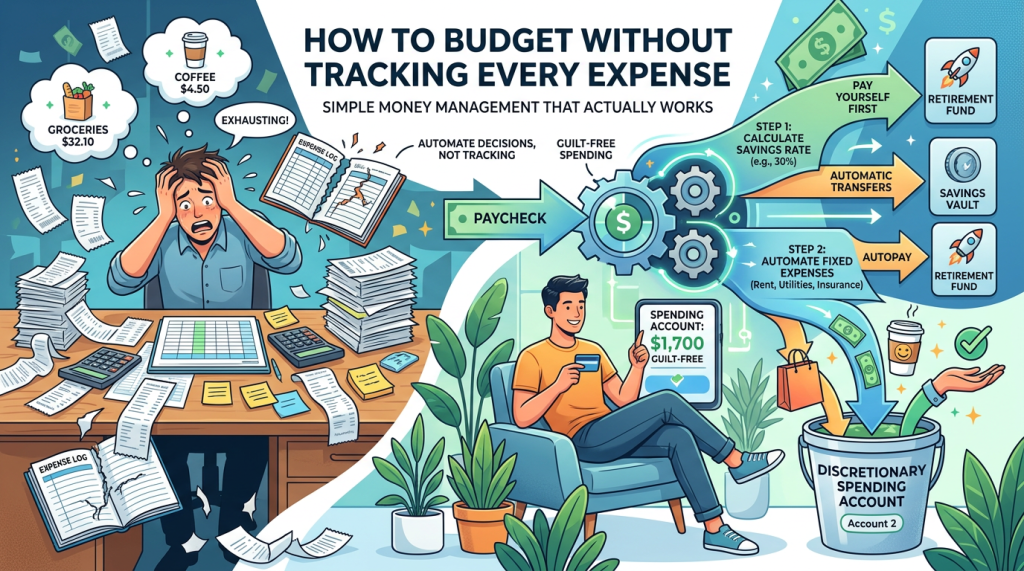
The Core Principle: Automate Decisions, Not Tracking
The anti-tracking budget works on a simple principle: make the right financial decisions automatic, so you don’t have to make them repeatedly.
Instead of tracking where money went, you decide where money goes before you ever see it. Instead of logging expenses, you create boundaries that make overspending difficult.
This is the difference between a reactive budget (tracking what happened) and a proactive budget (designing what happens).
The Framework: Pay Yourself First, Then Spend What’s Left
Here’s the complete system:
Step 1: Calculate Your Target Savings Rate
Start with your financial goal. If you’re pursuing FIRE (Financial Independence, Retire Early), you might target a 50% savings rate. If you’re building an emergency fund, maybe it’s 20%. If you’re getting started, even 10% is meaningful.
The number matters less than the commitment. Pick a percentage that’s challenging but sustainable.
Example:
- Monthly income: $5,000
- Target savings rate: 30%
- Monthly savings target: $1,500
Step 2: Automate Savings First
Set up automatic transfers on payday:
- Retirement accounts (401k, IRA)
- Investment accounts
- Emergency fund
- Any other savings goals
The key word is automatic. This happens before you see the money, before you make decisions about it, before you can spend it.
This isn’t willpower – it’s architecture.
Example structure:
- $500 → Retirement account (on payday)
- $500 → Investment account (on payday)
- $300 → Emergency fund (on payday)
- $200 → Travel fund (on payday)
Total automated: $1,500 (your 30% target)
Step 3: Automate Fixed Expenses
After savings, automate your predictable expenses:
- Rent/mortgage
- Utilities
- Insurance
- Subscriptions
- Debt payments
These happen automatically. You never think about them. You never make a decision.
Example:
- $1,500 → Rent (autopay)
- $150 → Utilities (autopay)
- $100 → Insurance (autopay)
- $50 → Subscriptions (autopay)
Total automated expenses: $1,800
Step 4: What’s Left Is Your Guilt-Free Spending
Here’s where the magic happens. After automated savings and fixed expenses, everything remaining is yours to spend however you want.
Example math:
- Income: $5,000
- Automated savings: -$1,500
- Fixed expenses: -$1,800
- Remaining for discretionary spending: $1,700
That $1,700 covers:
- Groceries
- Eating out
- Entertainment
- Shopping
- Random purchases
- Everything else
You don’t track it. You don’t categorize it. You just spend it—guilt-free.
The boundary is simple: when the account hits zero, you’re done for the month.
The Two-Account System
This works even better with two checking accounts:
Account 1: The Automation Account
- Receives your paycheck
- Handles all automated transfers (savings, investments, fixed bills)
- You rarely look at it
Account 2: The Spending Account
- Receives your discretionary allowance (the “what’s left” money)
- This is what you actually spend from
- When it’s empty, you’re done
This creates a natural boundary. You can’t accidentally spend your rent money or dip into savings. The spending account is a firewall.
How it works:
On payday:
- Paycheck hits Account 1
- Automated savings transfers execute
- Fixed bills get paid
- Remaining amount transfers to Account 2
- You spend freely from Account 2 until next payday
You only ever look at Account 2. It’s your only spending decision point.
Why This Works (The Psychology)
This system succeeds where tracking fails because it aligns with how humans actually make decisions:
1. Decision fatigue is real
Every time you track an expense, you make a micro-decision: “Should I have bought this?” That’s exhausting. The anti-tracking budget eliminates these decisions. Money in your spending account is meant to be spent.
2. Constraints breed creativity
A finite spending account forces prioritization naturally. You don’t need a spreadsheet to tell you that you can’t afford both the concert tickets and the new shoes—your account balance tells you.
3. Automation beats willpower
You can’t spend money that’s already gone to savings. You can’t forget to pay a bill that’s on autopay. Good behavior happens by default, not discipline.
4. Guilt-free spending is sustainable
Traditional budgets make every purchase feel like a potential mistake. This system gives you permission to enjoy your money within boundaries you’ve already set.
Setting It Up: A Step-by-Step Implementation
Week 1: Calculate Your Numbers
- Review 2-3 months of bank statements (yes, one-time tracking)
- Identify your true fixed expenses
- Calculate your current savings rate
- Decide your target savings rate
- Do the math to find your discretionary amount
Week 2: Set Up Automation
- Open a second checking account (if needed)
- Set up automatic transfers for savings (scheduled for payday)
- Set up autopay for all fixed expenses
- Set up automatic transfer to spending account (for remaining amount)
- Update your direct deposit if using two accounts
Week 3: Test Run
- Let the system run for one month
- Observe how it feels
- Notice where you run out of discretionary money
- Don’t adjust yet – just observe
Week 4: Refine
- Were your fixed expenses accurate?
- Is your discretionary amount too tight or too loose?
- Adjust the percentages
- Recommit for another month
Common Scenarios and Solutions
“What if I run out of spending money before the month ends?”
This is feedback. Either your discretionary amount is too low, or your spending needs adjustment. The system is working – it’s showing you reality. Options:
- Increase discretionary amount (by reducing savings temporarily)
- Identify specific overspending (eating out? shopping?)
- Embrace the constraint and get creative
“What about irregular expenses (car maintenance, gifts, etc.)?”
Create a third automated savings category: “irregular expenses fund.” Estimate annual irregular costs, divide by 12, and automate that monthly. When the expense hits, pull from this fund.
Example:
- Car maintenance: $1,200/year = $100/month
- Gifts: $600/year = $50/month
- Total automated to irregular fund: $150/month
“What if my income varies month to month?”
Base your automation on your lowest typical month. In higher-income months, manually move the excess to savings or let it accumulate in the spending account as a buffer.
“Do I really never track anything?”
The only number you track is your spending account balance. That’s it. One number. It tells you everything you need to know: how much you can spend right now.
The Minimum Effective Budget
If even this feels like too much, here’s the absolute minimum version:
- Automate a fixed dollar amount to savings every payday
- Pay your bills (manually or automatically)
- Spend the rest
That’s it. Three steps. No tracking. No categories. No spreadsheets.
The sophistication comes later, if you want it. But this core system – save first, spend what’s left – is 80% of the value.
When to Add (Minimal) Tracking
There are exactly two situations where light tracking makes sense:
1. Initial setup
Look back at 2-3 months to establish baseline expenses. This is one-time reconnaissance, not ongoing surveillance.
2. Problem diagnosis
If you consistently run out of discretionary money too early, spend one month tracking to find the leak. Then fix the system and stop tracking again.
Tracking is a diagnostic tool, not a lifestyle.
The FIRE Connection
This system is particularly powerful for FIRE because it makes your savings rate automatic and invisible. You’re not constantly choosing between spending and saving—the choice is made once, then executed automatically.
Your savings rate becomes a background process, not a daily battle.
This is how you maintain a 40-50% savings rate without feeling deprived. The money you see is the money you can spend. Everything else is already working toward your financial independence.
The Real Goal: Financial Slack
The anti-tracking budget isn’t really about budgeting—it’s about creating financial slack.
Slack is the buffer between your spending and your income. It’s the space that lets you make decisions based on what you want, not what you can afford this week.
When your system handles the important stuff automatically (savings, bills), you get to focus on the interesting stuff: how to spend your discretionary money in ways that add value to your life.
You’re not tracking expenses – you’re designing a life where money works in the background while you focus on what matters.
Getting Started Today
You don’t need to implement this perfectly. Start with one piece:
This week: Set up one automatic transfer to savings on your next payday.
Next week: Automate one more bill.
The week after: Open a second checking account.
Build the system incrementally. Each automated piece removes one decision from your life, one source of friction, one opportunity for the budget to fail.
The goal isn’t perfection – it’s a system that works with your life, not against it.
The Bottom Line
Tracking every expense is a job. For most people, it’s an unpaid job they’re bad at and don’t enjoy.
The anti-tracking budget says: design the system once, then let it run. Make the important decisions automatic. Create boundaries that make bad choices difficult and good choices effortless.
You don’t need to know where every dollar went. You need to know that the right dollars went to the right places, automatically, without you having to think about it.
That’s not budgeting—that’s financial architecture.
And it actually works.
Related Reading
If you found this helpful, explore these related posts on financial independence, systems thinking, and sustainable money management:
FIRE & Money Management:
- Why FIRE Isn’t Sustainable Without Financial Slack – Understanding why breathing room matters more than aggressive savings
- Designing Cash Flow for Financial Independence (Not Maximum Returns) – How to structure money for freedom, not just growth
- The Boring Middle of FIRE: How to Stay Consistent While Compounding Works – Maintaining motivation during the long accumulation phase
- Financial Independence as a skill, not a number – Why how you manage money matters more than how much you have
- The Optionality Playbook: Why Financial Independence Is About Better Choices, Not Early Retirement – Reframing FIRE as life design
Reducing Financial Stress:
- How to Reduce Financial Stress Without Earning More (The Lifestyle Beta Approach) – Lowering anxiety through system design
- The Psychology of Enough: How to Redefine Wealth Beyond Money – Understanding when you have what you need
- Why We Buy Things We Don’t Need: The Psychology of Spending Explained – The emotional drivers behind purchases
Lifestyle Design & Sustainability:
- Expense ratios for life: When frugality compounds – and when it backfires – The hidden costs of extreme frugality
- The Second-Order Effects of Frugality: When Saving Money Starts to Cost You – Understanding the tradeoffs of being too cheap
- Lifestyle Inflation Detox: How to Save More and Spend Smarter as You Earn More – Managing spending as income grows
- Future-Proofing Your Lifestyle: How to Spend Less Every Year (While Improving Your Quality of Life) – Building a life that gets better while costing less
Systems Thinking:
- Why Systems Beat Motivation: A Practical Framework for Health, Wealth, and Learning – How to build sustainable habits through design
- The 80/20 of FIRE: Tiny Financial Tweaks That Create Outsized Results (Fast) – High-leverage money moves
- Time Arbitrage: How Flexible Schedules Help You Save More, Spend Less, and Build Wealth – Using time flexibility to improve finances
FIRE Fundamentals:
- FIRE Math Made Simple: Breaking Down the 4% Rule – Understanding the core calculation
- The First $100K Is the Hardest: Why Reaching $100,000 Changes Your Financial Freedom – Why early accumulation feels slow
- 7 Essential Skills for Financial Independence: How to Reach FIRE Faster – The capabilities that accelerate your journey
Building a budget that works isn’t about tracking harder—it’s about designing better. Start with automation, add boundaries, and let the system handle the details while you focus on living well.
 VD
VD 
Leave a comment