You’re three days into your Barcelona trip. You’ve hit the major sights, found a decent coffee shop, and walked Las Ramblas twice. You’re starting to feel the rhythm of the city—then you leave for Lisbon.
Sound familiar?
Most travelers operate on a two-week sprint. Maybe a month if they’re “really taking their time.” But there’s a magic window that most people miss entirely: the three-month stay.
Not a vacation. Not quite moving there permanently. Three months.
This timeline unlocks a completely different type of travel—one that transforms you from a tourist into a temporary resident. And the difference isn’t just semantic. It’s structural, psychological, and often life-changing.
Here’s why three months is the sweet spot for meaningful travel, and how to design your life around it.
The Problem with Short-Term Travel
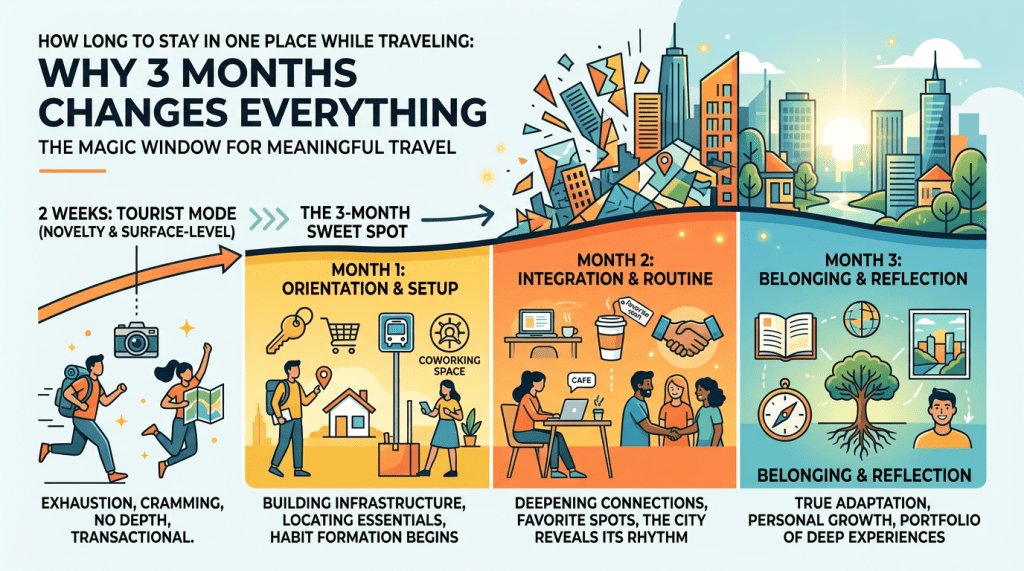
When you stay somewhere for a week or two, you’re operating in tourist mode by necessity.
You’re optimizing for novelty. Every day needs to “count.” You’re compressing experiences, racing through museums, cramming in restaurants, afraid of missing something important.
The pressure is real: you only have limited time, so you better make it memorable.
But this approach has hidden costs:
Energy depletion. Constantly seeing new things is exhausting. Your brain is in perpetual orientation mode—figuring out transportation, navigation, social norms, where to eat, where things are.
Surface-level experiences. You see the city, but you don’t understand it. You visit the famous square but miss the neighborhood rhythm. You eat at tourist traps because you don’t know where locals go.
No depth. Relationships stay transactional. The barista doesn’t know your order. The gym doesn’t become familiar. You never develop routines that anchor you.
Constant decision fatigue. Every single day requires dozens of micro-decisions that residents make on autopilot.
Short trips have their place. But if you’re trying to actually understand a place—or use travel as a tool for personal growth—two weeks isn’t enough.
You need time for the city to stop being a novelty and start being a place you actually live.
Why Three Months Is the Magic Timeline
Month One: Orientation and Setup
The first month is still partially tourism, but with a crucial difference: you’re not leaving soon.
This changes your behavior entirely.
Instead of racing to see everything, you settle in. You find an apartment or longer-term accommodation. You locate the grocery store, the gym, a coworking space. You figure out public transportation without looking at Google Maps every time.
You’re building infrastructure for life, not just sightseeing.
By week three or four, something shifts. The city stops feeling foreign. You recognize faces. You have a coffee shop. You know which streets to avoid during rush hour.
You’re no longer orienting—you’re inhabiting.
Month Two: Integration and Routine
This is where the magic happens.
By month two, you’ve stopped being a tourist. You have favorite spots that aren’t in guidebooks. You know the baker’s schedule. The guy at the corner store nods when you walk in.
You’ve developed routines.
You’re not “doing things” every day—you’re living. You work in the morning, walk the same route to lunch, read in the same park. You’ve joined a climbing gym or a running group. You’re no longer the new person.
Relationships deepen. The acquaintances you met in week two are now friends. You’re getting invited to local gatherings. You understand inside jokes.
The city reveals itself. You notice patterns—the rhythm of the week, the neighborhood personalities, the unspoken social codes. You start having opinions about neighborhoods you’d never heard of two months ago.
This is when travel stops being about novelty and starts being about depth.
Month Three: Belonging and Reflection
Month three is where most people bail—and it’s the biggest mistake.
By month three, the initial excitement has worn off. The city isn’t new anymore. You might feel restless, like you’ve “seen everything.”
But this is precisely when the real value emerges.
You’re no longer observing the city—you’re part of it. Your relationships have history. You’ve experienced the place across different moods and seasons. You’ve been sick there, worked through hard problems there, celebrated there.
You have enough distance to reflect. You can compare this place to others you’ve lived. You understand what you like and don’t like. You’ve had time to test assumptions about yourself.
Month three is when travel becomes transformative rather than just stimulating.
And crucially, you have time to miss things and come back to them. You can revisit that museum with fresh eyes. You can return to a neighborhood you dismissed initially. You can have a second or third conversation with someone and build real connection.
This is impossible on a two-week trip.
The Science Behind the Timeline
There’s research backing this up.
Habit formation takes time. Studies suggest it takes 18 to 254 days to form a new habit, with an average of 66 days. Three months (roughly 90 days) gives you enough time to build actual routines, not just sample activities.
Cultural adaptation follows predictable stages. The honeymoon phase (weeks 1-3) gives way to frustration (weeks 4-6), then gradual adjustment (weeks 7-10), and finally adaptation (weeks 11+). Most travelers leave right when they’re hitting true adaptation.
Memory consolidation improves with time. Neuroscience shows that memories become richer and more integrated when you have repeated exposure over weeks and months. A three-month stay creates a web of interconnected memories that a week-long trip simply can’t replicate.
Social integration requires multiple touchpoints. Research on relationship formation shows it takes roughly 50 hours to move from acquaintance to casual friend, and 200+ hours for close friendship. Three months gives you the runway to build real relationships.
What Changes at the Three-Month Mark
1. Your Relationship with Place Transforms
After three months, you stop asking “what should I see?” and start asking “how does this place work?”
You understand the city’s personality. You know which neighborhoods feel energizing and which feel draining. You’ve experienced different times of day and week. You have local knowledge that guidebooks don’t contain.
2. Decision Fatigue Disappears
By month three, you’re operating on autopilot for daily decisions. You know where to eat, where to work, how to get around. Your cognitive bandwidth is freed up for deeper thinking and creativity.
This is why many people report doing their best work during months 2-3 of a stay.
3. You Develop Real Routines
Travel stops feeling like an endless string of novel experiences and starts feeling like life—but with the benefits of a new environment.
You have a gym routine. A morning walk. A weekly market you visit. A friend you grab dinner with on Thursdays.
These routines create a sense of grounding that makes long-term travel sustainable.
4. The City Reveals Its Layers
Every city has a tourist layer, a expat layer, and a local layer. Short-term travelers never get past the first. Month-long stays might scratch the second.
Three months gets you into the third layer—where the actual life of the city happens. You’re invited to birthday parties, neighborhood festivals, local hangs that aren’t on Instagram.
5. You Learn What You Actually Like
This might be the most valuable outcome.
Three months is long enough to test assumptions about what kind of life you want. You thought you wanted to live by the beach, but you actually prefer the energy of a city center. You thought you needed constant novelty, but you thrive with routine. You thought you were an introvert, but you came alive in a more social culture.
These insights are impossible to gain from a vacation.
How to Design for Three-Month Stays
If you’re convinced but thinking “this sounds impractical,” here’s how to actually make it work:
Choose Your Cities Strategically
Not every city deserves three months. Look for:
- Medium to large size (enough to explore for 90 days)
- Good infrastructure (reliable internet, coworking spaces, transportation)
- Reasonable cost of living (so you can actually afford three months)
- Visa-friendly (many countries offer 90-day tourist visas)
- Personal resonance (somewhere you’re genuinely curious about)
Cities like Lisbon, Mexico City, Chiang Mai, Buenos Aires, Tbilisi, and Barcelona are popular for a reason—they tick all these boxes.
Front-Load the Setup
Your first week should be about infrastructure, not sightseeing:
- Find stable accommodation (Airbnb monthly discount, local rentals, coliving spaces)
- Set up your workspace and routine
- Locate essentials (grocery store, gym, coworking space, coffee shop)
- Handle admin (SIM card, transportation card, banking if needed)
The faster you set up, the more value you extract from months 2-3.
Build in Rest Days from Day One
The temptation in week one is to see everything. Resist it.
You have three months. You don’t need to cram. Build rest, routine, and blank space into your calendar from the start.
This prevents burnout and creates space for spontaneity and depth.
Join Something Regular
This is non-negotiable if you want real connection:
- A weekly fitness class
- A language exchange
- A coworking space with community
- A sports league or climbing gym
- A volunteer organization
Repeated exposure to the same people is how friendships form. One-off experiences don’t create community.
Allow for Boredom
This sounds counterintuitive, but boredom is a feature, not a bug.
When the initial excitement fades in month two, you’re forced to engage with the place on its own terms, not through the lens of novelty-seeking. You discover hidden gems because you’re wandering without a plan. You have deeper conversations because you’re not rushing.
Boredom is where depth lives.
Track Your Energy, Not Your Activities
Instead of optimizing for “things done,” pay attention to how the city affects your energy.
Do you wake up energized or drained? Are you more creative here? More social? More introspective?
Three months gives you enough data to notice patterns—and those patterns tell you what kind of environment you actually thrive in.
Common Objections (And Why They Don’t Hold Up)
“I can’t afford to not work for three months.”
You’re not taking a three-month vacation—you’re living somewhere else while maintaining your income. If you’re remote, you’re working as usual. If you’re not, this might be the push to build location independence.
“I’ll get bored.”
You won’t. Month two is when cities truly open up. But even if you do feel restless, that restlessness is valuable information about what you need from a place.
“What about visas?”
Most countries offer 90-day tourist visas. Some (Portugal, Mexico, Georgia, Thailand) offer digital nomad visas for longer stays. With basic planning, visa logistics are manageable.
“I can’t commit to one place for that long.”
Then you’re optimizing for novelty, not depth. Both are valid, but they’re different goals. If you want transformation, integration, and real understanding, three months is the minimum effective dose.
“What if I don’t like the city?”
You’ll know within the first month. The beauty of three months is that it’s long enough to matter but short enough to be low-risk. If it’s not working, leave. But most people who commit to the timeline are surprised by how much they get out of it.
The Compound Effect of Repeated Three-Month Stays
Here’s where this gets really powerful:
When you do multiple three-month stays in different cities, you’re not just traveling—you’re building a portfolio of deep experiences.
You’re stress-testing your assumptions about where and how you want to live. You’re building a global network of real friends, not just acquaintances. You’re developing cultural fluency that shallow travel never creates.
And you’re learning the skill of integration—of moving to a new place and building a life quickly. This skill compounds. Your second three-month stay is easier than your first. Your fifth is almost effortless.
You become someone who can thrive anywhere, not because you’re constantly adapting, but because you’ve practiced building home in many places.
The Real Gift of Three Months
The most surprising benefit of three-month stays isn’t what you learn about the city.
It’s what you learn about yourself.
When you’re somewhere long enough for the novelty to fade, you’re left with yourself. Your patterns become visible. Your values clarify. Your ideal lifestyle reveals itself.
You learn that you need green space more than you thought. Or that you’re energized by density. Or that you do your best thinking when you walk every morning.
These insights don’t come from Instagram-worthy experiences. They come from the boring, repetitive, daily rhythm of actually living somewhere.
And once you have them, you can design your entire life around them.
Start With One
You don’t need to commit to this forever. Start with one three-month stay.
Pick a city you’re curious about. Set up infrastructure. Build routine. Join something regular. Allow for boredom.
And see what happens.
You might discover that three months is too short. You might decide you prefer faster movement. You might realize you want to stay permanently.
But I guarantee this: you’ll learn more about yourself and the world in three focused months than in a year of week-long trips.
The three-month timeline isn’t about seeing more places.
It’s about seeing one place—and yourself—clearly.
And that changes everything.
Related Reading
If you found this helpful, you might also enjoy these related posts:
On Slow Travel & Long-Term Stays:
- Slow Travel: Why Staying Longer Saves Money and Creates Richer Experiences
- Why Repeating Destinations Beats Chasing New Ones: The Case for Slow Travel
- Travel in Chapters Works Better Than Checklists
- How to Test Living in a New City: The 30-Day City Experiment Framework
- Lifestyle Prototyping: How to Test-Drive a New Life Before You Commit
On Travel Systems & Sustainability:
- Why Comfort is a Force Multiplier for Long-Term Travel (and prevents burnout)
- Designing a Life That Travels Well: A Framework for Sustainable, Location-Flexible Living
- The Energy Budget of Travel: How to Avoid Travel Fatigue and Explore Without Exhaustion
- Comfort-Optimized Travel: Simple Systems That Reduce Stress and Save Time
On Deep Connection While Traveling:
- How to Build Deep Connections While Traveling: The Social Architecture of Temporary Places
- How to Travel Like a Local – Even If You Only Have One Day
- Why Some Cities Recharge You (and Others Drain You): The Hidden Energy Cost of Urban Living
- Mental Carry-On: How to Learn From Travel (Not Just Visit Places)
On Location Independence & Digital Nomad Life:
- Geographic Flexibility as Wealth: How Location Independence Multiplies Your Income
- Travel Optionality: How to Stay Location-Independent Without Feeling Rootless
- How to Turn Travel Into a Full-Time Career as a Digital Nomad (While Keeping Your Freedom)
- Living Out of a Backpack: How to Travel Long-Term Without Feeling Temporary
On Personal Growth Through Travel:
- How to Use Travel for Personal Growth and Self-Discovery: Unlock Your True Potential
- Travel That Pays You Back: How Travel Builds Skills and Expands Your Perspective
- The Return on Travel: How Travel Builds Skills, Perspective, and Long-Term Value
- Travel as Therapy: How Exploring New Places Boosts Mental Health
- Why Traveling Alone Will Change Your Perspective on Life
What’s your experience with longer stays? Have you tried the three-month timeline? I’d love to hear about it in the comments below.
 VD
VD 
Leave a comment