You sit down at your desk at 9 AM. You stand up at lunch, walk to the kitchen, then sit back down. By 6 PM, you’ve been sitting for over 8 hours. You stand up and feel it—tight hips, stiff lower back, shoulders that won’t quite roll back the way they used to.
This isn’t just about feeling stiff. It’s about accumulating what I call flexibility debt—the gradual loss of range of motion that compounds over months and years of sitting. And just like financial debt, the longer you ignore it, the harder it becomes to pay off.
The good news? Mobility isn’t like muscle mass that disappears quickly. It’s more forgiving. With consistent, targeted stretching, you can restore much of what you’ve lost—even after years of desk work.
This isn’t about becoming a contortionist or doing yoga for 90 minutes a day. It’s about a simple, sustainable daily routine that reverses the specific patterns of tightness that sitting creates.
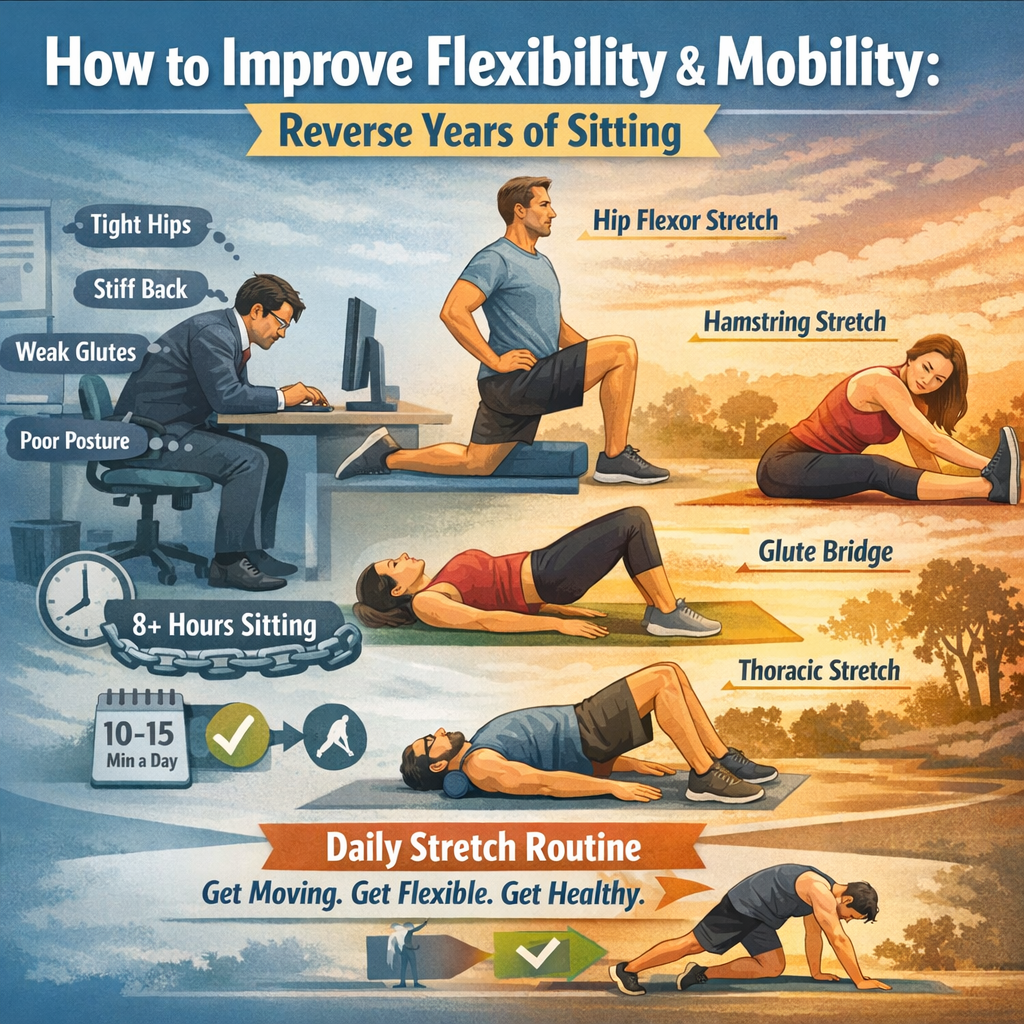
Why Sitting Destroys Flexibility (The Mechanics)
Sitting isn’t neutral. It actively shortens and tightens specific muscle groups while weakening others.
What happens when you sit for hours:
Hip flexors shorten. Your hips are flexed (bent) all day, so the muscles that perform hip flexion—primarily the psoas and rectus femoris—adapt by shortening. When you stand up, they pull your pelvis forward, creating anterior pelvic tilt.
Hamstrings tighten. Sitting places your hamstrings in a shortened position. Over time, they lose length and become stiff, limiting your ability to bend forward or extend your leg fully.
Glutes weaken. Your glutes do nothing while you sit. They’re turned off, literally. This is called “gluteal amnesia,” and it means your body forgets how to activate them properly during movement.
Thoracic spine rounds. Sitting—especially at a computer—encourages thoracic kyphosis (rounded upper back). Your chest muscles tighten, your shoulder blades wing out, and your upper back loses extension.
Ankles lose dorsiflexion. If you sit with your feet flat on the ground or dangling, your ankles spend all day in a neutral or plantarflexed position. You lose the ability to bring your shin toward your toes, which affects everything from squatting to walking uphill.
These aren’t minor inconveniences. They’re postural adaptations that limit how you move, increase injury risk, and make everyday activities harder as you age.
The longer you sit without intervention, the more your body accepts these positions as “normal.” Flexibility debt compounds.
The Flexibility Debt Framework
Think of flexibility like a financial account. Every hour you sit, you’re withdrawing from your mobility balance. Every stretch, every movement break, every walk—that’s a deposit.
Most people only make withdrawals. They sit all day, don’t stretch, and wonder why they can’t touch their toes anymore.
The goal isn’t perfect flexibility. It’s breaking even—or better yet, building a surplus.
Here’s the framework:
- Identify your tightness patterns (what sitting stole from you)
- Target those areas daily (strategic stretching, not random)
- Make deposits automatic (systems, not motivation)
- Track progress (small wins compound)
The routine below is designed to reverse the most common flexibility losses from sitting. It takes 10–15 minutes and can be done daily—ideally in the morning or after work.
The Daily Mobility Routine to Reverse Sitting Damage
This routine targets the exact areas that sitting tightens: hip flexors, hamstrings, glutes, thoracic spine, chest, and ankles.
You don’t need equipment. You don’t need flexibility to start. You just need consistency.
1. Hip Flexor Stretch (Couch Stretch or Kneeling Lunge)
Why: Sitting shortens your hip flexors, pulling your pelvis forward and compressing your lower back.
How to do it:
- Kneel on one knee (use a pad or towel if needed)
- Step the other foot forward into a lunge position
- Keep your torso upright—don’t lean forward
- Squeeze your glute on the kneeling side
- Push your hips forward gently until you feel a stretch in the front of your hip
- Hold for 60–90 seconds per side
Advanced version: Place your back foot on a couch or bench (couch stretch). This increases the stretch intensity.
What you should feel: A deep stretch in the front of your hip and quad on the kneeling side. If you feel it in your lower back, you’re overextending—engage your glutes more.
2. 90/90 Hip Stretch
Why: Sitting locks your hips into one position. This stretch improves internal and external hip rotation, which most people lose first.
How to do it:
- Sit on the floor with one leg bent in front of you at 90 degrees
- Bend the other leg behind you, also at 90 degrees
- Sit tall—don’t collapse forward
- Lean gently toward your front leg to deepen the stretch
- Hold for 60 seconds, then switch sides
What you should feel: A stretch in your outer hip and glute on the front leg, possibly some tightness in your inner thigh on the back leg.
Tip: If this is uncomfortable, sit on a yoga block or cushion to elevate your hips.
3. Hamstring Stretch (Standing or Seated)
Why: Tight hamstrings limit your ability to bend forward, contribute to lower back pain, and affect your gait.
How to do it (standing version):
- Stand and place one heel on a low step or bench
- Keep your leg straight (but don’t hyperextend the knee)
- Hinge forward at the hips, keeping your back flat
- Reach toward your toes until you feel a stretch in the back of your thigh
- Hold for 60 seconds per side
Alternative (seated version):
- Sit on the floor with one leg extended, the other bent
- Hinge forward from your hips, keeping your back straight
- Reach toward your toes
What you should feel: A stretch along the back of your thigh, possibly into your calf. If you feel it only in your lower back, you’re rounding your spine—focus on hinging at the hips.
4. Glute Activation (Glute Bridge)
Why: Your glutes are turned off from sitting. You need to wake them up, not just stretch them.
How to do it:
- Lie on your back with knees bent, feet flat on the floor
- Squeeze your glutes and lift your hips toward the ceiling
- Hold at the top for 2 seconds, squeezing hard
- Lower slowly and repeat for 15–20 reps
What you should feel: Your glutes doing the work—not your hamstrings or lower back. If you feel it in your lower back, tuck your pelvis slightly and focus on squeezing your glutes harder.
Progression: Hold the top position for 30–60 seconds, or do single-leg bridges.
5. Thoracic Extension (Foam Roller or Over a Chair)
Why: Sitting rounds your upper back. You need to restore thoracic extension to improve posture and shoulder mobility.
How to do it (foam roller version):
- Lie on your back with a foam roller positioned under your mid-back
- Support your head with your hands
- Arch backward over the roller, extending your upper back
- Hold for 5–10 seconds, then move the roller up or down slightly
- Repeat for 1–2 minutes
Alternative (no foam roller):
- Sit in a chair and interlace your fingers behind your head
- Arch backward over the back of the chair, extending your upper back
- Hold for 10–15 seconds, repeat 5 times
What you should feel: A stretch across your chest and upper abs, extension in your mid-back. Avoid overextending your lower back.
6. Chest Opener (Doorway Stretch)
Why: Sitting tightens your chest muscles (pecs), pulling your shoulders forward and contributing to rounded posture.
How to do it:
- Stand in a doorway with one arm bent at 90 degrees, forearm against the doorframe
- Step forward gently until you feel a stretch across your chest and shoulder
- Hold for 60 seconds per side
Variation: Adjust arm height (higher or lower) to target different parts of your chest.
What you should feel: A stretch across your chest and front of your shoulder.
7. Ankle Dorsiflexion Stretch (Wall Ankle Stretch)
Why: Limited ankle mobility affects your squat depth, walking mechanics, and knee health.
How to do it:
- Stand facing a wall, one foot forward
- Keep your heel on the ground and push your knee toward the wall
- Your knee should track over your toes
- Hold for 60 seconds per side
What you should feel: A stretch in your calf and the front of your ankle.
Progression: Move your foot farther from the wall to increase the stretch.
8. Cat-Cow (Spinal Mobility)
Why: Sitting locks your spine into flexion. This movement restores both flexion and extension through your entire spine.
How to do it:
- Start on your hands and knees
- Arch your back (cow pose), lifting your head and tailbone
- Round your back (cat pose), tucking your chin and pelvis
- Move slowly between the two positions for 10–15 reps
What you should feel: Movement through your entire spine—not just your lower back.
How to Make This Routine Stick
Knowing what to do is easy. Doing it consistently is hard.
Here’s how to build the habit:
1. Anchor it to an existing routine. Do this right after you wake up, right after work, or right before bed. Tie it to something you already do daily.
2. Start smaller than you think. If 15 minutes feels like too much, do 5 minutes. Do three stretches instead of eight. Consistency beats intensity.
3. Track your progress. Take a “before” video of yourself doing a forward fold or trying to touch your toes. Retest every two weeks. Small improvements compound.
4. Pair it with something enjoyable. Listen to a podcast, play music, or do it while watching TV. Remove friction.
5. Use the “just show up” rule. On days you don’t feel like it, commit to just one stretch. Usually, you’ll end up doing more. But even if you don’t, you kept the habit alive.
What to Expect (Timeline)
Week 1–2: You’ll feel looser immediately after stretching, but it won’t last. Your body is still adapting.
Week 3–4: You’ll notice sustained improvements. Movements that felt tight start to feel easier. Your body begins to “remember” these ranges of motion.
Month 2–3: Significant changes. You can touch your toes (or get closer). Your hips feel more open. Your posture improves without thinking about it.
Month 6+: You’ve paid off most of your flexibility debt. Maintenance becomes easier. You move better, feel better, and your body tolerates sitting with less damage.
This isn’t a quick fix. It’s a long-term investment in how your body functions for the next 20, 30, 40 years.
Why This Matters Beyond “Feeling Tight”
Flexibility isn’t just about comfort. It’s about functional longevity.
Limited mobility increases injury risk. If you can’t squat properly because your ankles and hips are tight, you’re more likely to hurt your back picking something up off the floor.
Tight hips and rounded shoulders contribute to chronic pain—lower back pain, neck pain, shoulder impingement.
Poor mobility limits what you can do as you age. The ability to get up off the floor, walk without pain, and move confidently—all of this depends on maintaining flexibility.
Sitting steals your mobility slowly. You don’t notice it day to day. But over years, it compounds into a body that doesn’t move the way it should.
The solution isn’t dramatic. It’s 10–15 minutes a day of deliberate stretching.
Think of it as paying off debt. Small, consistent payments. Over time, you get back what sitting took from you—and then some.
Related Reading
If you found this helpful, here are other articles that complement your mobility and longevity practice:
- Why Grip Strength Predicts Longevity (And How to Improve It) – Another simple marker of functional health you can improve daily.
- Training for Longevity: How to Exercise for Long-Term Health, Not Just Looks – The bigger framework for building a body that lasts.
- The Minimum Effective Longevity Habits: What Actually Improves Healthspan – The essential habits (including mobility) that matter most for long-term health.
- Daily Mobility for Joint Health: Small Movements That Pay Off for Decades – A complementary approach to mobility beyond static stretching.
- The Hidden Injuries of Sitting All Day (and How to Fix Them Early) – Understanding the broader damage sitting causes to your body.
- Posture, Breath, and Walking: Three Simple Habits That Improve Health and Longevity – Three foundational practices that stack with mobility work.
- Recovery is a skill: Why it doesn’t happen automatically (and how to improve it) – How to help your body adapt and recover from training and daily stress.
- Digital Posture: How Screens Reshape Your Body (and How to Fix It Fast) – Addressing the postural damage from screen time specifically.
- Movement Snacks: How to Stay Active Without “Working Out” – Micro-movement strategies to break up sitting throughout the day.
- Designing a Body That Tolerates Modern Life: How to Stay Healthy in a Sedentary, Screen-Based World – The complete system for building resilience against desk work.
- How to Build a Fitness Practice (Not Just a Workout Routine) – Shifting from motivation-based exercise to sustainable daily practice.
- Your Body’s Dashboard: Early Physical Signs of Burnout You Shouldn’t Ignore – Recognizing when tightness and pain are signals of deeper issues.
The flexibility you lose from sitting isn’t gone forever. It’s just waiting for you to make a deposit.
Start today. Ten minutes. One stretch at a time.
 VD
VD 
Leave a comment