Burnout doesn’t arrive overnight. It builds quietly – slow enough that you rationalize the warning signs, but fast enough that by the time you finally notice, you’re already deep in it. What makes burnout dangerous is not its intensity but its subtlety. Your body sends signals long before your mind collapses under pressure.
Think of your body as a dashboard. Before an engine fails, lights start blinking: low fuel, overheating, required maintenance. Burnout works the same way. The signals are there. But most people ignore them because they seem “normal,” or worse, because they’ve adapted to discomfort.
Your job is simple: learn to read these signals before they become emergencies.
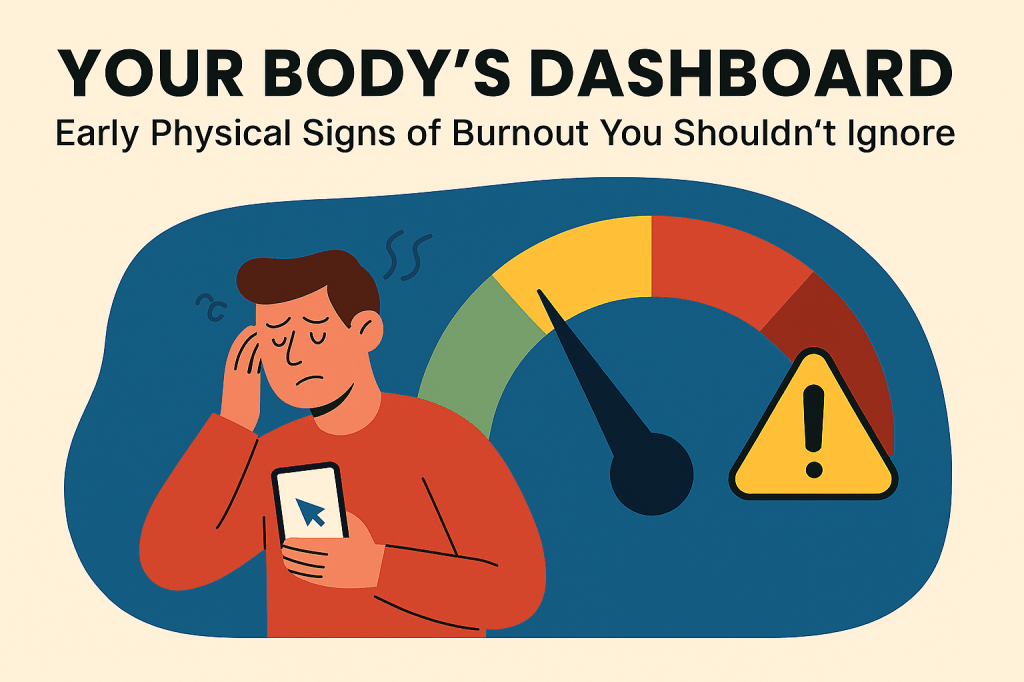
Here’s the dashboard your body uses—and what each indicator really means.
1. The Fatigue Signal: Tired Beyond What Sleep Can Fix
Everyone feels tired. Burnout fatigue is different.
This is non-recovering exhaustion – the kind that sleep, weekends, and vacations don’t solve.
Early signs include:
- You wake up tired even after a full night’s sleep.
- Your energy collapses midday, no matter what you eat.
- Small tasks feel disproportionately heavy.
- You start malfunctioning—you forget things, misplace items, skip steps.
Why it matters:
Your body is allocating energy to survival, not performance. That’s an early warning that your internal stress system is overloaded.
Action step:
Rate your “morning energy” from 1–10 every day for a week. If it’s consistently below 5, something deeper is happening.
2. The Sleep Disturbance Signal: Your Nights Start Falling Apart
Burnout often shows up in your sleep before your mood.
Three patterns indicate trouble:
- Difficulty falling asleep (your mind won’t shut down)
- Waking up at 2–4 AM (stress hormones are peaking)
- Restless, light sleep (you never reach deep recovery)
Why it matters:
Your nervous system is stuck in an elevated state. You’re not resting; you’re fighting invisible fires all night.
Action step:
Track nighttime awakenings for one week. Even two or three broken nights can indicate you’re nearing burnout.
3. The Irritability Signal: Your Fuse Gets Shorter
Burnout makes your emotional threshold collapse.
You might notice:
- You snap at small things.
- Noise feels louder.
- People drain you faster.
- Delays feel personal.
- You have no patience for ambiguity.
Why it matters:
Your brain is shifting into defensive mode. When cognitive bandwidth shrinks, emotional volatility rises.
Action step:
Pay attention to micro-annoyances. Irritation is often the first emotional red flag your body sends.
4. The “Fake Hunger” Signal: Cravings Replace Nutrition
One of the earliest physical indicators of burnout is craving high-energy foods—sugar, caffeine, salty snacks. This isn’t about appetite. It’s about survival mode.
You might notice:
- You need caffeine to function, not to enhance your day.
- You crave sugar in the afternoon.
- You snack more even when not hungry.
- Meals become irregular because your hunger cues are off.
Why it matters:
This is your body trying to compensate for depleted energy reserves and elevated stress hormones.
Action step:
Track your caffeine intake. If you’re increasing it week after week, burnout is the silent driver.
5. The “Body Tightness” Signal: Your Muscles Stay Permanently On
Chronic tension is one of the clearest burnout predictors.
Common early signals:
- Jaw clenching or teeth grinding
- Tight shoulders or neck
- Lower-back stiffness
- Random muscle twitches
- Headaches that come from tension, not illness
Why it matters:
Burnout activates your fight-or-flight system continuously. Your muscles stay semi-contracted, like you’re bracing for impact.
Action step:
Do a 10-second body scan right now. Shoulders dropped? Jaw relaxed? If not, tension is running the show.
6. The Focus Signal: Your Brain Stops Cooperating
Burnout affects cognition before emotion.
Early cognitive indicators:
- Difficulty concentrating
- Reading the same sentence repeatedly
- Taking longer to finish simple tasks
- Forgetting what you were just doing
- Increased mistakes
Why it matters:
Your prefrontal cortex—the part responsible for decision-making—is under stress and losing efficiency.
Action step:
Track how often you lose your train of thought. If it’s happening several times a day, your mind is signaling overload.
7. The Motivation Signal: “I Don’t Care” Becomes a Default Setting
There’s a specific burnout marker that people dismiss:
You lose interest in things you normally enjoy.
It shows up as:
- You stop reading
- You stop exercising
- You stop planning anything fun
- Everything feels like a chore
- Even good news feels muted
Why it matters:
Your dopamine system is disrupted. Burnout reduces your capacity for joy long before it collapses your ability to work.
Action step:
List three things you normally enjoy. If none excite you right now, your dashboard is flashing bright orange.
8. The Social Withdrawal Signal: You Want to Be Alone All the Time
Burnout doesn’t always look like crying or breaking down. Sometimes it looks like disappearing.
Signs include:
- Ignoring messages
- Avoiding calls
- Cancelling plans
- Feeling overwhelmed by social interaction
- Wanting isolation even when you’re lonely
Why it matters:
Your brain is conserving energy. Socializing becomes too expensive.
Action step:
Look at your last seven days. Have you withdrawn more than usual? That’s a major early warning sign.
9. The Micro-Frustration Signal: Everything Becomes Too Much
This is the stage where your resilience collapses.
Examples:
- A delayed email annoys you
- Traffic feels unbearable
- Someone asking for help feels intrusive
- Technology glitches feel catastrophic
- Small decisions feel impossible
Why it matters:
Your internal capacity is at its limit. Micro-frustrations are the final warning before full burnout hits.
Action step:
Count the number of times something “small” upset you today. More than five? You’re hitting the edge.
What Your Body Is Really Trying to Tell You
These signals aren’t failures. They’re feedback.
Your body isn’t being dramatic.
It’s warning you.
The goal isn’t to eliminate stress forever – that’s impossible. The goal is to respond to signals early enough that you never reach collapse.
Burnout is predictable.
Burnout is preventable.
Burnout is reversible – but only if you catch it early.
Your body gives you data.
Your job is to listen before the dashboard lights up red.
What to Do When You See These Signs
Here’s the simplest intervention system:
1. Reduce load
Remove one commitment, pause one project, or delay one responsibility.
2. Restore energy
Prioritize sleep, hydration, slow mornings, and extra downtime.
3. Rebuild capacity
Reintroduce movement, sunlight, and low-pressure routines.
4. Replace habits
Swap the stress-feeding behaviors (caffeine spikes, doomscrolling, overwork) with grounding ones.
Small shifts done early prevent major crashes later.
Final Thought
Burnout is not a character flaw. It’s not a lack of willpower. It’s a mismatch between output and recovery – and your body knows it long before you do.
If you learn to read your body’s dashboard, you don’t just avoid burnout – you design a life that never gets close to it again.
Your body is always talking.
Start listening before it starts shouting.
 VD
VD 
Leave a reply to Time vs Money: Which One Compounds Faster for Long-Term Freedom? – VD Cancel reply