Most people think of travel as consumption.
You spend money, collect experiences, take photos, and return home with memories. That framing isn’t wrong – but it’s incomplete. Travel can also be an investment, one that pays dividends long after the trip ends.
The problem is that most people don’t extract the return.
They optimize itineraries, not learning. They maximize sights, not growth. And when the trip is over, the value quietly decays.
Travel doesn’t automatically change you.
How you travel determines the return.
Why Travel Feels Valuable — but often isn’t
Travel feels meaningful because it’s novel. Novelty heightens emotion and attention, which makes experiences memorable.
But memorability isn’t the same as impact.
Without reflection or application:
- Insights fade
- Lessons stay contextual
- Perspective resets once routine returns
This is why two people can take the same trip and walk away with radically different outcomes. One gets photos. The other gets upgraded mental models.
The difference isn’t budget or destination. It’s extraction.
Defining the “Return on Travel”
Return on travel isn’t measured in:
- Countries visited
- Miles flown
- Money spent
It’s measured in lasting changes to how you:
- Think
- Decide
- Act
- Design your life
A high-return trip leaves residue. It changes what feels normal. It widens your sense of what’s possible.
That’s the real asset.
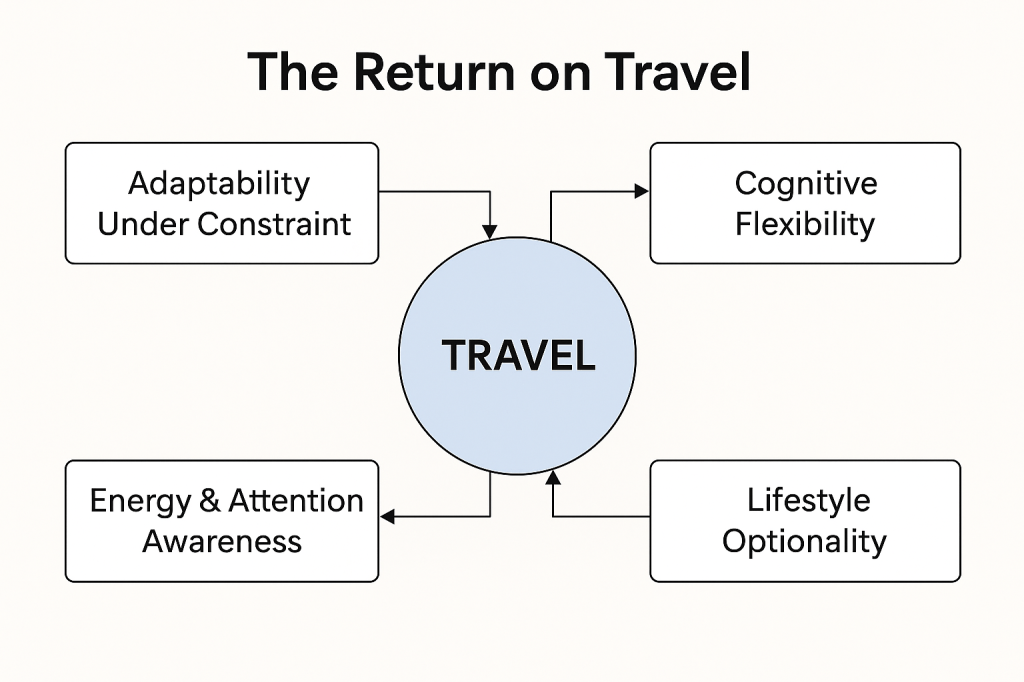
Skill #1: Adaptability Under Constraint
Travel constantly removes familiar scaffolding:
- Language
- Routines
- Infrastructure
- Social cues
You’re forced to solve small problems repeatedly, often with incomplete information.
This builds:
- Comfort with uncertainty
- Improvisation skills
- Decision-making without perfect data
These are not “travel skills.” They’re life skills—especially valuable in careers, entrepreneurship, and leadership.
People who travel well tend to stay calmer when plans break. That calm compounds everywhere else.
Skill #2: Context Switching and Cognitive Flexibility
Travel breaks the illusion that your way is the way.
Different cultures solve the same problems—food, work, family, time—in radically different ways. Seeing this repeatedly loosens rigid thinking.
You begin to:
- Question defaults
- Spot arbitrary rules
- Separate values from habits
This is cognitive flexibility, and it’s a competitive advantage. It makes you better at:
- Learning new systems
- Collaborating across differences
- Designing unconventional solutions
The world feels bigger—and more navigable.
Skill #3: Energy and Attention Awareness
Travel disrupts your energy patterns.
Jet lag, walking more, different food, new schedules—all of it makes you notice things you normally ignore:
- When you’re sharp
- When you’re drained
- What actually restores you
Back home, most people run on autopilot. Travel breaks that loop.
High-return travelers use trips as diagnostics:
- What routines are essential?
- What comforts are optional?
- What drains me unnecessarily?
These insights often reshape daily life more than any productivity book.
Perspective #1: Lifestyle Optionality
Seeing other ways of living recalibrates your internal benchmarks.
You notice:
- How little people need to live well
- How much comfort comes from systems, not stuff
- How geography shapes cost, pace, and stress
This matters deeply for FIRE and lifestyle design.
Travel shows you that:
- High quality of life doesn’t require high spending
- Trade-offs are choices, not laws
- Location is leverage
Once you see this, it’s hard to go back to unconscious consumption.
Perspective #2: Time Feels Different Elsewhere
Travel exposes how culturally constructed time is.
In some places, speed is valued. In others, presence. Neither is right or wrong—but noticing the difference is powerful.
It helps you ask:
- Where am I rushing unnecessarily?
- What pace actually supports my goals?
- Which deadlines are real—and which are inherited?
Many people return from travel with a quieter urgency: doing less, but doing it with more intent.
Measuring Growth Without Reducing It to Metrics
Not everything valuable is measurable—but that doesn’t mean it’s vague.
After a trip, ask:
- Did my tolerance for ambiguity increase?
- Do I question defaults more often?
- Have my “normal” standards shifted?
- Did I bring anything home that changed my routine?
If nothing changes after two weeks back home, the return was low—regardless of how good the trip felt.
How to Increase the Return on Any Trip
You don’t need extreme travel or long trips. You need intention.
1. Travel With a Question
Before you go, pick one:
- How do people structure their days here?
- What does “enough” look like in this place?
- How does this environment shape behavior?
Questions guide attention. Attention drives insight.
2. Reduce Consumption, Increase Observation
Fewer attractions. More noticing.
- How people move
- How they rest
- How they socialize
- How they spend money
This is where perspective shifts happen.
3. Apply One Insight at Home
Within a week of returning, change something:
- A routine
- A spending habit
- A time boundary
- A work assumption
If travel doesn’t leak into daily life, it didn’t compound.
Travel as a Long-Term Investment
The highest return on travel isn’t a single trip. It’s the stacking effect over time.
Trips build on each other:
- You adapt faster
- You notice more
- You extract value sooner
Eventually, travel becomes less about escape and more about calibration – periodically realigning how you live with what actually matters.
That’s not a luxury. It’s a strategic reset.
Final Thought
Photos fade. Souvenirs collect dust.
But skills, perspective, and optionality compound quietly for decades.
When traveled intentionally, travel isn’t an expense.
It’s an investment in how you think, choose, and design your life.
The return is subtle – but permanent.
 VD
VD 
Leave a reply to Adventure Friendship Cancel reply