We live in an age of unlimited learning.
At any moment, you can open a book, enroll in a course, listen to a podcast, skim a thread, or save an article “for later.” Knowledge has never been more accessible. And yet, many people feel strangely stuck—busy learning, but not necessarily improving.
They read constantly but struggle to apply what they learn.
They take notes that never get revisited.
They accumulate insights without momentum.
The problem isn’t a lack of information.
It’s bad timing.
Most people practice just-in-case learning: consuming knowledge in advance, hoping it will be useful someday. What actually works better—especially for adults—is just-in-time learning: learning the right thing, at the moment it’s needed.
Volume feels productive.
Timing creates results.
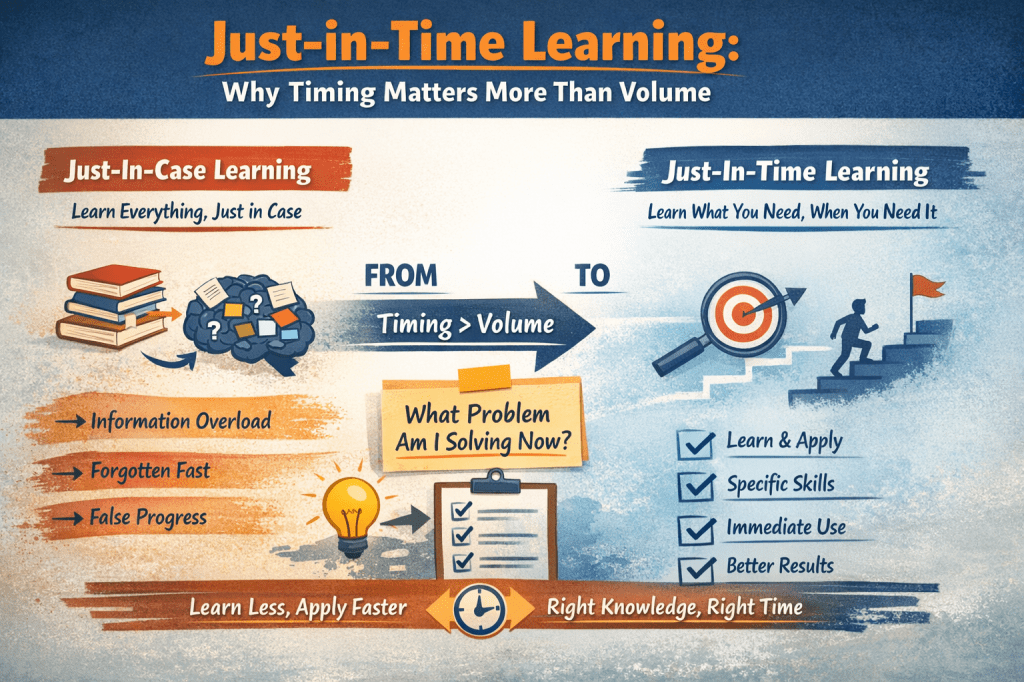
The hidden cost of learning ahead of need
Learning without immediate application comes with costs that aren’t obvious at first.
1. Forgetting accelerates
The forgetting curve is unforgiving. Without use, information decays rapidly. Concepts that felt clear while reading blur within days. Details vanish. You remember that you learned something, but not what or how to use it.
This is why rereading feels familiar but rarely transformative. Recognition replaces understanding.
2. Everything feels equally important
When you don’t have a specific problem to solve, your brain has no filter. You highlight too much. You take vague notes. You leave with the sense that everything matters—and no idea where to start.
Learning without context creates noise, not clarity.
3. Consumption masquerades as progress
Learning feels good. It’s safe. It provides a sense of forward motion without requiring change.
But reading about fitness isn’t the same as training.
Reading about money isn’t the same as deciding.
Reading about thinking isn’t the same as thinking.
Just-in-case learning often becomes a substitute for action.
What is Just-in-Time Learning?
Just-in-Time Learning (JITL) is simple in principle:
Learn the minimum amount necessary to solve a real problem you’re facing right now.
Instead of asking:
- What should I learn next?
You ask:
- What problem am I trying to solve today?
Learning stops being an abstract self-improvement project and becomes a practical tool.
Why timing beats volume
Context changes how the brain learns
When learning is tied to an immediate need, the brain pays attention differently. Information is filtered through relevance. Details stick because they matter.
The same idea read too early feels theoretical.
Read at the right moment, it feels obvious—and memorable.
This is why advice often makes sense only after you’ve struggled. Experience creates hooks for understanding.
Application locks in memory
Action is the strongest form of retention. When learning directly feeds behavior, forgetting slows dramatically.
You don’t need perfect notes or elaborate systems.
You need short feedback loops between learning and doing.
The faster knowledge turns into action, the deeper it embeds.
Less learning, more leverage
Just-in-time learning dramatically reduces how much you need to consume. You stop preparing for hypothetical futures and start responding to your actual present.
Instead of learning broadly “just in case,” you learn narrowly “just enough.”
This creates speed, focus, and confidence.
What Just-in-Time Learning looks like in real life
Fitness and health
Instead of:
“I should learn everything about training and nutrition.”
You learn:
- how to hinge safely when your back feels off
- how to recover when soreness affects consistency
- how to adjust volume when progress stalls
The knowledge sticks because it’s tied to physical feedback and lived experience.
FIRE and money
Instead of:
“I’ll read everything about investing and FIRE.”
You learn:
- tax optimization when income changes
- withdrawal strategies when FI approaches
- geoarbitrage when relocation becomes realistic
Learning is anchored to real decisions, not abstract planning.
Reading and thinking
Instead of:
“I’ll read broadly to become smarter.”
You learn:
- mental models when facing a hard decision
- frameworks when something breaks
- philosophy when values are challenged
Books stop being a collection and start becoming a toolkit.
Why formal education teaches the opposite
Traditional education is built around just-in-case learning:
- theory first
- application later
- standardized pacing
This works poorly outside classrooms.
Adults learn best when:
- motivation is intrinsic
- stakes are real
- feedback is immediate
Life doesn’t present problems in syllabus order.
Just-in-time learning matches how learning actually happens outside school.
Designing a Just-in-Time Learning system
Just-in-time learning isn’t about discipline. It’s about design.
1. Start with friction
Pay attention to moments of resistance:
- confusion
- repeated mistakes
- slow progress
- lingering uncertainty
These are signals that learning is needed now, not later.
Friction is feedback.
2. Ask precise questions
Replace:
- What should I learn about X?
With:
- What’s the smallest thing I need to know to move forward one step?
Precision beats completeness. Always.
3. Learn narrowly—and stop early
Resist the urge to “finish the book” or “take the whole course.”
Stop learning when:
- the problem is solved
- clarity replaces confusion
- the next action becomes obvious
More learning after that point often reduces momentum instead of increasing it.
4. Store breadcrumbs, not archives
You don’t need a second brain full of notes.
You need:
- a few principles
- a short list of trusted sources
- confidence that you can relearn quickly
Trust your ability to re-access knowledge when needed.
When volume actually helps
Just-in-time learning doesn’t mean learning nothing in advance.
Volume has a place when:
- exploring a new domain
- building taste and intuition
- reading for meaning or reflection
- developing long-term perspective
But even exploration should be intentional—and bounded.
Without constraints, exploration quietly turns into avoidance.
The deeper shift: demand-driven learning
The most effective learners don’t ask:
“What should I consume next?”
They ask:
“What does my life currently demand of me?”
Learning becomes responsive, not aspirational.
This is how:
- busy people keep learning
- generalists stay effective
- knowledge compounds instead of cluttering
The paradox of learning less
Learning less—but at the right time—creates:
- better retention
- faster progress
- lower overwhelm
- more confidence
Just-in-time learning can feel slower at first because you’re not constantly consuming. But over time, it outperforms almost everything else.
Because knowledge isn’t meant to be stored.
It’s meant to be used.
A simple mental rule
Before you read, watch, or enroll, ask:
What decision or action will this help me make this week?
If the answer is unclear, wait.
The information will still be there when the timing is right.
Final takeaway
Most people don’t need to learn more.
They need to learn later.
Stop learning for a hypothetical future version of yourself.
Learn for the problem in front of you.
That’s where timing beats volume—every time.
 VD
VD 
Leave a reply to Cognitive Nutrition: Why Information Quality matters more than Quantity – VD Cancel reply