The most popular version of FIRE has a problem.
It treats financial independence like a sprint: cut everything, save aggressively, endure discomfort now so you can finally live later. Health is postponed. Joy is deferred. Life is put on hold in exchange for a faster spreadsheet result.
For some people, this works—briefly.
For many, it leads to burnout, resentment, or a quiet rebound into lifestyle inflation.
The issue isn’t FIRE itself.
It’s the extreme interpretation of it.
Financial independence was never meant to be a test of how much discomfort you can tolerate. It’s a tool for designing a better life, not surviving a miserable one.
A sustainable approach to FIRE looks different. It prioritizes health, energy, and flexibility during the journey—not just after the finish line.
The Hidden Cost of Extreme FIRE
Extreme FIRE optimizes one variable: time to independence.
Everything else becomes negotiable:
- Health
- Relationships
- Enjoyment
- Curiosity
- Optionality
This creates three common failure modes.
1. Health Debt
Aggressive saving often pairs with:
- Long sedentary hours
- Poor sleep
- Cheap but low-quality food
- Chronic stress framed as “temporary”
Health debt compounds just like financial debt. The interest shows up later—as pain, fatigue, medical costs, and reduced options.
Ironically, many people reach FIRE only to realize they’ve weakened the very body meant to enjoy it.
2. Psychological Rebound
Extreme restriction creates tension.
When the pressure breaks, it often breaks hard:
- Overspending after years of deprivation
- Abandoning systems entirely
- Quietly inflating lifestyle while pretending discipline failed
This isn’t a willpower issue. It’s a sustainability issue.
3. Fragile Independence
If your FIRE plan only works under perfect conditions—high income, constant discipline, no health disruptions—it’s fragile.
True independence is resilient.
It bends under stress instead of breaking.
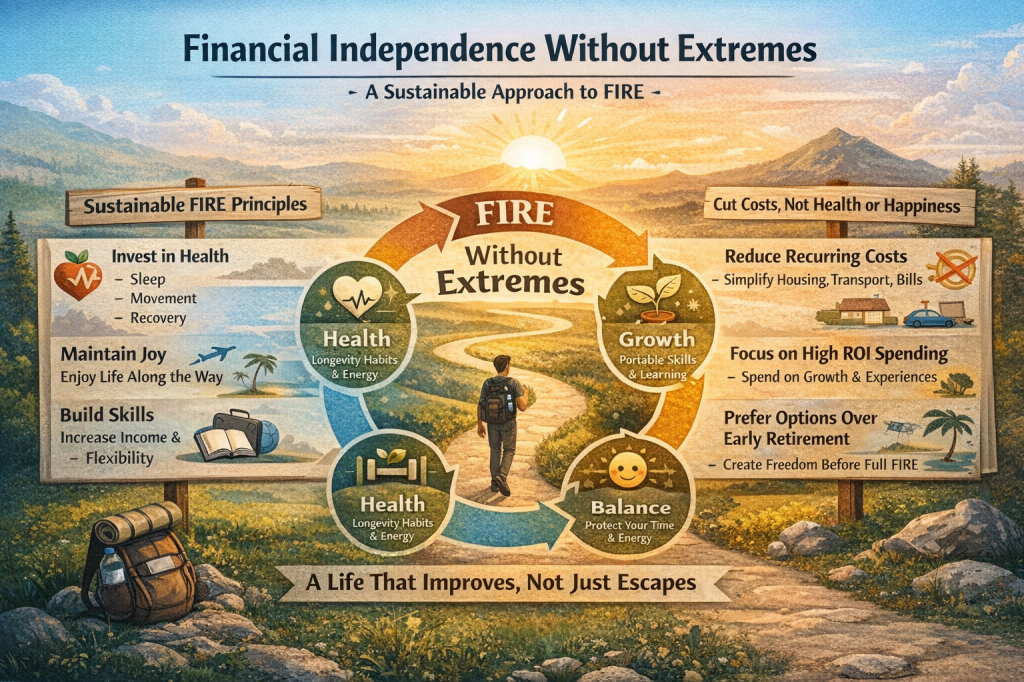
FIRE as a Lifestyle Upgrade, Not a Sacrifice
A sustainable FIRE approach reframes the goal.
Instead of asking:
How fast can I escape work?
Ask:
How can I design a life that improves every year—financially, physically, and mentally?
This shift changes everything.
- You optimize for energy, not just savings rate
- You build skills, not just accounts
- You increase optionality, not just net worth
Financial independence becomes a byproduct of good systems, not extreme behavior.
The Core Principles of Sustainable FIRE
1. Health Is a Compounding Asset
Health isn’t separate from FIRE. It’s foundational to it.
Energy affects:
- Income potential
- Decision quality
- Consistency
- Motivation to maintain systems
A body that feels good makes disciplined choices easier. A depleted body looks for relief—often through spending, convenience, or distraction.
Sustainable FIRE treats:
- Sleep
- Movement
- Recovery
- Nutrition
as investments, not expenses.
You don’t need perfection. You need consistency.
2. Reduce Fixed Costs, Not Daily Joy
Extreme FIRE often targets small pleasures while ignoring structural costs.
A sustainable approach flips this:
- Reduce housing friction
- Simplify transportation
- Eliminate recurring expenses that don’t add value
Then spend intentionally on what improves daily life:
- Good food
- Movement
- Learning
- Experiences
- Tools that save time and energy
Cutting lattes rarely changes your life.
Designing a low-friction lifestyle does.
3. FIRE is a Skill Stack
Money alone doesn’t create independence. Skills do.
Key FIRE skills include:
- Income leverage
- Negotiation
- Geographic flexibility
- Learning efficiently
- Health maintenance
- Lifestyle design
This is why two people with the same net worth can have radically different freedom.
One is fragile.
The other is flexible.
Sustainable FIRE focuses on building portable skills that reduce dependence on any single employer, market, or location.
4. Optimize for Optionality, Not Early Retirement
Early retirement is just one option among many.
Optionality includes:
- Taking a lower-stress role
- Working fewer days
- Taking extended breaks
- Switching careers
- Traveling slowly
- Saying no without panic
These benefits often arrive long before full FIRE.
If your plan only pays off at the end, it’s poorly designed.
What Sustainable FIRE Looks Like in Practice
Spending: Intentional, Not Ascetic
Instead of asking, Can I cut this?
Ask, Does this reliably improve my life?
Spend freely on:
- Health-supporting habits
- Learning and skill building
- Experiences that expand perspective
Cut ruthlessly on:
- Status spending
- Convenience that increases dependence
- Repeating costs that add little value
The goal isn’t minimal spending.
It’s high-return spending.
Income: Flexibility Over Maximization
Maximizing income at all costs often increases stress and fragility.
Sustainable FIRE prioritizes:
- Skills that compound
- Income streams you can maintain
- Work that doesn’t destroy health
A slightly lower income sustained for decades often beats short bursts of high income followed by burnout.
Saving: Consistency Beats Aggression
A 30–40% savings rate you can maintain for years beats a 70% rate you abandon after two.
Sustainable FIRE:
- Builds automated systems
- Avoids constant decision fatigue
- Leaves room for life changes
Consistency compounds quietly.
The Long Game Advantage
Here’s the paradox: people who avoid extremes often reach effective independence faster.
Why?
- Fewer burnouts
- Better health
- Higher adaptability
- More learning
- Better decision quality
They may not retire at 35.
But they often gain meaningful freedom much earlier.
And when they do reach FIRE, they actually enjoy it.
FIRE without Extremes is Anti-Fragile
Life is unpredictable:
- Health changes
- Interests evolve
- Markets fluctuate
- Relationships matter
Extreme plans break under change.
Sustainable FIRE is anti-fragile. It improves under stress because it’s built on:
- Skills
- Health
- Flexibility
- Low fixed costs
- Strong routines
This is independence that lasts.
Redefining “Enough”
One of the most overlooked FIRE skills is defining “enough.”
Without it:
- Goals drift
- Satisfaction is postponed
- Comparison never ends
Enough isn’t a number.
It’s a lifestyle definition.
What does a good day look like?
What does a good year feel like?
What tradeoffs are no longer worth it?
Sustainable FIRE answers these early—so you don’t keep raising the bar forever.
Final thought: FIRE should improve your life now
If your FIRE plan:
- Makes you unhealthy
- Makes you miserable
- Makes life feel postponed
…it’s not working.
Financial independence isn’t about escaping life.
It’s about building one you don’t need to escape from.
The most powerful version of FIRE isn’t extreme.
It’s sustainable.
 VD
VD 
Leave a reply to The Boring Middle of FIRE: How to Stay Consistent While Compounding Works – VD Cancel reply